
From Bhopal to Boeing, India’s recurring tragedy may not merely be the disasters themselves — but the long silences, hesitant investigations and institutional caution that follow when powerful global interests enter the frame.
By Ravishankar Kalyanasundaram
When exactly does India decide to defend itself firmly?
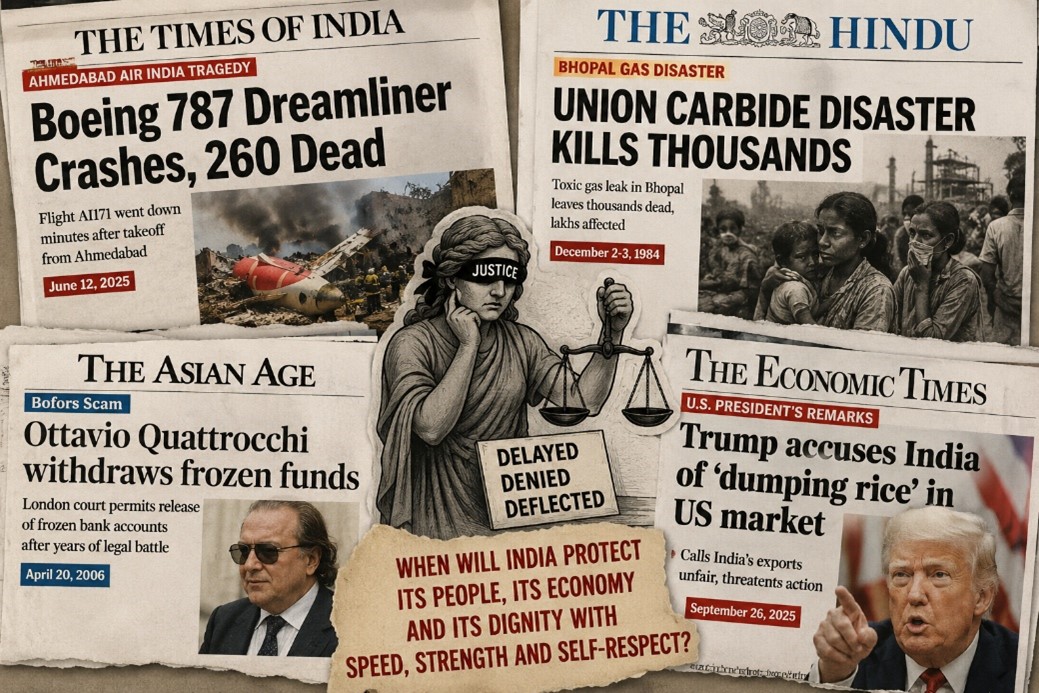
That question once again returns after today’s reports that Indian aviation authorities will travel to Seattle to observe testing of a fuel-control switch linked to the fatal Boeing Dreamliner crash investigation. Nearly a year after the June 12, 2025 Air India Boeing 787 disaster in Ahmedabad that killed 260 people, the investigation still appears surrounded by uncertainty, conflicting narratives and extraordinary caution.
The preliminary report was released on July 12, 2025. The final report is still awaited. Meanwhile, fresh questions continue to emerge over the aircraft’s fuel-control switches after another Air India Dreamliner incident in February 2026 on the London–Bengaluru route, where pilots reportedly observed the switch slipping from “RUN” to “CUTOFF” under slight pressure. Yet the manufacturer reportedly declared the unit “serviceable.”
And so the public quietly asks:
Why does this investigation still feel so hesitant?
Why does the language remain so guarded?
Why does India appear more cautious about upsetting a global aerospace giant than demanding rapid clarity for 260 lives lost?
The issue is larger than aviation.
It touches a deeper national pattern India has repeatedly lived through for decades — a strange institutional softness whenever the counterparty is powerful, foreign or geopolitically influential.
The memories are painful.
On the night of December 2–3, 1984, toxic methyl isocyanate gas leaked from the Union Carbide plant in Bhopal. Officially, over 3,700 deaths were immediately acknowledged, though later estimates placed fatalities and long-term health impacts far higher, running into tens of thousands across generations. It remains one of the world’s worst industrial disasters.
But for many Indians, the wound was not merely the gas leak.
It was the helplessness that followed.
The feeling that India never demonstrated the institutional force expected from a sovereign nation confronting such devastation. The compensation battle dragged endlessly. Accountability became blurred. And eventually, public memory absorbed a dangerous lesson: that large multinational interests somehow operate under a different emotional temperature in India.
Then came the Ottavio Quattrocchi episode in the Bofors scandal.
In 2006, frozen bank accounts in London holding roughly €3 million linked to Quattrocchi were unfrozen and withdrawn despite years of national outrage surrounding the corruption investigation. Once again, Indians watched with disbelief as another high-profile international controversy slowly dissolved into procedural ambiguity.
And the pattern has never fully disappeared.
When Indian pharmaceutical exports face even isolated quality concerns abroad, reactions are immediate and brutal. Entire consignments are rejected. Import alerts spread globally within hours. One failed inspection can damage the reputation of an entire sector employing millions.
Sometimes the accusations themselves become disproportionate.
A few adverse reports or isolated compliance failures suddenly become sweeping narratives against Indian manufacturing standards. Indian rice exports, Indian medicines, Indian chemicals — all can rapidly become targets of suspicion in international political and media discourse.
Yet where is the same assertiveness when India faces reputational or economic damage?
Why does India so often appear defensive rather than decisive?
That is the discomfort many citizens increasingly feel while observing the Boeing investigation unfold so cautiously. Nobody is demanding recklessness. Nobody is asking investigators to prejudge outcomes.
But people are asking for visible confidence.
After all, 260 people died on June 12, 2025.
Families were shattered.
One of the world’s most advanced aircraft became a flaming wreck shortly after takeoff.
And nearly a year later, the public conversation still appears trapped between pilot-error speculation, technical uncertainty and diplomatic sensitivity.
Contrast this with how aggressively major powers defend their own institutional interests.
The United States moves swiftly when safety, trade or national security concerns arise. Europe imposes compliance barriers rapidly. China reacts strategically and unapologetically when domestic priorities are affected.
India, however, often appears psychologically restrained precisely at moments where national confidence should become visible.
Why?
Why should a country aspiring to become the world’s third-largest economy still appear hesitant in protecting its own narrative?
Why should ordinary citizens feel that large global entities are treated with exceptional caution while Indian businesses face relentless scrutiny both at home and abroad?
The consequences go beyond individual controversies.
Repeated hesitation weakens institutional credibility itself.
Because in the modern information age, silence creates its own narrative. Delay creates suspicion. Caution begins to resemble weakness.
And gradually the citizen starts recognising a familiar pattern:
Another disaster.
Another prolonged investigation.
Another cautious response.
Another fading outrage.
The tragedy is that India today possesses enormous capability. It launches lunar missions, builds world-class digital infrastructure, conducts gigantic elections and aspires to become a global manufacturing hub. Yet institutionally, there are moments where the country still appears uncertain about exercising sovereign confidence against powerful external interests.
That contradiction is becoming harder to ignore.
The Boeing investigation therefore carries symbolic importance beyond aviation safety. It has become a test of institutional psychology itself.
Can India investigate firmly, transparently and independently without appearing intimidated by global corporate stature?
Can India communicate with confidence rather than hesitation?
Can India demonstrate that Indian lives, Indian credibility and Indian public trust matter as much as commercial or diplomatic sensitivities?
Because increasingly, citizens are not merely evaluating the disaster.
They are evaluating the response.
And somewhere beneath the technical reports, switch examinations and procedural caution, an unsettling national question continues to linger:
Why does India so often react as though protecting itself requires permission?
 Business and Economy
  Education
  Food
Food  Government
  Lifestyle
  Politics
  Travel
  World
World