
“Not a Triumph, But a Transition—Where Legacy Meets the Test of Governance.”
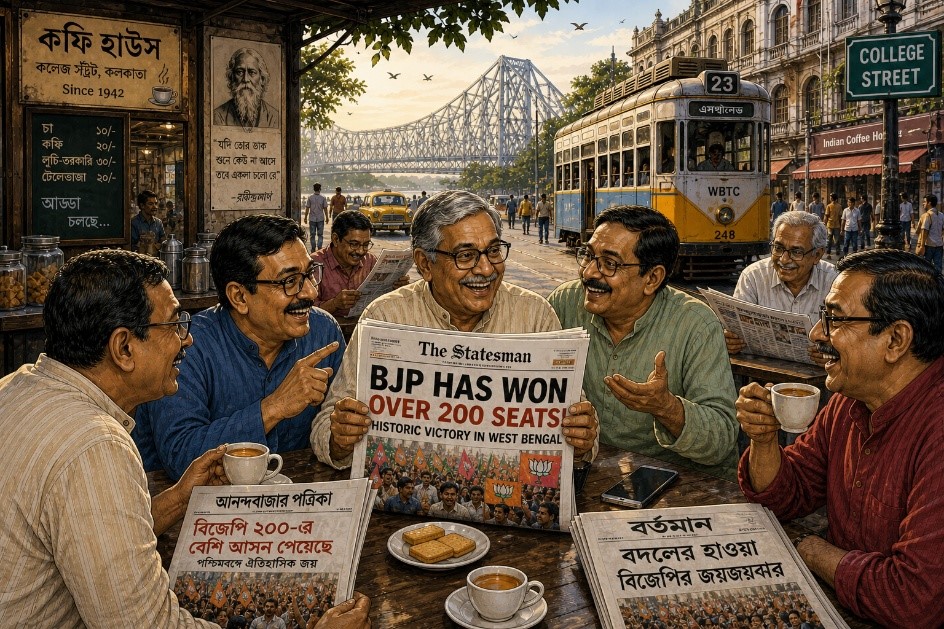
The victory of the Bharatiya Janata Party in West Bengal is not merely a political outcome; as Narendra Modi called it, a “Poribardhan”—a transformation—and in that word lies the true weight of this moment, for Bengal is not a state that is easily won, it is a civilisation of thought, memory, and argument, and any change here must pass through its long, layered past before it can claim its future; and so, to understand what may now unfold, one must step into that continuum where history is not distant, but alive, where names are not statues, but conversations, and where every political shift must reconcile with a deeper intellectual inheritance.
There was a time when Bengal did not merely participate in India’s economy—it powered it, when the jute mills along the Hooghly drove exports across continents, when engineering and manufacturing units around Kolkata supplied industrial India, when tea from Darjeeling defined global quality, and when its ports connected the subcontinent to the world, contributing nearly 20% of India’s industrial output in the decades after Independence, a figure that today has receded to under 6%, marking not just an economic decline but a quiet drift away from national centrality, as capital moved elsewhere, industries thinned, and opportunity followed new geographies, leaving behind a state rich in talent but searching for momentum.
And here, history meets possibility.
For the BJP, this moment will not be seen merely as an electoral expansion, but as a return to origins, and for sure it will bring back into sharper public memory Syama Prasad Mukherjee, the founder of the Bharatiya Jana Sangh, a son of Bengal whose political vision travelled beyond the state but whose presence within Bengal’s own contemporary narrative has often remained understated, not forgotten, but not foregrounded in the manner of other icons, and in doing so the party will not be entering a vacuum, for Bengal has never lacked heroes, only the manner in which they are woven together has varied over time.
For in 1882, Bankim Chandra Chatterjee gave India Vande Mataram, a song that moved from literature into the bloodstream of a nation; in 1893, Swami Vivekananda stood in Chicago and redefined India’s voice to the world, calling for strength and self-belief; in 1913, Rabindranath Tagore brought global recognition to India’s intellectual depth; in the early decades of the twentieth century, revolutionaries like Sachindra Nath Sanyal turned thought into organised resistance; and in 1951, Mukherjee articulated a political strand that would, decades later, find its expression in the BJP’s rise, and these are not isolated figures but a constellation of ideas—emotion, intellect, courage, and political articulation—that together shaped Bengal’s contribution to India’s national identity.
The BJP’s opportunity, therefore, lies not in replacing Bengal’s heritage, but in reframing its constellation—bringing together Bankim’s emotion, Vivekananda’s call for strength, Tagore’s intellectual depth, Sanyal’s courage, and Mukherjee’s political vision into a broader national narrative that seeks alignment without erasure, continuity without distortion, and resonance without imposition.
We have seen this approach before; in Gujarat, the legacy of Sardar Vallabhbhai Patel was elevated into national consciousness with renewed scale and symbolism, transforming remembrance into a visible, institutionalised presence, but Bengal is a more complex canvas, where memory is not curated but contested, where history is not archived but argued, and where any attempt to reshape narrative must pass through a society that questions as much as it celebrates.
Which is why this moment carries both promise and risk.
For beyond memory lies the harder test of delivery, and Bengal’s future will not be secured by invocation alone; its fertile agricultural plains—among the most productive in India—hold the potential to move from subsistence to value creation through food processing, storage, and market integration, while its strategic geography, with ports along the Bay of Bengal and proximity to key Asian trade routes including those connecting to China, positions it as a natural gateway for commerce, capable of linking eastern India with global supply chains, and if infrastructure, logistics, and policy alignment are executed with clarity, Bengal can once again emerge as an economic engine rather than a missed opportunity.
Industry, too, waits at the edge of revival, for the legacy remains—steel, engineering, textiles, chemicals—but what has been missing is the confidence of capital, the assurance of policy, and the predictability of governance, and if these are restored, the state’s economic narrative can shift with surprising speed.
Yet Bengal will not be persuaded by promise alone.
It will observe, measure, question.
It will weigh whether celebration expands memory or narrows it, whether governance delivers outcomes or merely amplifies intent, whether transformation is felt in livelihoods or confined to language.
For the BJP, this victory is both culmination and commencement, an opportunity to demonstrate that its governance model can adapt to a state where identity is layered and political culture deeply independent, and for Bengal, it is an opening—a chance to reconnect its past strength with future possibility without losing the intellectual spirit that has always defined it.
And so, as the slogans settle and governance begins, what remains is a quieter, deeper unfolding—not of power asserted, but of history engaged, not of narratives imposed, but of meanings negotiated.
For Bengal has not just changed its government; it has reopened its own story.
And as always in Bengal—restless, reflective, and never quite finished—
the real journey has just begun.


 Business and Economy
  Education
  Food
Food  Government
  Lifestyle
  Politics
  Travel
  World
World