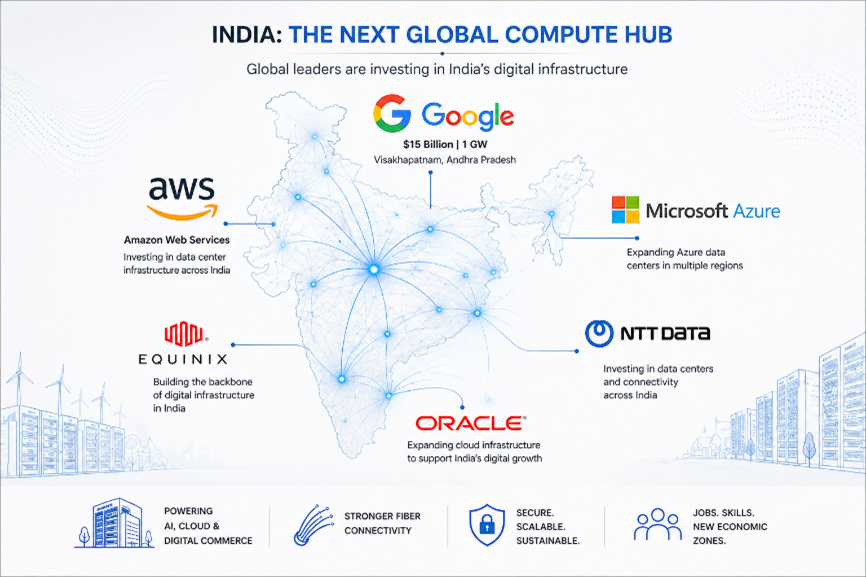

The 1 GW data centre is more than a project — it signals a structural shift where states act as economic engines and India begins to host the infrastructure powering AI, digital commerce, and the world’s data flows
By Ravishankar Kalyanasundaram
Today’s headline is easy to skim past: a $15 billion, “1 GW data centre project by Google in Visakhapatnam”. But this is not another investment announcement in a crowded news cycle. It is a turning point — a signal that India is beginning to anchor the physical infrastructure of the digital world, not just participate in it.
For years, India’s digital rise has been defined by scale at the consumption end — hundreds of millions of users, billions of transactions, and a rapidly expanding universe of data. But the infrastructure required to process this scale has lagged behind. That gap is now closing, and it is closing decisively.
The significance of a 1 GW data centre campus lies precisely here.
This is not a building. It is an ecosystem trigger.
When a campus of this scale comes up, it pulls with it an entire economic layer. It demands renewable energy at scale because power is its lifeblood. It requires high-capacity fibre networks where latency becomes a competitive variable. It drives the adoption of advanced cooling systems, precision engineering, and specialised construction capabilities. Around it emerge cybersecurity frameworks, cloud operations, and digital service layers. And critically, it creates a workforce trained to manage complex, always-on computing environments.
What begins to form around such infrastructure resembles the industrial corridors of an earlier era — clusters of activity, supply chains, and specialised capabilities. But the output is fundamentally different. It is not physical goods. It is computational capacity — the raw material of artificial intelligence, digital commerce, financial systems, and global services.
That is why this moment matters.
Alongside Amazon and Microsoft, global technology players are not merely expanding presence in India. They are relocating critical infrastructure closer to where data is generated and consumed. India is shifting from being a peripheral digital participant to becoming a core computing geography.
There is also a governance dimension that cannot be overlooked.
Projects of this scale do not materialise on national opportunity alone. They require states to act with clarity, speed, and intent. Andhra Pradesh’s push under N. Chandrababu Naidu reflects a model where state leadership increasingly behaves like an economic steward — aligning land, power, and approvals to attract global capital. In a federal economy, this role of the Chief Minister as a de facto “CEO of the state” is becoming central. It does not merely shape political narratives; it directly influences the trajectory of investment, jobs, and growth.
The implications are far-reaching.
First, such investments anchor high-value capital within India’s physical economy, not just its services exports. Second, they accelerate allied sectors — energy, telecom, construction, and digital services — creating multiplier effects well beyond the project itself. Third, they deepen India’s integration into global technology supply chains, especially in cloud computing and artificial intelligence.
For states, this marks a new competitive frontier. The contest is no longer limited to attracting factories; it is about hosting the infrastructure that will define future economic power. For the workforce, it signals a shift toward new industrial capabilities — managing digital infrastructure at scale rather than only building software on top of it.
And for the country, it opens a larger possibility.
In a world where trade flows are being redrawn and geopolitics increasingly shapes economic choices, it is infrastructure of this kind that will determine a nation’s place in the global order. Data centres, fibre networks, and computing clusters are no longer peripheral investments; they are strategic assets. For India, building this backbone is not just about keeping pace with the digital economy, but about defining its role within it. If sustained with clarity and intent, this shift could well mark the moment when India moved from participating in global growth to quietly shaping it.




 Business and Economy
  Education
  Food
Food  Government
  Lifestyle
  Politics
  Travel
  World
World