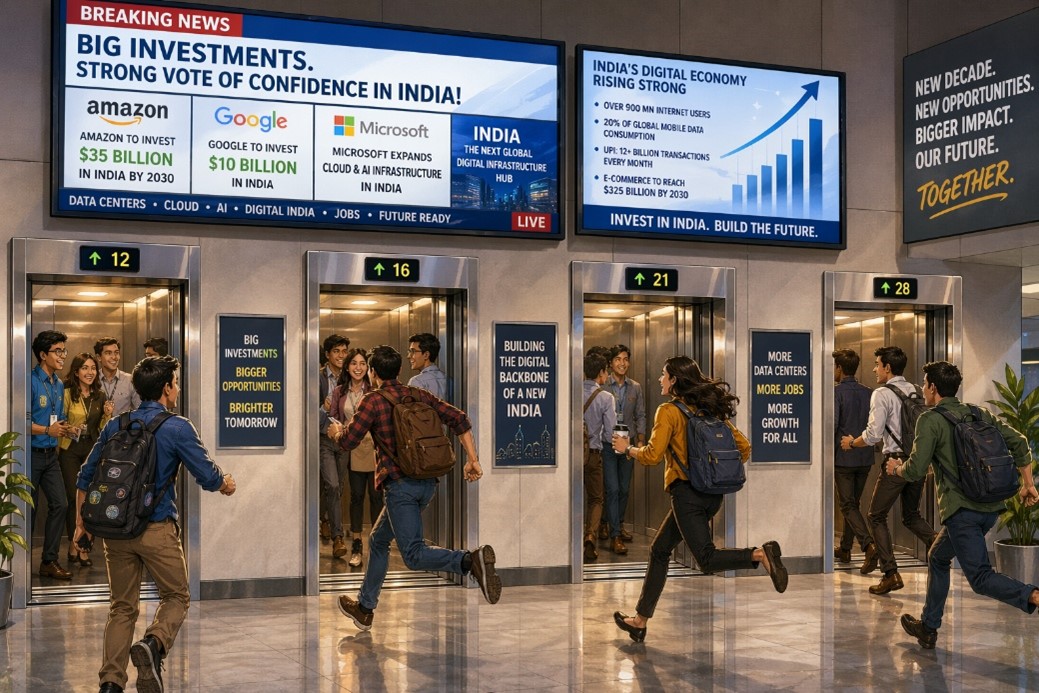

As Google, Amazon and Microsoft expand massive data-centre investments, India’s extraordinary digital scale is turning the country from a software powerhouse into one of the world’s most important computing platforms.
Why are the world’s largest technology companies — Google, Amazon, Microsoft and others — suddenly racing to India to build data centres?
The answer lies in something few countries possess at this scale: a vast digital population combined with an exploding demand for computing power.
India today has over 900 million internet users, a connected population larger than the entire population of Europe. Indians consume around 25 gigabytes of mobile data per user every month, among the highest levels anywhere in the world. Digital payments through UPI now exceed 12 billion transactions every month, making India the largest real-time payments ecosystem on the planet.
Every one of these actions — every payment, every streamed film, every logistics order, every e-commerce purchase, every artificial-intelligence query — produces data.
And data must be processed somewhere.
That is why data centres have quietly become the factories of the digital age, converting electricity and fibre connectivity into computing power.
Yet India remains dramatically underbuilt for the scale of digital activity it generates. The country currently operates only about 1.1–1.3 gigawatts of data-centre capacity, a surprisingly small footprint for an economy producing such enormous digital traffic.
This gap is precisely what global investors have noticed.
Between 2019 and 2025 alone, nearly $95 billion has already been committed to India’s data-centre sector, and industry analysts expect installed computing capacity to expand fivefold to more than 8 gigawatts by 2030.
The demand driving this expansion is powerful. India’s digital economy is already generating over $250 billion in annual revenue, while e-commerce alone is projected to reach $325 billion by the end of the decade. Artificial intelligence, cloud computing, digital finance and advanced logistics platforms will push computing demand dramatically higher.
Global technology companies are moving quickly.
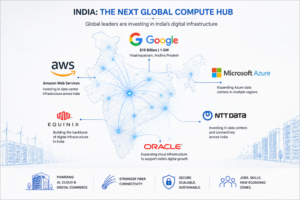
Amazon plans to invest $35 billion in cloud infrastructure in India by 2030. Google has committed $10 billion through its India digital initiatives, while Microsoft continues expanding Azure data-centre regions across multiple Indian cities. Infrastructure specialists such as Equinix, NTT Data and Oracle are building hyperscale facilities designed to serve both Indian enterprises and global workloads.
Indian industry is responding with equal ambition. Major conglomerates are building digital infrastructure platforms linking renewable energy, telecom networks and hyperscale computing campuses designed for artificial-intelligence workloads.
States have also recognised the opportunity. Maharashtra, Tamil Nadu, Telangana and Uttar Pradesh have introduced dedicated policies offering land, electricity incentives and faster approvals for data-centre investments.
What is emerging is something much larger than a technology trend.
India’s technology sector already employs nearly six million professionals, while Global Capability Centres employ another 1.6 million engineers, analysts and technology specialists. As digital infrastructure expands, the broader ecosystem — including artificial intelligence, cybersecurity, cloud operations, electronics manufacturing and digital services — could push India’s digital workforce toward ten million professionals by the end of the decade.
For India’s young population, this transformation represents a new horizon of opportunity.
Digital infrastructure is therefore becoming far more than a technology sector. It is emerging as a new layer of national economic strength, as important to the twenty-first century as railways, ports and power plants were to the industrial age.
Countries that host the world’s computing infrastructure will shape the future of artificial intelligence, digital commerce and global innovation.
India now has the scale, the talent and the demand to become one of those countries.
If government policy remains steady and industry continues to invest with ambition, the silent rise of data centres, fibre networks and AI computing clusters across India may soon power not just India’s economy — but a significant part of the world’s digital future.
And in the decades ahead, the question may no longer be why the world’s technology giants came to India.
The question may simply be how India became one of the engines of the digital world.



 Business and Economy
  Education
  Food
Food  Government
  Lifestyle
  Politics
  Travel
  World
World