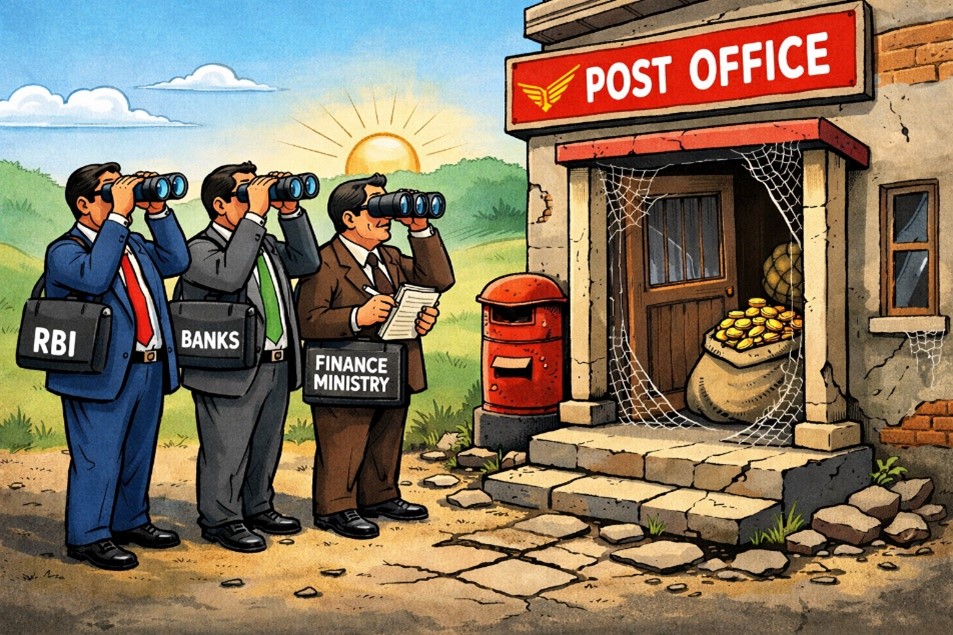

As the Reserve Bank of India urges banks to mobilise deposits, the world’s largest postal network sits under-utilised — proof that India built the infrastructure of savings but never the institution.
By Ravishankar Kalyanasundaram
The news that the Reserve Bank of India has begun engaging banks on improving deposit mobilisation appears routine. Yet it reflects a deeper shift taking place within India’s financial system. Bank credit has risen to nearly ₹219 lakh crore, while deposits stand at about ₹268 lakh crore, pushing the credit-deposit ratio toward 83 percent — one of the tightest funding positions the banking system has seen in decades. What makes this more striking is the trend beneath the numbers. Over the past year, bank credit has grown close to 16 percent while deposits have risen only around 13 percent. Loans are expanding faster than the savings that fund them.
For an economy like India’s — where banks still finance housing, infrastructure, MSMEs and working capital for industry — this imbalance cannot be ignored. When deposit growth persistently trails credit demand, the banking system eventually runs into a structural constraint. The immediate solutions are predictable. Banks may raise deposit rates, run savings campaigns, or design new products. But the more interesting question lies elsewhere.
Because at the very moment when India is worrying about deposits, the country already possesses what may be the largest savings distribution platform in the world — the network of India Post.
India operates about 1.65 lakh post offices, the largest postal network on the planet. Nearly 90 percent of these branches are located in rural areas. Through this system, postal savings schemes already hold roughly ₹22 lakh crore across about 38 crore accounts. No commercial bank anywhere in the world reaches that many households. Yet the scale of deposits remains modest when compared with similar systems abroad.
Consider Japan. Through a network of roughly 24,000 post offices, Japan Post Bank mobilises deposits of nearly ¥190 trillion, equivalent to roughly ₹110–120 lakh crore. In simple terms, a network seven times smaller than India’s mobilises nearly five times more deposits. South Korea presents a similar contrast. Through the postal savings framework operated by Korea Post, deposits approach 100 trillion won — roughly ₹6 lakh crore — in a country with barely five crore people. The difference is not population, nor network reach. The difference is institutional design.
Japan and Korea did not treat postal savings as administrative schemes. They designed them as strategic national savings institutions. In Japan, postal deposits historically flowed into the Fiscal Investment and Loan Program, financing highways, housing, ports and industrial infrastructure. Household savings became the capital that built modern Japan. South Korea followed a similar philosophy, backing postal savings with sovereign credibility, tax incentives and links to development finance. Saving money was presented not merely as a personal habit, but as participation in national progress.
India created something very different. Postal savings schemes exist — recurring deposits, time deposits, pension-linked products — but the architecture remains fragmented. Much of the money flows into the National Small Savings Fund, largely financing government borrowing rather than visibly supporting productive investment. Meanwhile the India Post Payments Bank operates under payments-bank restrictions and cannot lend. The country with the largest financial distribution network in the world therefore runs it as a passive savings counter. The pipes exist. The plumbing does not.
This becomes even more striking as India’s household savings behaviour itself evolves. Retail investors are increasingly moving toward equities, mutual funds and digital investment platforms. That shift is natural for a growing economy. A mature financial system requires vibrant capital markets as well as strong banks. But it also requires careful institutional design so that these channels complement one another rather than compete destructively.
Banks need stable deposits to finance credit creation. Capital markets need risk capital to fund enterprise. A national savings platform can provide long-term patient capital for infrastructure and development. India already possesses the physical foundation for such an institution. What is missing is coordination.
The moment therefore calls for joint action by the Ministry of Finance (India), the Reserve Bank of India and India Post. Postal savings, the payments bank and small savings schemes should be integrated into a unified digital financial platform capable of offering modern deposit products. Long-term deposits could receive modest tax incentives to encourage patient household capital. And a portion of these funds could be transparently channelled into infrastructure, housing and green-energy investment so that citizens see a clear connection between their savings and national development.
None of this requires building a new institution. India already built the network. It only needs to give that network purpose.
Japan and Korea did not merely encourage savings. They built national savings machines. India built the network but never built the institution.
And that leads to an uncomfortable but unavoidable conclusion. India does not lack reach. It does not lack trust. It does not even lack savings. What India lacks is imagination.
The country has created the largest physical savings grid in the world, yet continues to treat it as a modest collection of schemes rather than as a strategic engine of national capital formation. The tragedy is not that India has too little. The tragedy is that it has so much — and still chooses to think so small.




 Business and Economy
  Education
  Food
Food  Government
  Lifestyle
  Politics
  Travel
  World
World