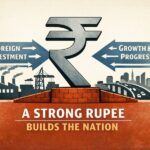

The arrival of global banks like Sumitomo Mitsui is a signal: if India wants to lead in energy, food systems, and advanced manufacturing, it must build a financial architecture capable of financing growth over decades.
Recent media reports that Sumitomo Mitsui Banking Corporation is expanding its presence in India may appear, at first glance, to be just another banking development. In reality, it signals something far more significant.
It reflects growing global recognition that India is entering a phase where the scale of opportunity is enormous — but the scale of financing required will be even larger.
India today speaks with confidence about becoming a global manufacturing hub, a leader in the clean-energy transition and a major exporter across sectors ranging from agriculture to advanced technology. The country’s economic momentum justifies this optimism.
But ambition alone does not build industries.
Behind every great economic transformation lies something less visible but decisive: patient capital — finance that can stay invested through long development cycles, often for decades.
And this is where India faces a structural constraint.
India saves substantially as a nation, with overall savings close to 30% of GDP. Yet much of this wealth sits in bank deposits, gold and real estate. These are safe stores of value but not easily converted into the long-duration capital required for infrastructure, industrial ecosystems and technological sectors.
Banks themselves operate largely on short-tenor deposits, often three to five years in maturity. Yet many national development projects require financing horizons of twenty to thirty years.
The result is a structural mismatch. Projects that demand patient capital often struggle to find financing at the required scale. When funding becomes uncertain or short-term, projects slow down, costs rise and sectors grow below their potential.
This constraint becomes visible across several sectors central to India’s future.
Consider food systems.
India imports roughly $18–20 billion of edible oils annually, despite having the agro-climatic diversity to produce oilseeds at scale. At the same time, global food trade exceeds $1.7 trillion, while India’s agricultural exports remain around $50 billion.
The contrast is striking.
With investment in irrigation efficiency, seed technology, storage, food processing and cold chains, India could dramatically reduce import dependence while expanding exports of oilseeds, processed foods, fruits, vegetables and marine products.
Such transformation would do more than increase exports. It would diversify farm incomes, reduce the risks of mono-crop agriculture and convert today’s occasional surplus burdens into globally traded, high-value dollar crops.
But modern agricultural supply chains require sustained capital for rural infrastructure and processing systems — investments that mature over long periods.
Energy transition presents an even larger financial challenge.
India aims to reach 500 GW of non-fossil electricity capacity by 2030. Yet renewable energy introduces a fundamental challenge: intermittency.
Solar disappears after sunset. Wind fluctuates with weather patterns.
Large-scale energy storage systems — batteries and pumped hydro — are therefore essential. These investments, running into several lakh crore rupees, will determine whether India can stabilise renewable power and protect itself from the volatility of global fossil-fuel supply chains.
Then comes green hydrogen.
India’s National Green Hydrogen Mission aims for 5 million tonnes of production annually by 2030, positioning the country as a supplier of clean fuel to energy-importing economies.
The hydrogen economy is expected to become a multi-trillion-dollar global market in the coming decades.
But hydrogen infrastructure — electrolysers, renewable energy supply, storage and export logistics — requires massive upfront capital and long investment horizons.
Manufacturing and technology sectors tell a similar story.
India aims to raise manufacturing’s share of GDP toward 25%, while building strength in semiconductors, electronics and electric mobility — industries that together represent trillion-dollar global markets.
Yet manufacturing ecosystems require much more than factories. Industrial corridors, logistics systems, supplier networks and export finance structures all require deep pools of long-term capital.
This is why the arrival of global financial institutions matters.
Countries that transformed their economies understood the importance of financial architecture. Japan’s industrial rise was supported by institutions such as Mitsubishi UFJ Financial Group and Mizuho Financial Group. South Korea and China similarly mobilised vast financial resources through banking systems capable of sustaining investment over decades.
India must now think with similar clarity.
Encouraging large multinational banks, development finance institutions, sovereign funds and pension capital to establish deeper operations in India should not be seen merely as financial liberalisation.
It should be seen as economic strategy.
Because the sectors that will define India’s next chapter — food security, agricultural exports, clean energy, storage, hydrogen, manufacturing and global supply chains — all require the same foundation.
Not just capital.
But patient capital with scale, structure and confidence.
And building a financial architecture capable of attracting that capital may well determine how quickly India’s ambitions become reality.




 Business and Economy
  Education
  Food
Food  Government
  Lifestyle
  Politics
  Travel
  World
World