
When democracy becomes transactional and fiscal promises reckless, the real casualty is not just an election—it is the Republic’s moral and financial foundation.
By Ravishankar Kalyanasundaram
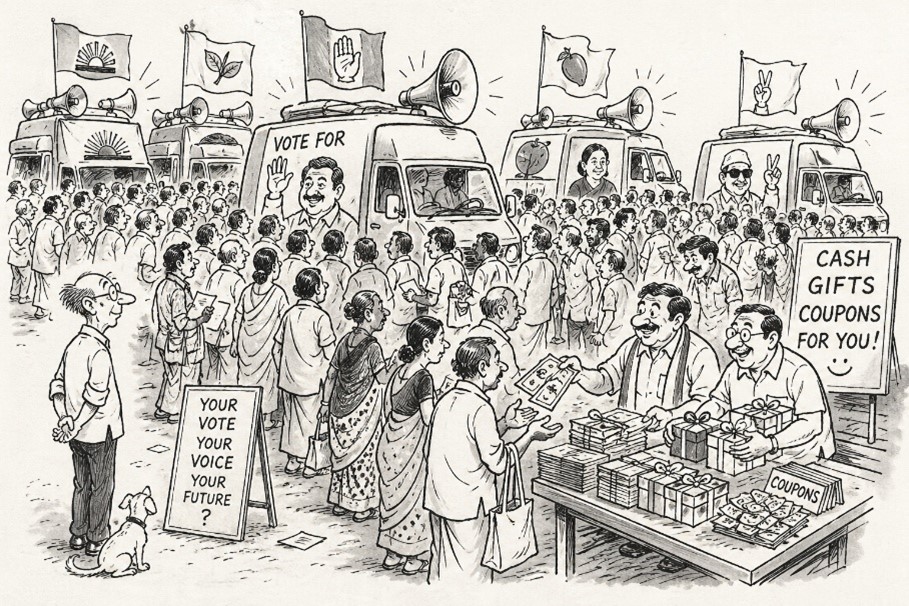
The ballots have been cast in Tamil Nadu, the noise has begun to settle, and the familiar rituals of counting, claims, and counterclaims are underway. Yet beneath the choreography of democracy lies a quieter, more troubling story—one that rarely enters official records but decisively shapes them. It is the story of money. Not declared campaign expenditure, but currency that travels silently through neighbourhoods, reducing a citizen’s choice to a transaction.
Tamil Nadu has lived with this shadow for long. Cash distribution, gifts, coupons—these are no longer whispered irregularities but expected features of elections. What was once episodic has become systemic. The voter is not merely persuaded; he is priced. And what is more unsettling is the normalization of this practice, where outrage has given way to resignation.
Contrast this with several other Indian states where, despite intense political competition, elections are still largely fought on narrative, leadership, and organisation rather than direct inducement. States such as Kerala, Himachal Pradesh, or even parts of the North-East continue to demonstrate that electoral integrity, while imperfect, has not surrendered to transactional politics at this scale. Money does play a role everywhere, but not always in this overt, retail form that distorts the sanctity of the vote itself.
What deepens the concern is the quiet presence—and absence—of institutions. The Election Commission, the police, and enforcement agencies remain visible, even active. Seizures are announced, vigilance is proclaimed, and yet the flow of inducements adapts and continues. The system acknowledges the problem, but stops short of confronting it with finality. Enforcement appears episodic; the practice, continuous.
Responsibility, then, cannot be assigned to one actor alone. Political parties are the immediate agents, but the ecosystem is wider—the networks that facilitate, the local structures that enable, and, importantly, the voter who accepts. Over time, a corrosive equilibrium takes hold, where morality adjusts to convenience, and the abnormal becomes routine.
Alongside this, another dimension quietly compounds the problem—the nature of electoral promises themselves. Competitive populism has reached levels where manifestos often resemble fiscal wish-lists rather than responsible policy frameworks. Free power, cash transfers, loan waivers, and an expanding list of entitlements are announced with little regard for the state’s fiscal capacity. Tamil Nadu’s debt is already estimated at over ₹8 lakh crore, with a debt-to-GSDP ratio hovering around 26–27%. Interest payments and committed expenditures consume a growing share of revenues. Yet, election cycles continue to push promises that risk stretching public finances further, effectively mortgaging the future to secure the present.
When votes are influenced by immediate gain and promises are framed without fiscal discipline, governance itself becomes secondary. Leadership is not chosen for long-term vision or administrative competence, but for the efficiency of distribution—both before and after the election. In such a setting, what meaning do institutions retain? What authority can they command if their writ is consistently outpaced by informal economies of influence?
And yet, to resign ourselves to decline would be a grave mistake. Societies do not erode overnight, nor do they recover through a single reform. Redemption begins with discomfort—with the refusal to accept this as normal. It requires institutions to rediscover both the will and the methods to act decisively. But equally, it demands that citizens reclaim the dignity of their vote.
The task ahead is not merely regulatory, but cultural. Stricter enforcement, sharper surveillance, and stronger penalties are necessary—but insufficient if society itself remains complicit. The deeper challenge is to restore the idea that a vote is not a commodity but a trust; that its value lies not in what it fetches today, but in what it shapes tomorrow.
Tamil Nadu has long been a state of political awareness, social reform, and institutional legacy. That is precisely why this moment calls for reflection—not outrage alone, but introspection; not despair, but resolve.
If the price of a vote continues to be counted in currency, the cost to the Republic will be immeasurable. The real question before us is not who wins this election, but whether we still recognise what is being lost—and whether we are prepared, collectively, to reclaim it.
 Business and Economy
  Education
  Food
Food  Government
  Lifestyle
  Politics
  Travel
  World
World