
“India signs FTAs with ambition—but without preparation, they risk becoming gateways for imports rather than engines of exports.
By Ravishankar Kalyanasundaram
The FTA Illusion: Promise, Imbalance, and the Missing Execution
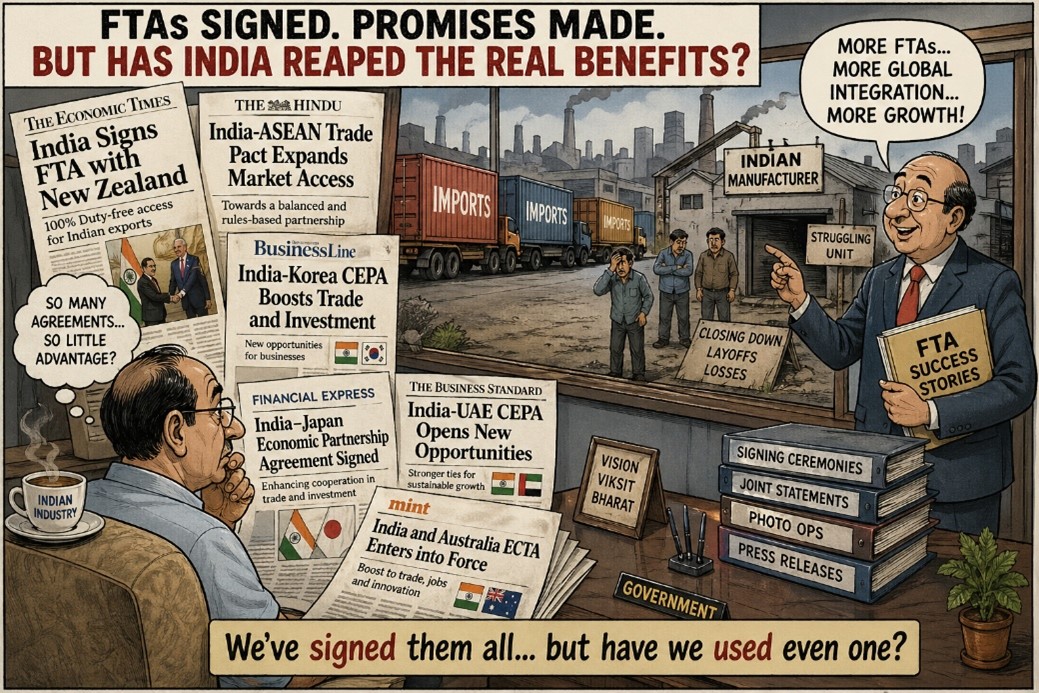
Have India’s FTAs truly strengthened its economy?
Has there been periodic course correction when outcomes diverge?
How balanced has trade been—before and after these agreements?
These are uncomfortable questions. But they are necessary.
The recently signed FTA with New Zealand once again brings optimism—zero-duty access for Indian exports, safeguards for sensitive sectors, and the promise of investment. Yet, India’s experience with earlier agreements urges caution.
Consider the FTA with ASEAN. India’s trade deficit widened dramatically—from about $5 billion in 2010 to over $40 billion by FY23. Imports surged to nearly $84 billion, while exports remained around $39 billion. Similar trends followed agreements with South Korea and Japan.
This imbalance was not merely statistical—it reshaped industry dynamics.
Imports expanded rapidly in electronics, electrical machinery, chemicals, plastics and consumer durables, often at prices domestic producers could not match. A telling example was the inflow of air conditioners and components—manufactured in China but routed through Indonesia to benefit from concessional duties under the ASEAN FTA. For Indian manufacturers, this was not competition—it was circumvention.
The impact was immediate. MSME clusters—from plastics in Gujarat to engineering hubs in Tamil Nadu and Punjab—saw margins compress and market share erode. In several FTA corridors, imports were nearly double exports, creating sustained structural pressure.
And yet, the policy response lagged.
Were rules of origin strictly enforced? Not consistently.
Were safeguard measures timely? Often delayed.
Were quality controls proactive? Mostly reactive.
For industry, the disruption was swift.
For policy, the correction was gradual.
The deeper issue lies in sectoral misalignment.
Electronics opened up before domestic manufacturing scaled.
Textiles, despite access, lost ground to better-integrated competitors.
Engineering goods faced standards and certification hurdles.
Agriculture remained inward-looking.
Services, India’s strength, remained under-leveraged in FTAs.
Contrast this with Singapore. Singapore does not merely sign FTAs—it prepares for them. Sectors are aligned in advance, exporters are supported with logistics, standards, financing and market intelligence, and utilisation is continuously tracked. When tariffs fall, exports rise—not by chance, but by design.
India’s omission is not in negotiation—it is in execution.
FTAs rarely come with:
An FTA reduces tariffs. It does not create competitiveness.
If India is to change outcomes, every agreement must be treated as a continuous program—before and after signing. Sectoral “export war rooms,” integration of MSME clusters into global value chains, strict rules-of-origin enforcement, and transparent annual FTA scorecards must become the norm.
The New Zealand FTA is an opportunity—but also a test.
FTAs do not fail because they are poorly written.
They fail because they are not worked upon.
And until India moves from signing agreements to executing them, the promise of free trade will remain—elegant on paper, but incomplete in practice.
 Business and Economy
  Education
  Food
Food  Government
  Lifestyle
  Politics
  Travel
  World
World