
Tamil Nadu’s dramatic political moment may prove that electoral victory is only the beginning — for in politics, the real battle often starts when power appears within reach, and old rivals suddenly discover a common fear.
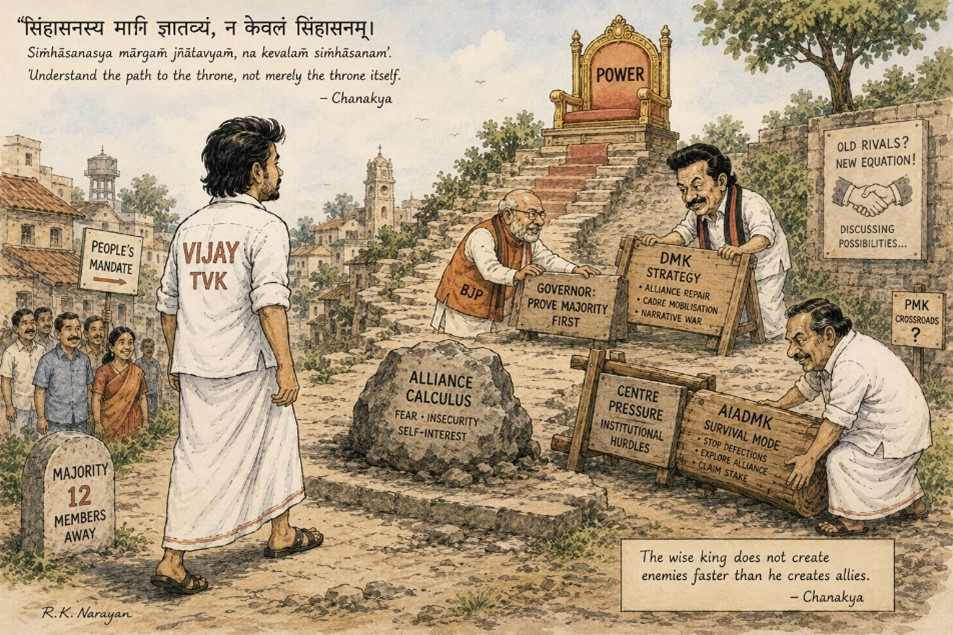
“सिंहासनस्य मार्गं ज्ञातव्यं, न केवलं सिंहासनम्।”
Siṁhāsanasya mārgaṁ jñātavyaṁ, na kevalaṁ siṁhāsanam.
“Understand the path to the throne, not merely the throne itself.”
The wisdom attributed to Chanakya feels uncannily relevant to Tamil Nadu’s extraordinary political moment. The state has witnessed something few thought possible. A political debutant, Vijay, has broken through the entrenched dominance of the DMK and AIADMK — two formations that shaped the state’s political grammar for more than six decades. The crowds moved. The voters shifted. The emotional energy of the state visibly changed direction.
Yet politics, as Chanakya repeatedly warned, is rarely decided by public emotion alone.
Chanakya never viewed politics as a moral theatre. He viewed it as a chessboard of interests, anxieties, ambitions and survival. One of the oldest lessons of the Arthashastra is that when a rapidly rising force threatens multiple centres of power simultaneously, those centres may momentarily forget their rivalries and unite against the larger disruption. Old enemies become temporary partners. Ideological contradictions suddenly become negotiable. Fear becomes the adhesive of politics.
That is precisely what now appears to be unfolding in Tamil Nadu.
The Congress decision to break away from the DMK alliance and offer support to TVK may have appeared numerically attractive, but was the deeper political reaction adequately anticipated? Would it not naturally provoke both the DMK and the BJP, though they stand on opposite sides nationally? For the DMK, it threatens alliance stability and signals that smaller parties may begin exploring alternative futures. For the BJP, Congress supporting Vijay creates an entirely different political complication in a state where the party is carefully attempting to expand its long-term footprint.
Equally, when Vijay openly called upon leaders and cadres from rival parties to join TVK, did he unknowingly accelerate the anxieties of the very parties whose cooperation he may eventually need, directly or indirectly, to stabilise governance? Politics is not merely about defeating opponents. It is also about ensuring defeated opponents do not unite against you.
And suddenly the atmosphere changes.
The Governor asks Vijay to prove majority before swearing in.
The BJP watches cautiously from Delhi.
The DMK recalibrates survival strategies.
The AIADMK fears erosion within its own ranks.
The PMK’s future equations become uncertain.
And now whispers emerge of even the DMK and AIADMK discussing possibilities that once seemed unimaginable.
This is where Indian civilisational memory offers a deeper lens than modern political commentary.
The Mahabharata itself was not won merely by superior weapons. It was won by strategy, sequencing and anticipation. Krishna understood that some battles are decided long before the armies actually clash.
Consider the story of Barbarika, the immensely powerful grandson of Bhima. Barbarika possessed extraordinary capability and had vowed that he would always support the weaker side in battle. But Krishna immediately understood the consequence of such a warrior entering the war. The balance of power would continuously shift, prolonging chaos endlessly. Barbarika’s very presence could alter the destiny of Kurukshetra itself.
And so Krishna did something morally uncomfortable yet strategically decisive. Before the war began, Barbarika was removed from participation altogether.
The lesson was stark.
In great political struggles, systems do not merely confront visible enemies. They also neutralise uncertain variables capable of reshaping the outcome.
The same logic echoes through the elimination of Ekalavya before he could emerge as a challenge to the established order, through the carefully engineered fall of Bhishma, the psychological breaking of Drona, and the isolation of Karna at decisive moments. The epic repeatedly reminds us that raw capability alone is never enough. A warrior who sees only the battlefield may miss the invisible game unfolding around it.
Perhaps that is the deeper challenge before Vijay today.
Tamil Nadu’s electorate may indeed have signalled exhaustion with the old order. The rise of TVK may well represent the arrival of a generational political transition. But transitions are rarely smooth because entrenched systems instinctively resist disruption.
A leader carried forward by public emotion must therefore become even more careful after victory than before it. Every move creates consequences. Every alliance creates insecurity somewhere else. Every public statement rearranges invisible equations.
Should Vijay have anticipated that accepting Congress support would simultaneously alarm both the DMK and BJP?
Should he have moved more subtly while reaching out to rival cadres?
Should reassurance have preceded expansion?
Should consolidation have come before confrontation?
These are not questions of morality. They are questions of statecraft.
For history repeatedly shows that the throne rarely slips away because of lack of popularity alone. More often, it drifts away because rising leaders underestimate how many invisible hands control the staircase leading to it.
And perhaps that is why Chanakya’s warning survives after more than two thousand years:
“The wise king does not create enemies faster than he creates allies.”
 Business and Economy
  Education
  Food
Food  Government
  Lifestyle
  Politics
  Travel
  World
World