
The voters may have accepted the old election culture — but this time, they refused to surrender their vote to it. In that quiet act of independence lies the beginning of a new political era for Tamil Nadu.
By Ravishankar Kalyanasundaram
For decades, Tamil Nadu elections carried a familiar and almost exhausting visual language. Giant cut-outs towered above highways. Endless banners swallowed neighbourhoods. Loud processions paralysed roads. Walls disappeared beneath layers of political posters. Beneath this spectacle ran a quieter but more corrosive current — the normalisation of electoral inducements, where cash distribution, gifts, and localised “management” slowly became embedded into the culture of campaigning itself. Elections often appeared less like a democratic exercise and more like a massive seasonal mobilisation of money, visibility, and influence.
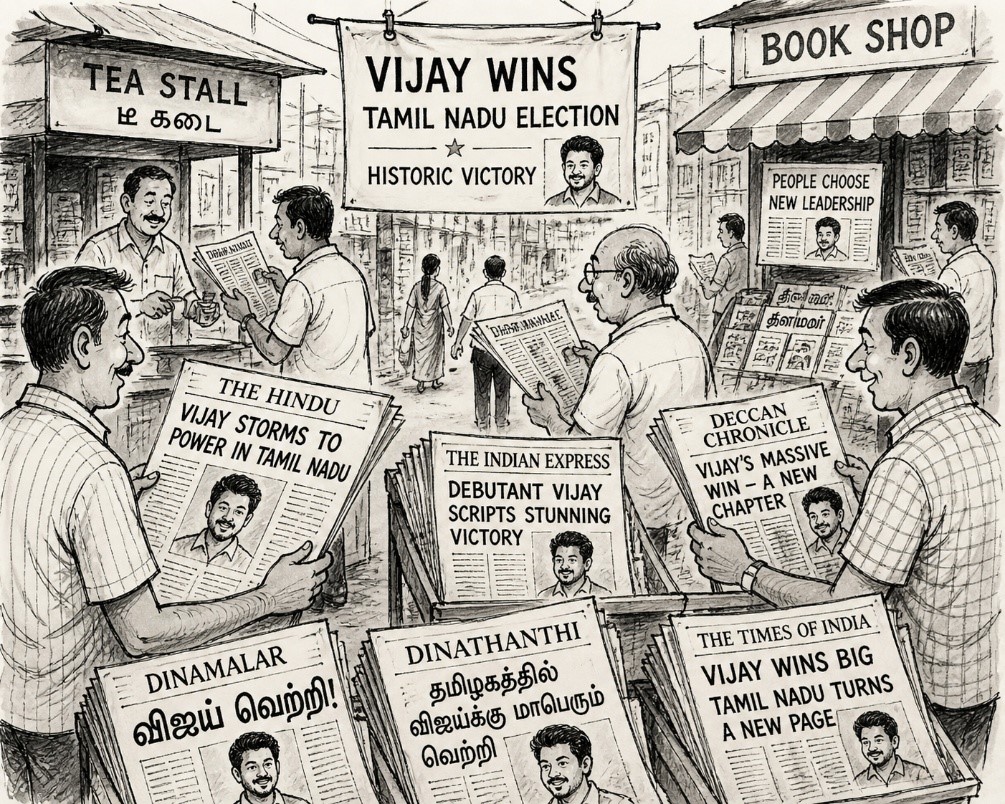
This election, at first glance, did not appear entirely different. Several established parties continued with many of the old methods — hoardings, extravagant campaign visibility, expensive mobilisation, and the familiar undercurrent of electoral spending that Tamil Nadu has witnessed for years. But beneath that familiar surface, something important changed. The eventual winner consciously adopted a more restrained campaign culture, avoiding much of the visual excess that had long defined Tamil Nadu politics. More importantly, the electorate appeared to respond to that restraint with unusual clarity.
That may prove to be the real turning point.
For perhaps the first time in decades, Tamil Nadu’s voters quietly signalled that political extravagance no longer automatically commands emotional loyalty. Many voters reportedly accepted the customary election-time distributions offered across constituencies, yet voted independently and without visible obligation. In one stroke, they separated transaction from conviction. The vote itself became autonomous again. The electorate seemed to say: “You may distribute money, but you can no longer purchase political admiration.”
That is not merely an electoral shift. It is a cultural correction.
And at the centre of this shift stands Vijay — a debutant in politics who appears to have tapped into a deeper psychological change underway in Tamil Nadu society. His rise was not built upon ideological aggression, street violence, or institutional disruption. Nor did it emerge from the old structures of cadre dominance and patronage politics. Instead, it drew energy from aspiration, emotional connection, generational impatience, and perhaps most importantly, fatigue with excess itself.
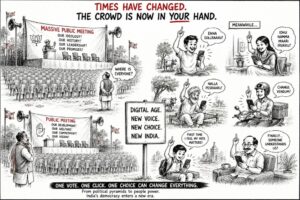
The Gen Z voter in Tamil Nadu is not the same voter of the 1980s or 1990s. This generation has grown up in a globally connected world of smartphones, entrepreneurship, technology employment, migration, global media exposure, and rising personal ambition. They seek efficiency, dignity, opportunity, cleaner governance, and a politics that speaks of the future rather than endlessly recycling the emotional scripts of the past. Yet unlike youth unrest witnessed elsewhere in the world, this shift in Tamil Nadu came through democratic restraint rather than destruction. There were no mobs, no vandalism, no collapse of civic order. The message was delivered quietly through the ballot box itself.
That places enormous responsibility on Vijay.
The affection of the electorate can create an opening. But sustaining trust requires far more than symbolism. Tamil Nadu now expects something deeper from its emerging political leadership — administrative seriousness, institutional discipline, cleaner governance, investment-led growth, urban improvement, water management, jobs, skilling, industrial expansion, technology readiness, and social stability. The first step in the race to power appears to have discovered a more ethical path. The larger challenge now is whether governance too will follow a wiser path — one shaped more by development and less by competitive populism.
For Tamil Nadu possesses extraordinary strengths: industrial capability, educational depth, entrepreneurial culture, ports, manufacturing ecosystems, healthcare infrastructure, and a globally connected workforce. But no state can indefinitely sustain prosperity if politics becomes consumed by spectacle, subsidies without productivity, and perpetual electoral theatrics.
Perhaps this election marks the beginning of a more mature phase in Tamil Nadu’s democracy — where voters still value welfare and social justice, but increasingly seek dignity through growth, governance, and opportunity rather than through endless political performance.
If that sentiment deepens, Tamil Nadu may not merely witness a change of leadership. It may witness the quiet reinvention of its political culture itself.
 Business and Economy
  Education
  Food
Food  Government
  Lifestyle
  Politics
  Travel
  World
World