
The worrying ‘two hundreds’ are not just economic numbers. They are warning signals that India must move from political competition to coordinated national execution before global instability overwhelms domestic preparedness.
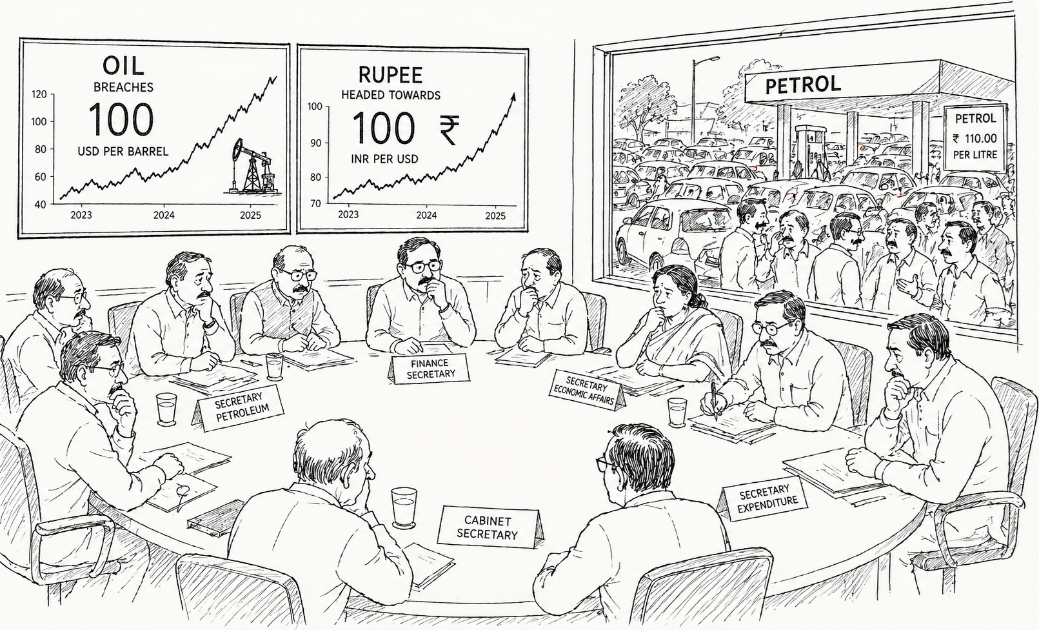
Oil crossing $100.
The Rupee inching toward ₹100 to the dollar.
One is a global crisis. The other is increasingly becoming a reflection of India’s own economic vulnerability.
And together, these two numbers are beginning to send one of the strongest warning signals the country has seen in years.
India imports nearly 85% of its crude oil requirement. At current consumption levels of more than 5 million barrels per day, every $10 rise in crude prices increases India’s annual import bill by roughly $15–18 billion. When oil remains above $100 for prolonged periods, the impact spreads quickly through the economy. Fuel prices rise, fertiliser costs increase, logistics becomes expensive, inflation accelerates and pressure builds on the rupee and foreign exchange reserves.
But crude oil is only one part of the story.
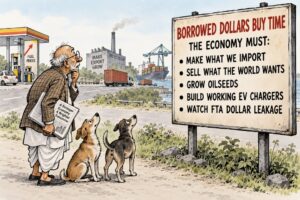
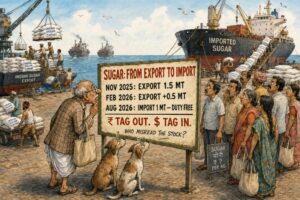
India’s imports crossed $700 billion last year. Gold imports alone exceeded $50 billion. Electronics imports continue to surge. Despite decades of discussion around self-sufficiency, India still imports nearly 55–60% of its edible oil requirement. Palm oil arrives from Indonesia and Malaysia, soybean oil from Argentina and Brazil, while disruptions during the Russia–Ukraine war sent sunflower oil prices sharply higher across Indian households.
Every geopolitical disruption now enters Indian kitchens almost immediately.
And yet this vulnerability was never unknown.
India once approached external economic risk with far greater seriousness. Older policymakers understood that oil shocks could destabilise entire economies. Mechanisms such as the Oil Pool Account and oil price equalisation frameworks were created precisely to cushion external volatility. Petroleum cesses and energy levies were also justified partly on the grounds of building future resilience and funding energy transition. The National Clean Energy Fund, financed through coal cess collections, was intended to support renewable energy and reduce long-term fossil fuel dependence.
Over time, many of these stabilisation frameworks were diluted, repurposed or quietly faded away.
The uncomfortable question now is this: what replaced them?
Did India build sufficiently large strategic buffers during years of relative global stability? Did we move fast enough on reducing import dependence in energy, electronics, edible oils and critical minerals? Or did the country slowly become comfortable assuming that global supply chains and cheap imports would always remain permanently available?
The present situation is now exposing the cost of that complacency.
Take edible oils.
India consumes nearly 25 million tonnes of edible oil annually, but domestic production remains structurally inadequate. The National Mission on Edible Oils–Oil Palm carried ambitious targets, yet progress remained uneven because agriculture ultimately requires state-level ownership for execution. Oil palm cultivation needs long gestation periods, irrigation support, pricing assurance and local farmer engagement. Several states moved cautiously while procurement ecosystems remained weak and imports continued to dominate markets.
The result is that India remains heavily dependent on foreign supply chains for a basic household necessity.
Mining and strategic minerals reveal an even deeper institutional problem.
India possesses reserves of lithium, rare earths, copper, bauxite and several critical minerals essential for semiconductors, batteries, renewable infrastructure and electric vehicles. Yet exploration and commercialisation continue to move painfully slowly because projects frequently become trapped between central ambition and state-level execution realities.
Land acquisition disputes, environmental litigation, rehabilitation concerns and political mistrust delay projects for years. In many cases, state governments are not taken fully into confidence during conceptualisation, while the political burden of execution is left largely to them later.
The consequences are visible in some of India’s most prominent stalled investment stories. Rio Tinto eventually exited its Bunder diamond mining project in Madhya Pradesh after years of regulatory, environmental and land-related hurdles. POSCO walked away from what was once projected as one of India’s largest foreign investment projects in Odisha after prolonged delays involving land acquisition, environmental clearances and local resistance.
These were not merely failed investments. They reflected a deeper structural weakness — India’s inability to align national strategic ambition with state-level political ownership and local execution.
And this perhaps is India’s greatest institutional mistake today.
The Central Government appears to be fighting many of these battles largely alone.
But India is not governed by New Delhi alone. The states are not junior administrative units expected merely to implement centrally branded schemes. They are equal stakeholders in determining whether India reduces external vulnerability or drifts deeper into strategic dependence.
Yet many national programmes quietly slow down because political ownership itself becomes fragmented. No regional political party can be expected to enthusiastically champion centrally branded programmes that potentially weaken them politically in state elections. Equally, the Centre often views opposition-ruled states through a political lens rather than as equal partners in nation-building.
This political disconnect silently weakens national execution.
Industrial corridors slow down. Renewable energy projects face local resistance. Mining approvals remain trapped in delays. Manufacturing ecosystems fail to deepen uniformly. Strategic infrastructure loses years navigating mistrust between Delhi and the states.
And meanwhile imports continue rising.
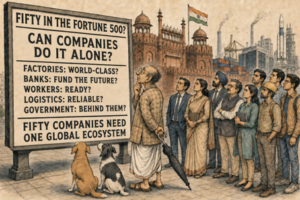
Perhaps the time has now come for a fundamentally different institutional approach — a permanent Centre–State Economic Resilience Council with meaningful multi-party participation focused on strategic national priorities such as energy security, edible oil self-sufficiency, mining acceleration, manufacturing ecosystems and external vulnerability reduction.
Not as centrally delegated schemes.
But as jointly owned national missions.
Because the world itself is changing dangerously. Oil prices now react to missile strikes. Freight rates react to wars. Supply chains react to sanctions. Currencies react to geopolitical rivalry. One regional conflict can alter inflation, bond yields and household budgets across continents within days.
India cannot confront such a world with fragmented political execution and institutional complacency.
The worrying “two hundreds” are therefore not merely about oil prices and the rupee.
They are warning signals asking whether India is finally prepared to move from political competition toward coordinated national execution.
Because resilience cannot be built through slogans alone.
It can only be built when complacency disappears, execution becomes relentless, and the Centre and the states begin working not as political competitors — but as equal partners protecting India’s economic future.
 Business and Economy
  Education
  Food
Food  Government
  Lifestyle
  Politics
  Travel
  World
World