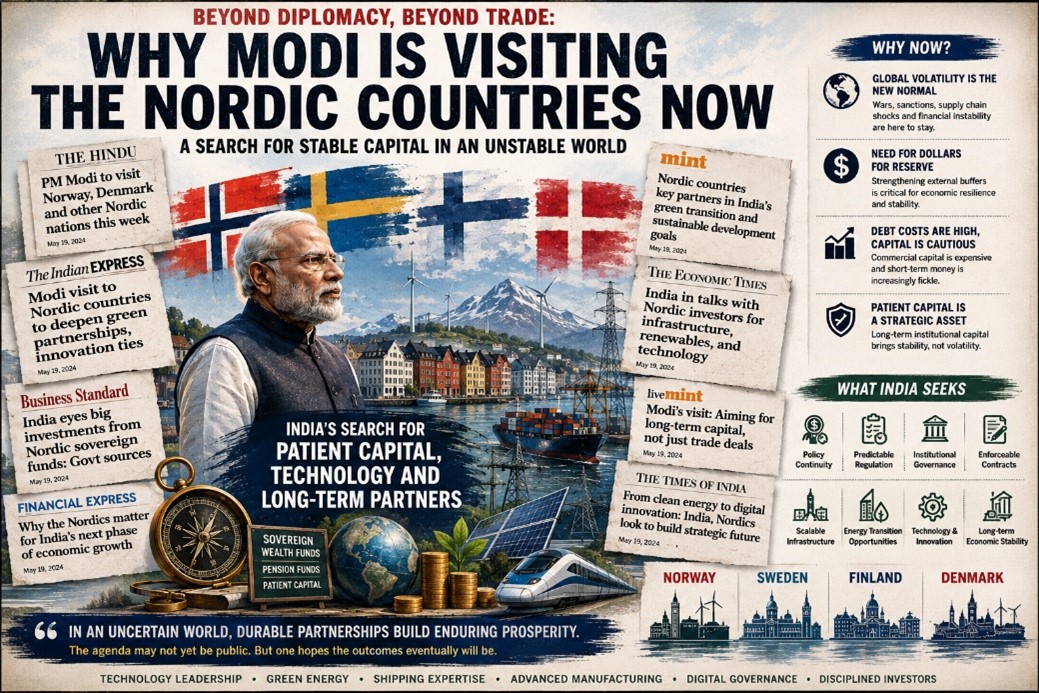

Beyond diplomacy and trade, India may be quietly searching for something far more important in an unstable world — patient capital, institutional trust and durable strategic partnerships.
“Watch the Nordic visit carefully. The real agenda may not be fully public yet.”
That is how some observers and insiders in policy circles are quietly describing Prime Minister Narendra Modi’s current outreach to the Nordic nations.
Publicly, the visit is being framed in familiar diplomatic language — green partnerships, innovation, sustainability, shipping, technology and strategic cooperation. But beneath the official statements, many in India’s economic and institutional circles suspect that a deeper financial and geopolitical conversation may also be unfolding quietly in the background.
And the timing itself is revealing.
The world economy today is entering one of its most uncertain phases in decades. Nations are finding that economic resilience today is not merely about growth rates. It is increasingly about the quality of capital supporting the system and the stability of external financial partnerships during turbulent times.
It is in this environment that the Nordic countries suddenly appear strategically important.
Countries like Norway, Sweden, Finland and Denmark are not merely prosperous welfare states sitting quietly in Northern Europe. They represent some of the world’s deepest reservoirs of long-duration institutional capital, technological sophistication and governance-driven investment cultures.
Norway alone manages the world’s largest sovereign wealth fund, estimated at over $2 trillion, with investments spread across thousands of companies globally. Such funds are fundamentally different from speculative pools of money chasing quick exits. They think in generations, not quarters. They seek stable destinations capable of absorbing capital over decades through infrastructure, energy systems, logistics networks and institutional partnerships.
And that distinction matters enormously today.
The world economy is slowly moving away from an era dominated by fast-moving speculative capital toward one where nations increasingly seek what policymakers quietly call “stable money.” Hedge funds leveraged global flows and short-term portfolio capital can reverse overnight when geopolitical tensions rise. Sovereign wealth funds and pension institutions operate differently. Their liabilities stretch decades into the future. Stability matters to them as much as returns.
India today requires exactly that kind of capital.
The next phase of India’s development is extraordinarily capital intensive. Renewable energy transitions, transmission corridors, ports, logistics parks, rail modernisation, semiconductor ecosystems, data centres, warehousing platforms, water systems and urban transport networks together require trillions of dollars over the coming decades. Domestic banking systems alone cannot comfortably finance this expansion without balance-sheet strain.
Therefore, India’s real strategic challenge is no longer merely attracting foreign portfolio inflows into equity markets. It is persuading the world’s largest pools of patient capital that India can offer policy continuity, predictable regulation, institutional governance, enforceable contracts and scalable infrastructure opportunities.
That may well explain why the Nordic region has emerged as an important destination now.
These countries combine green energy leadership, shipping expertise, advanced manufacturing, digital governance and some of the world’s most disciplined sovereign investors. India increasingly needs credibility in exactly those areas — green hydrogen, offshore energy, climate financing, smart logistics and sustainable urbanisation.
There is another dimension too.
The global competition for patient capital is intensifying. Countries across Asia, Europe, Latin America and Africa are all competing to attract sovereign wealth funds and pension capital into their infrastructure and industrial ecosystems. In a world where speculative capital is becoming unstable, long-duration institutional capital is itself becoming a geopolitical asset.
Perhaps India recognises that securing such partnerships early may provide an important cushion against future global turbulence.
That may be the larger story behind this visit.
Not merely diplomacy.
Not merely symbolism.
And perhaps not even merely trade.
But a search for durable strategic capital partnerships in an increasingly uncertain world.
The agenda may not yet be public.
But one hopes the outcomes eventually will be.
 Business and Economy
  Education
  Food
Food  Government
  Lifestyle
  Politics
  Travel
  World
World