
Perhaps our greatest failure is that we have become extraordinarily good at calculating the value of what we build—and remarkably poor at calculating the value of what we destroy.
By Ravishankar Kalyanasundaram
The recent protest in Uttarakhand against the proposed felling of 4,369 trees for the widening of the Bhaniyawala–Rishikesh road made me think of what I have witnessed much closer to home. During my frequent journeys from Chennai to Mayiladuthurai, I have watched the East Coast Road and connecting corridors being widened, while many magnificent mature trees that once shaded these routes disappeared. Better roads were certainly needed. But I cannot help wondering whether better planning, greater public scrutiny and more sensitive engineering could have saved many of them. Did development really require such extensive loss, or did we simply accept the trees as expendable because they stood in the way?
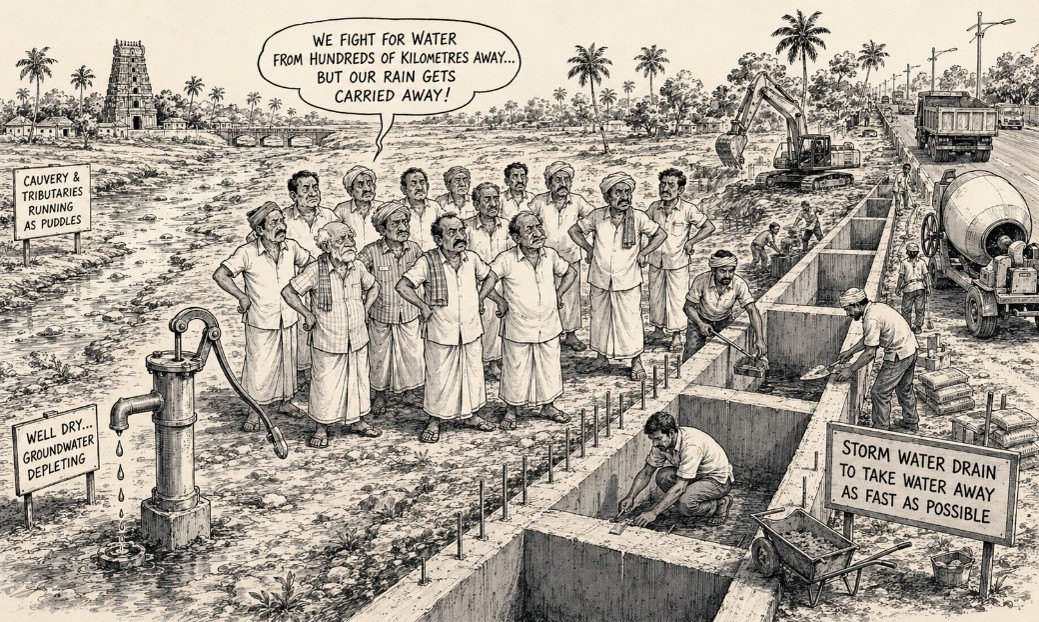
What troubles me even more is whether the road infrastructure has been designed with sufficient sensitivity to the water needs of the region through which it passes. As one travels towards the Cauvery delta, the contradiction becomes increasingly difficult to ignore. This is a great agricultural landscape where many tanks are depleted, groundwater is under stress, and the Cauvery and its network of tributaries and channels can shrink dramatically outside periods of adequate flow. Farmers anxiously wait for water released from reservoirs hundreds of kilometres away, while Tamil Nadu and Karnataka have spent decades arguing, negotiating and litigating over the sharing of Cauvery water.
Yet alongside roads passing through this precious agricultural landscape, we see concrete storm-water drains designed primarily to move rainwater away from the road as quickly as possible.
There is something profoundly troubling about designing infrastructure without adequately understanding the needs of the land through which it passes. A road cannot be viewed merely as a strip of asphalt to be protected from water. In a water-stressed agricultural region, every major drainage system should surely ask where the water will ultimately go. Can it replenish a drying tank? Can it recharge the groundwater beneath nearby fields? Can it be slowed, stored and allowed to percolate rather than simply being carried away?
The Cauvery delta should have inspired a completely different philosophy of road design—one that protected as many mature trees as possible and treated every drop of rain as a resource to be conserved. Instead, we risk doing precisely the opposite: removing trees that help the land retain water while building concrete channels whose purpose is to move that water elsewhere.
Imagine the irony. We spend public money to carry precious rainwater away from the very land that desperately seeks water from afar—and then spend more public money on schemes to replenish the groundwater we helped deplete.
Across parts of the developed world, including Germany, water-sensitive planning is increasingly moving away from the old philosophy of simply collecting rain and conveying it elsewhere. Where local conditions permit, the emphasis is on retaining, infiltrating, storing and reusing water close to where it falls.
The principle is remarkably simple: do not treat rainwater as waste that must be removed. Treat it as a resource that must be managed.
Why should that principle matter less in the Cauvery delta, where water is infinitely more precious?
Perhaps this reveals a deeper failure in the way we conceive development. We design a road as a road and a drain as a drain, while the farmer, the aquifer, the village tank, the trees and the surrounding ecosystem seem to belong to somebody else’s project.
Each department may successfully complete its work.
Yet the region can collectively become poorer.
We meticulously calculate the cost of every kilometre of road, the time saved and the economic benefits created. But where is the Balance Sheet of Nature? Where do we account for the mature trees lost, the groundwater not recharged, the tanks left dry and the ecological services that nature once provided without sending us an invoice?
These are not arguments against development. India must build, and build well. But the true measure of progress cannot be merely how quickly we complete a project. It must also be whether we understand the landscape through which we build and whether the economic value we create justifies the ecological value we permanently lose.
Perhaps the question we should ask before every major project is not merely, “What will this create?” but also, “What will this destroy?”
Because development that ignores the balance sheet of nature may look profitable today.
Nature may simply present the unpaid bill to the next generation.

 Business and Economy
  Education
  Food
Food  Government
  Lifestyle
  Politics
  Travel
  World
World