
Why Tata’s succession question is larger than the search for N. Chandrasekaran’s successor
By Ravishankar Kalyanasundaram
Who will succeed him?
But perhaps we are asking the smaller question.
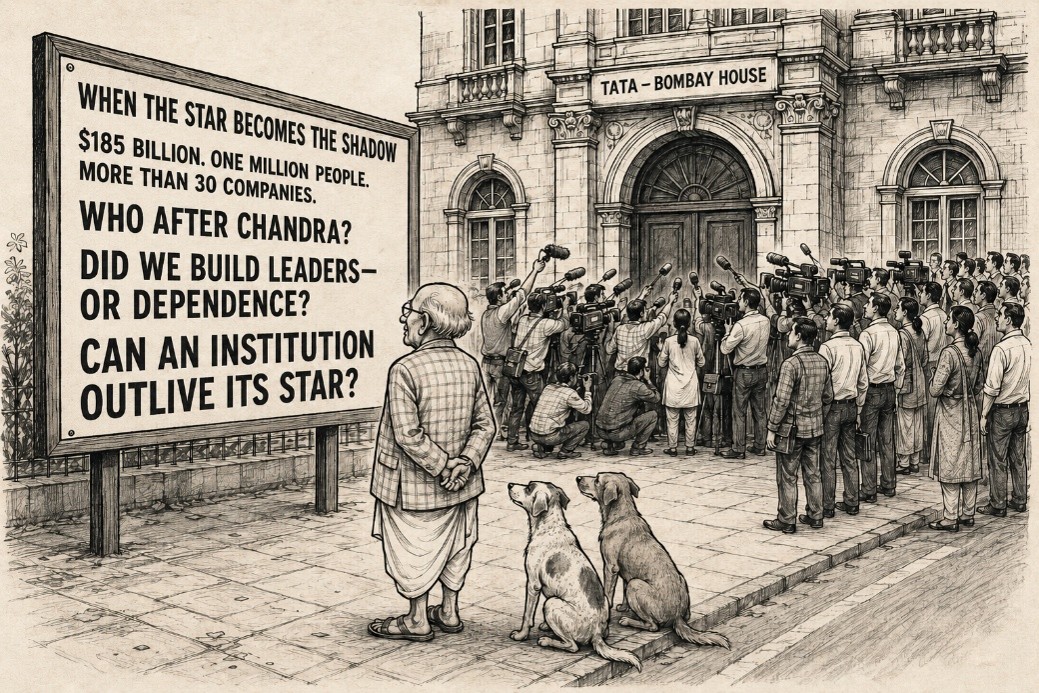
The Tata Group comprises more than 30 companies, including 26 listed entities. Its businesses extend from software, steel and automobiles to hotels, aviation, electronics and semiconductors. It employs more than a million people and reported aggregate revenue of approximately $185 billion in 2025–26.
How can an institution possessing such extraordinary managerial depth suddenly appear uncertain about who should lead it next?
Where are the leaders developed across decades? Why are several credible successors not already visible? And why does the departure of one individual create anxiety across an empire containing some of India’s finest companies?
This is not a judgment on Chandra, whose present term continues until February 2027. Nor is it an invitation to speculate about reported differences within Tata Sons and Tata Trusts.
The more unsettling question is one every corporate board must ask:
If your most successful leader disappeared tomorrow, would the institution continue—or would everyone merely begin searching for another version of him?
The Star Performer Effect
A successful leader initially strengthens an organisation.
He establishes direction, restores confidence, resolves difficult problems and becomes the face of the institution. Boards trust him. Investors associate performance with him. Employees begin looking upward for every important decision.
Gradually, however, admiration can become dependence.
The organisation stops asking, “What system made this performance possible?” and begins believing, “Only this individual can make it happen.”
The stronger the star shines, the harder it becomes to see the people around him. Capable executives remain within the organisation, but few are allowed to acquire comparable visibility, authority or institutional legitimacy.
Who will challenge the leader’s thinking? Who will risk appearing ambitious? Which board will reduce dependence on a leader who is delivering exceptional results?
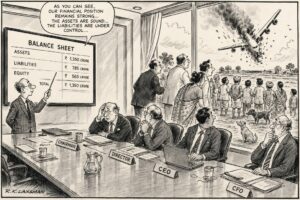
Eventually, the leader’s greatest strength can become the institution’s greatest vulnerability.
The more indispensable a leader becomes, the less prepared the institution may become to replace him.
Edward de Bono explained how the mind becomes locked into successful patterns. Once an approach has worked repeatedly, we stop searching for alternatives. Success itself becomes a trap.
Boards can fall into precisely this pattern. Instead of continuously developing several possible leaders, they extend the tenure of the existing one—until succession changes from a planned process into an organisational emergency.
What Happened to the Tata Leadership Factory?
Tata recognised this challenge much earlier than most Indian companies.
J.R.D. Tata established the Tata Administrative Service in 1956 as the group’s flagship leadership programme, exposing promising managers to different industries, responsibilities and companies across the Tata universe.
It was an exceptional idea: create not merely managers for individual businesses, but a continuing cadre of leaders capable of serving the entire group.
TAS has undoubtedly produced many respected executives. But Tata’s Leadership Experiment, by Bharat Wakhlu, Mukund Rajan and Sonu Bhasin, offers an important qualification: relatively few TAS officers acquired sufficient influence at the Group Centre. The group’s unity and direction continued to depend heavily upon the personalities of J.R.D. Tata and later Ratan Tata.
That observation deserves attention today.
Tata does not lack managerial talent. It has accomplished leaders running TCS, Tata Steel, Tata Motors, Titan, Indian Hotels, Tata Consumer and several other substantial enterprises.
But leading one company is different from commanding legitimacy across listed businesses, Tata Sons, Tata Trusts, institutional shareholders and industries with little in common.
The question is therefore not merely: “Where are the leaders?”
It is: “Why were several possible successors not made visible, tested and credible before the vacancy appeared?”
A leadership programme succeeds not when it produces hundreds of excellent managers, but when the institution can face its most important succession without appearing to search the horizon.
Succession Is Capital Protection
Boards frequently treat succession as a confidential list maintained by human resources. Names are placed in boxes, the presentation is noted and everyone moves to the next agenda item.
The economic consequences suggest that succession deserves much greater seriousness. Succession is not administrative housekeeping. It is capital protection.
A board that approves a twenty-year investment but has no credible leadership plan beyond the next two years has not understood risk management.
For Tata, the question is not whether talent exists. It is whether the board has given several leaders the breadth, visibility and legitimacy to lead the whole group—and whether it will permit the successor to be different.
The Final Test
We measure leaders by what they build—profits, market value, acquisitions completed and crises overcome.
Perhaps we should add one final measure:
How strong was the institution the day after they left?
A truly great leader distributes authority, encourages alternative voices and ensures that several people become capable of succeeding him. A responsible board does not wait for a resignation, retirement, illness or internal disagreement before discovering the urgency of succession.
The final achievement of leadership is not indispensability. It is continuity.
And that leaves the Tata board—and every board—with one unavoidable question:
Will the board have the institution’s next leader ready—or will the search begin only after uncertainty, speculation and a prolonged media debate?
References: Tata Group and Chandrasekaran transition reporting, Reuters; Tata Administrative Service, Tata Group; Tata’s Leadership Experiment, Bharat Wakhlu, Mukund Rajan and Sonu Bhasin; The High Cost of Poor Succession Planning, Harvard Business Review.

 Business and Economy
  Education
  Food
Food  Government
  Lifestyle
  Politics
  Travel
  World
World