
A strong growth rate deserves celebration. But when its calculation is questioned, Parliament must replace political argument with transparent explanation.
India’s first-quarter GDP growth of 7.8% should have been a moment of genuine national satisfaction. At a time of global uncertainty, expensive oil and unsettled trade, a strong Indian economy is something every citizen should welcome.
The Government celebrated it. Much of the media became enthusiastic. The Opposition questioned it. Economists began debating the calculation.
Within hours, an important economic announcement became another political contest.
That is unfortunate.
Having watched governments, markets and economic cycles for over five decades, I have learned that the credibility of a number does not depend on how loudly it is celebrated. It depends on how calmly and confidently it can be explained.
The controversy arose because the GDP estimate for the corresponding quarter of the previous year had been substantially revised under the new series. Since growth is calculated by comparing today’s economy with last year’s, critics asked whether lowering the earlier base had made the latest growth appear stronger.
The Government explained that the comparison was misleading. The GDP base year had changed from 2011–12 to 2022–23. New GST and administrative data had been introduced. The Producer Price Index had replaced some older wholesale-price measures. Agriculture and manufacturing were now being measured using double deflation, separately adjusting the prices of output and inputs.
These may all be perfectly legitimate improvements. Indeed, an economy transformed by digital business, GST, online commerce and new services cannot continue to be measured indefinitely through the structure of 2011–12.
But this is not easy for the ordinary citizen to understand.
When a previous figure changes sharply and the new growth rate turns out to be surprisingly high, questions are inevitable. Questions do not prove manipulation. But they cannot be answered merely by dismissing the critics or issuing technical FAQs after the controversy has erupted.
This should have gone to Parliament.
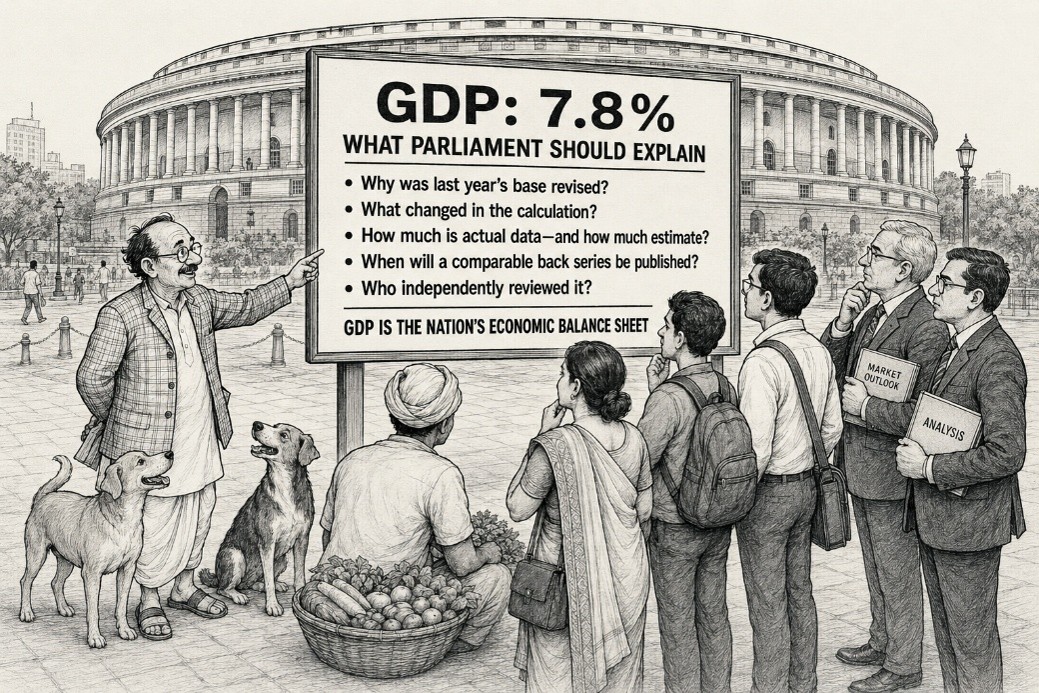
The Government should have placed before Parliament a complete explanation: why the previous year’s figures changed, what the new methodology altered, how much of the estimate came from actual data and how much from assumptions, whether industrial production, employment, consumption, investment and corporate performance supported the result, and when a comparable historical series would be published.
The appropriate Parliamentary Committee could have heard the Ministry of Statistics, the RBI, members of the technical advisory committee and independent economists.
Its task would not be to declare whether the Government was right or the Opposition was wrong. It would be to establish whether the methodology was internationally accepted, consistently applied, independently reviewed and adequately disclosed.
Other countries revise GDP figures regularly. The United States openly calls its first number an “advance estimate” and follows it with second and third estimates. It explains what information was incomplete and publishes the normal scale of revisions. Britain publishes detailed methodology reports and allows its statistical regulator and parliamentary committees to scrutinise important data concerns.
India itself faced a similar argument when the GDP base year was changed in 2015. Growth for some earlier years altered considerably, and competing back-series calculations soon became a political contest between governments. We should have learned from that experience.
Changing methodology is not the problem. Improving it is necessary. The problem begins when a major change arrives without a simple bridge explaining how the old number became the new one.
GDP influences the Budget, borrowing, interest rates, investment decisions, sovereign assessments and our standing in the world. It also tells citizens whether the progress they hear about is visible in production, employment and incomes.
The Government may be entirely right about the 7.8%. If so, transparent parliamentary scrutiny would strengthen the achievement—not diminish it.
A national economic number should not require political faith. It should command public confidence.
GDP is not the Government’s number or the Opposition’s number. It is the nation’s economic balance sheet. Parliament should ensure that every citizen can trust it.


 Business and Economy
  Education
  Food
Food  Government
  Lifestyle
  Politics
  Travel
  World
World