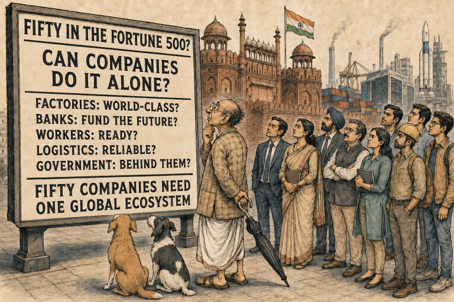

The Prime Minister has set the target. Can Indian companies reach it alone—or will India build the ecosystem they need?
By Ravishankar Kalyanasundaram
From the ramparts of the Red Fort, Prime Minister Narendra Modi asked why India should not have 50 companies in the Fortune 500 within the next decade.
It is an inspiring ambition. But can we achieve it?
Is it simply a matter of asking Indian companies to grow larger? Can acquisitions and domestic sales take them there? What can we learn from the winners and losers of the Fortune list? Why did companies that once appeared invincible disappear? What did the newcomers do differently? And can companies build global businesses without the support of government, banks, infrastructure and skilled workers?
These questions must be answered before the target can become a blueprint.
WHAT DOES THE TARGET REALLY MEAN?
The Fortune Global 500 ranks the world’s largest companies by revenue. Its 2026 members together generated $43.1 trillion and employed 70.2 million people.
Entry is not a reward for reputation, market value or national importance. It requires enormous and sustained revenue.
India will therefore need more than a few large conglomerates becoming larger. It must create a broad generation of companies that can sell internationally,
acquire customers across markets and remain competitive through economic, technological and geopolitical change.
Reaching the list is difficult. Remaining there is even harder.
WHY DID YESTERDAY’S CHAMPIONS FALL?
More than 1,800 companies have appeared in the American Fortune 500 since 1955. By its 70th anniversary, only 49 had appeared every year.
Many that disappeared once looked invincible.
Kodak dominated photography. Nokia and BlackBerry ruled mobile communication. Intel was at the centre of the computing revolution. They possessed famous brands, formidable technology, talented managers and strong balance sheets.
But yesterday’s balance sheet can become tomorrow’s blindfold.
Kodak invented the digital camera but remained attached to film. Nokia and BlackBerry saw the smartphone emerging but underestimated how quickly the telephone would become a software platform. Intel remains a major company but lost its unquestioned leadership as computing moved towards mobile devices, specialised chips and artificial intelligence.
These companies did not necessarily fail to see the future. They became comfortable defending the businesses that had created their success.
They failed to disturb the present—and became victims of it.
WHAT DID THE NEWCOMERS DO DIFFERENTLY?
The new winners did not merely improve existing products. They redefined the businesses they were in.
Amazon moved beyond books to create a marketplace, logistics network and cloud-computing platform. Walmart reinvented retail through technology and supply-chain mastery. Tesla treated the automobile as software, batteries and energy. SpaceX changed the economics of space through reusable rockets.
Nvidia converted a graphics chip into an artificial-intelligence ecosystem. It is now working with leading global financial institutions to mobilise more than $500 billion for AI infrastructure.
The fallen lived in the comfort of what they had already built. The winners were prepared to disrupt their products, structures and profits.
They did not inherit the future. They invented it.
That is the first lesson for India Inc. Size may provide entry. Only continuous reinvention can provide endurance.
CAN COMPANIES DO IT ALONE?
No global company succeeds entirely inside its own compound.
A product carries its country with it: the quality of the factory, reliability of power, speed of logistics, efficiency of ports, availability of finance, skills of workers, credibility of regulation and diplomatic strength of the government.
India has much to catch up—not only inside companies, but around them.
Government programmes, banking policies, infrastructure projects and skill missions cannot operate as separate islands. They must work as one industrial system built around the needs of international markets.
Two examples reveal the gaps.
QUALITY CANNOT BEGIN AT THE PORT
India’s pharmaceutical industry supplies medicines across the world and is central to global healthcare. Yet WHO alerts involving contaminated oral medicines and repeated US FDA warnings about manufacturing practices weaken trust in the words “Made in India.”
Quality cannot become important only when an export consignment is ready to leave the port. It must begin with the raw material, laboratory, machine, records and attitude of every person on the factory floor.
Nor can there be one standard for regulated export markets and another for Indian customers.
A certificate may permit a product to leave the factory. Only reliability makes the customer return.
The benchmark must move from local compliance to global acceptance.
GLOBAL INVESTMENT NEEDS NATIONAL SUPPORT
Tata Motors’ purchase of Jaguar Land Rover offers another lesson.
JLR operated in Britain, employed British workers, sustained a British supply chain and paid taxes to the British government. Yet when the global financial crisis pushed it into a funding squeeze, the credit support it sought in Britain did not become available on workable terms.
JLR had to turn to India. State Bank of India stepped forward with a £175 million loan, alongside Bank of Baroda and other banks, helping protect an overseas investment that later became a global success.
Indian companies entering international markets cannot be expected to fight every institutional battle alone.
India’s diplomatic and financial strength must travel with them. Free-trade and investment agreements must go beyond tariffs to ensure non-discriminatory treatment, fair market access, investment protection and effective dispute resolution.
This is not about rescuing commercial mistakes. It is about supporting credible Indian ambition.
WHAT MUST THE BLUEPRINT CONTAIN?
First, the factory floor must meet international standards in cost, quality and reliability. Domestic customers must receive the same quality promised abroad.
Second, boards must look beyond current profits. They must invest in research, cybersecurity, technology and businesses that may eventually replace today’s successful products.
Third, infrastructure must become predictable. India’s improvement to 38th among 139 countries in the World Bank’s 2023 Logistics Performance Index is encouraging—but it is not the finishing line for a country seeking fifty global champions.
Fourth, workers must move with technology. Reskilling cannot remain an occasional government programme or an HR presentation. It must become a continuing partnership among companies, training institutions and workers.
Fifth, banks must learn to finance the future. New businesses are built increasingly on intellectual property, software, research, data and specialist talent—not merely land and buildings. Banks must distinguish innovation risk from poor governance without abandoning prudence.
Finally, government must provide predictable policy, faster dispute resolution, international market access and diplomatic support for Indian investments abroad.
THE REAL FORTUNE 500 TEST
The Prime Minister’s target is not merely for chief executives. It is a national operating test.
Can our factories match the world’s best? Can Indian quality win global trust? Can logistics deliver predictably? Can workers be reskilled before technology displaces them? Can banks finance capability rather than only collateral? Can government and diplomacy stand behind Indian companies internationally?
Fifty companies cannot be manufactured through fifty corporate plans. They will emerge only when companies, government, banks, workers and national infrastructure operate as one globally competitive system.
Entry into the Fortune Global 500 will then be a consequence—not a strategy.
India has the ambition, talent and market. But the honest place to begin is not with the fiftieth company on a future list.
It is with the first machine, the first worker, the first loan and the first customer of today.
POSTING NOTE
FIFTY IN THE FORTUNE 500? THE TARGET IS INDIA’S. THE TEST IS NOT INDIA INC.’S ALONE.
From the Red Fort, Prime Minister Narendra Modi asked why India should not have 50 companies in the Fortune 500 within the next decade.
It is a powerful ambition. But can companies achieve it alone?
The history of the Fortune list offers a warning. Kodak, Nokia and BlackBerry once appeared invincible. They had technology, talent and strong balance sheets. Yet yesterday’s balance sheet became tomorrow’s blindfold.
The new winners thought beyond their comfort zones. Amazon, Nvidia, Tesla and SpaceX challenged legacy business models, created new markets and invented the future.
For us in India, however, corporate ambition is only one part of the answer.
Can our factories meet global standards? Can banks finance tomorrow’s capabilities rather than yesterday’s collateral? Can workers be reskilled before technology overtakes them? Can logistics deliver predictably? Will government diplomacy and trade agreements protect Indian investments abroad?
Fifty companies cannot be created through fifty isolated corporate plans.
They will emerge only when companies, government, banks, workers and infrastructure operate as one globally competitive ecosystem.
My new article asks what it will really take to turn the Red Fort ambition into an achievable national blueprint.
I invite your views—and a deeper conversation.


 Business and Economy
  Education
  Food
Food  Government
  Lifestyle
  Politics
  Travel
  World
World