India has strengthened its immediate currency defence through an extraordinary mobilisation of foreign-currency funds. But borrowed dollars provide only time. India must use that time to build factories, replace imports and create exports.
By Ravishankar Kalyanasundaram
Brent crude has moved towards $109 a barrel, while the rupee has again weakened beyond ₹95 to the dollar. The RBI reportedly sold between $8 billion and $15 billion in one week while supporting the currency, and has subsequently used foreign-exchange swaps to absorb surplus liquidity and discourage speculation against the rupee.
If intervention continued anywhere near that intensity for several weeks, a substantial part of the newly augmented foreign-currency resources could be consumed within months. India is not facing an immediate foreign-exchange crisis. But even formidable reserves cannot permanently overpower an economy’s recurring demand for dollars, particularly when crude oil remains above $100.
The RBI can borrow dollars and defend the currency temporarily. Only the economy can earn the dollars required for a durable defence. India must move from foreign-exchange management to foreign-exchange creation.
FROM TECHNOLOGY APPROVAL TO COMMERCIAL PRODUCTION
India should identify a limited number of major imported products—including electronic components, solar equipment, industrial machinery, speciality chemicals and battery materials—that can be manufactured locally within two or three years. Global technology leaders, including carefully selected Chinese companies, should be invited to establish production with Indian partners under appropriate security and ownership safeguards.
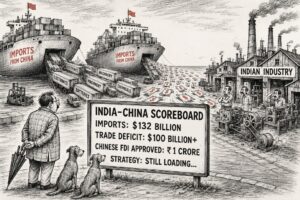
The objective should not be another collection of memoranda. Each partnership should lead quickly to a commissioned factory and commercial production. The test is straightforward: how soon will it manufacture, how much imported value will it replace, and can the product eventually be exported? India cannot buy extensively from China while closing the door to non-sensitive Chinese manufacturing and technology.
AGRICULTURE MUST BEGIN WITH THE GLOBAL BUYER
India is the world’s largest banana producer, harvesting many times Ecuador’s output. Yet Ecuador built an international banana-export economy while India exports only a small fraction of what it grows. The difference is not the fruit alone. It is Ecuador’s organisation of varieties, quality, packing, shipping and dependable access to foreign buyers.
The Netherlands provides a broader contrast. With a fraction of India’s land and population, it exported agricultural goods valued at approximately €129 billion in 2024. Its success rests on technology, protected cultivation, grading, cold chains, processing, ports and market access—and even trading and re-exporting produce grown elsewhere.
India should engage global traders, supermarket chains and food distributors with ready markets for food grains, fruits, vegetables and processed foods. Production should be organised backwards from confirmed demand. Export policy must remain dependable, while states align farmers, planting material, testing, cold storage and transport. Agricultural exports should become a continuing business rather than the disposal of an occasional surplus.
EDIBLE OIL IS A LARGE IMPORT THAT CAN BE REDUCED
India imported about 16.65 million tonnes of edible oil in FY2025–26. This vulnerability cannot be corrected by a central scheme operating independently of the states. Oilseed cultivation must be accelerated state by state, with suitable crops, assured procurement, better seeds and rural crushing and refining capacity.
Large businesses such as Tata, Birla, Wipro, Godrej and Reliance, together with established edible-oil companies, should build long-term farmer-to-market arrangements. Their procurement, brands and distribution can connect cultivation with rural processing and national demand. The target need not be immediate self-sufficiency, but a visible annual reduction in the import bill.
ELECTRIC MOBILITY IS ALSO CURRENCY DEFENCE
China’s electric-vehicle advance shows what coordinated execution can achieve. It now has around 23 million charging points, including home chargers. Electric vehicles accounted for roughly 65 per cent of new sales in July 2026 and are expected to displace about 1.2 million barrels a day of oil demand this year.
India has installed thousands of charging stations, but availability on paper is not enough. Earlier assessments found a disturbingly large share of public chargers non-functional. Motorists also encounter incompatible connectors, broken applications and uncertain maintenance. A charger that cannot be found or used does not support an electric vehicle.
India should rapidly build a dependable charging network across cities, highways and transport hubs, with uptime publicly measured. Oil companies, electricity distributors, fleet operators and states must participate. Battery manufacturing should advance through Chinese, Japanese, Korean and European partnerships. Electric buses, taxis and delivery fleets deserve priority because their intensive use can save the most fossil fuel.
MEASURE POLICY IN DOLLARS EARNED OR SAVED
India does not suffer from an absence of schemes. Manufacturing, agricultural exports, oilseeds, batteries and electric vehicles already have separate policies. What is missing is a single measure of whether they strengthen the external account. Every important programme should disclose the dollars it will earn through exports or save by replacing imports.
India’s FTAs have so far not contained its trade deficit. New agreements must therefore be monitored closely so that greater market access does not become another source of dollar leakage.
The present reserve augmentation has given India something extremely valuable: time. That time should not be spent merely designing the next method of borrowing foreign currency. It should be used to commission factories, secure technology, organise agricultural exports, produce oilseeds, manufacture batteries and reduce fossil-fuel dependence.
A currency does not become strong because its central bank defends a number on a trading screen. It becomes strong when the economy behind it produces more of what the country consumes and sells more of what the world wants.
The RBI has brought in the dollars. The government must now ensure that the economy begins earning—and conserving—them.
 Business and Economy
  Education
  Food
Food  Government
  Lifestyle
  Politics
  Travel
  World
World