
What cricket, corporate collapse and political power teach us about the danger of believing yesterday’s applause will protect tomorrow
By Ravishankar Kalyanasundaram
Indian cricket’s recent tours of Ireland and England should provoke questions deeper than who scored, who failed or who deserves to be dropped.
Several young players arrived carrying the glow of the IPL—lucrative contracts, spectacular sixes and instant celebrity. Yet unfamiliar pitches, moving deliveries, changing weather and disciplined bowling exposed a simple truth: reputation cannot negotiate with reality.
This is not an indictment of young talent. Vaibhav Sooryavanshi is only 15 and has already demonstrated extraordinary ability, including a magnificent 175 against England in the 2026 Under-19 World Cup final. One difficult tour cannot define his future.
The concern is the ecosystem surrounding such players.
The IPL discovers talent, rewards audacity and provides invaluable exposure. But celebrity can sometimes arrive before capability has been fully tested. High-scoring pitches, short boundaries and television spectacle can make one brilliant innings appear proof of complete mastery.
International cricket is less accommodating. A swinging ball does not know a player’s auction price. A damp Belfast morning is unimpressed by Instagram followers.
Sachin Tendulkar, Kapil Dev, Rahul Dravid, Virat Kohli and Rohit Sharma became great because their talent was repeatedly examined across countries and conditions. Failure revealed weaknesses; adversity demanded adaptation; reputation had to be earned again.
What is true of cricketers is even more true of companies.
The World Will Not Wait
Never has that lesson been more urgent.
Technology is arriving like a tsunami. Artificial intelligence, robotics and automation can overturn an established business model almost overnight. A distant conflict can abruptly disrupt a supply chain built over decades. Tariffs, currencies, sanctions, technology restrictions, market access and even critical minerals are increasingly being weaponised in the contest for global power.
Companies can no longer assume that yesterday’s markets will remain open, that the most efficient supplier will necessarily retain access to customers or that a geopolitical dispute elsewhere will not suddenly reach their factory gates.
Competitors may emerge not from the familiar road ahead, but silently in the rear-view mirror—smaller, faster and armed with a different technology or business model.
In such a world, yesterday’s market share, profits and brand reputation provide no permanent protection. Success becomes dangerous when it persuades an organisation that the road will continue unchanged—or that nobody is rapidly catching up.
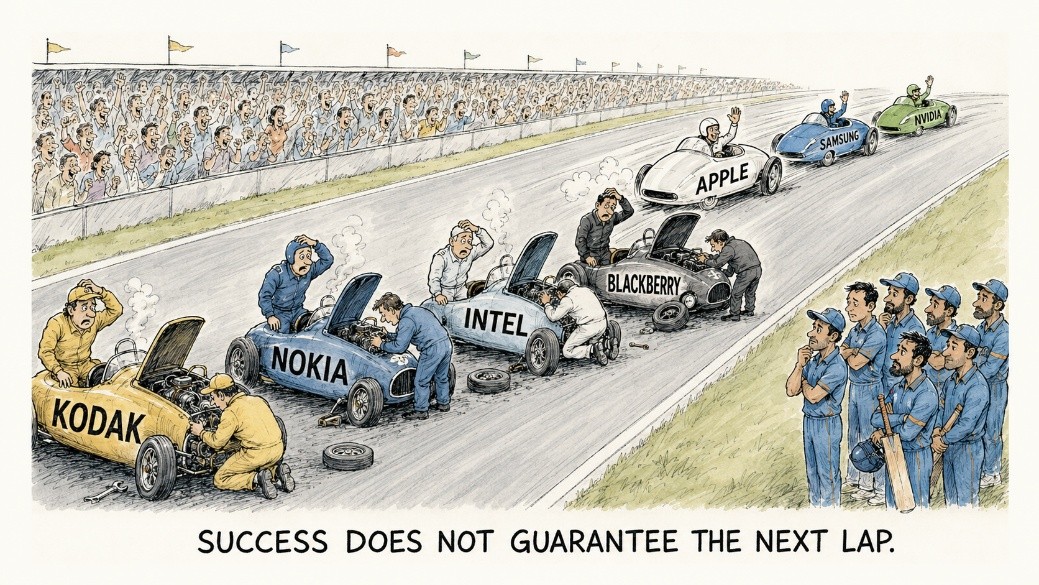
Kodak saw the digital future—and looked away. Nokia dominated mobile phones—but misunderstood what the phone was becoming. Intel once determined the speed of technological progress—before finding itself chasing it.
Kodak Saw the Future—and Looked Away
For much of the twentieth century, Kodak was photography. It controlled the camera, film, processing and the treasured family photograph. Its success appeared unassailable.
The great irony is that Kodak engineer Steven Sasson developed the first self-contained digital-camera prototype in 1975. Kodak did not fail because it could not see the future. It had helped invent it.
But digital photography threatened its immensely profitable film business. To embrace the future, Kodak would have had to disrupt itself. Management hesitated while existing revenues continued to provide reassurance.
The market did not wait.
Kodak’s annual revenue, once around $16 billion in the 1990s, had fallen to approximately $3.6 billion by 2011. In January 2012, it filed for bankruptcy protection.
Kodak possessed technology, talented scientists and one of the world’s most recognised brands. What it lacked was the willingness to damage yesterday’s successful business before somebody else destroyed it.
Success had become a prison.
Nokia’s Astonishing Descent
At the beginning of this century, Nokia was not merely a successful company. It was Finland’s national champion.
At its peak, Nokia accounted for approximately 4% of Finland’s GDP and 21% of its exports. Its market value exceeded €200 billion. Nokia appeared to own the mobile future.
Then the meaning of a mobile phone changed.
Apple and Android transformed the phone from a piece of hardware into an ecosystem connecting applications, developers, services and users. Nokia continued improving its devices while the market began demanding an entirely different experience.
Its shares, which reached €65 in 2000, fell to approximately €1.33 in July 2012—a collapse of nearly 98%. The following year, Microsoft agreed to acquire Nokia’s handset business for €5.44 billion.
A company that had defined the mobile age discovered that the mobile age had moved beyond it.
The fall was astonishingly fast. Market leadership, distribution, engineering strength and customer familiarity could not compensate for misunderstanding a fundamental change.
Intel: From Setting the Pace to Chasing It
Intel once stood at the heart of the global technology revolution. “Intel Inside” represented extraordinary leadership in computing.
But dominance in personal computers did not automatically produce leadership in smartphones, advanced chip manufacturing or artificial intelligence. ARM-based processors came to dominate mobile devices. TSMC established itself at the centre of advanced-chip manufacturing. Nvidia seized the AI opportunity.
Intel did not stop innovating. But manufacturing delays and missed transitions imposed a heavy price. Its revenue declined from approximately $79 billion in 2021 to $53 billion in 2024—a fall of one-third in just three years. It recorded a net loss of $18.8 billion and was removed from the Dow Jones Industrial Average, replaced by Nvidia.
The symbolism was unmistakable. The company that had once helped define the computing revolution was displaced in the world’s best-known share index by the company defining the AI revolution.
Kodak, Nokia and Intel did not lack intelligence, capital or talented people. They suffered from something more subtle: the belief that the capabilities responsible for yesterday’s success would remain sufficient tomorrow.
When Political Victory Becomes Political Deafness
The same danger confronts political parties.
In December 2019, Britain’s Conservative Party won 365 parliamentary seats and an 80-seat majority. It had broken through Labour’s traditional strongholds and appeared politically dominant.
Only five years later, it won just 121 seats—its worst result since the party’s formation in the nineteenth century. Fourteen years in government ended in a defeat of historic proportions.
How could political dominance disappear so quickly?
Repeated victories can cause leaders to confuse electoral success with permanent public approval. Party workers become reluctant to carry unwelcome messages upward. Internal critics are treated as disloyal. Policy errors are defended because admitting them appears weak. Citizens continue speaking, but those in power gradually lose the ability to hear them.
The warning applies to every political party, ideology and democracy.
A victory confirms only that a party understood the electorate at a particular moment. It does not mean society has stopped changing.
Young voters emerge. Economic anxieties shift. Regional aspirations gather force. Technology transforms communication. When employment opportunities fail to keep pace with the rising expectations of millions of young people, disappointment can quickly become social and political anger.
Social media intensifies this tension. It displays wealth, achievement and celebrity instantly, creating expectations of rapid success in a world where genuine capability still requires years of learning, discipline and failure.
The marketplace removes companies that stop listening. Democracy removes governments.
The Most Important Boardroom Question
When revenues are rising, share prices are climbing and praise surrounds management, directors can become ceremonial admirers of success. Yet that is precisely when they must become most questioning.
Is our most profitable product preventing investment in its successor? Is technology changing the basis of competition? Are new entrants serving customers we have ignored? Is geopolitical risk threatening our supply chain? Does the information reaching the board describe reality—or merely protect the comfort of leadership?
Companies must expose themselves to difficult conditions before the market does it for them. Boards must encourage dissent, test assumptions and invest in tomorrow even when doing so threatens today’s profits.
The rear-view mirror is not for admiring the distance already travelled. It is for noticing what may be rapidly catching up.
Cricketing talent must be tested away from friendly pitches. Corporate strategy must be tested away from favourable assumptions. Political leadership must be tested away from applause.
Failure forces us to ask questions. Success frequently persuades us that questions are no longer necessary.
Success is not a permanent address. It is only a temporary confirmation that yesterday’s decisions worked. The moment we begin worshipping it, protecting it or believing it has made us invincible, success quietly changes sides.
It ceases to be our achievement—and becomes our enemy.
 Business and Economy
  Education
  Food
Food  Government
  Lifestyle
  Politics
  Travel
  World
World