
The Prime Minister has promised fast-track courts. But after years of delayed trials, weak prosecutions and negligible convictions, why should students believe that justice will be different this time?
By Ravishankar Kalyanasundaram
Prime Minister Narendra Modi has now promised fast-track courts to ensure swift trials and stringent punishment for those involved in examination paper leaks.
But does he really believe that students and their parents still trust such promises?
Does adding the label “fast-track” to a court suddenly make justice certain?
The record should cause anger, not reassurance.
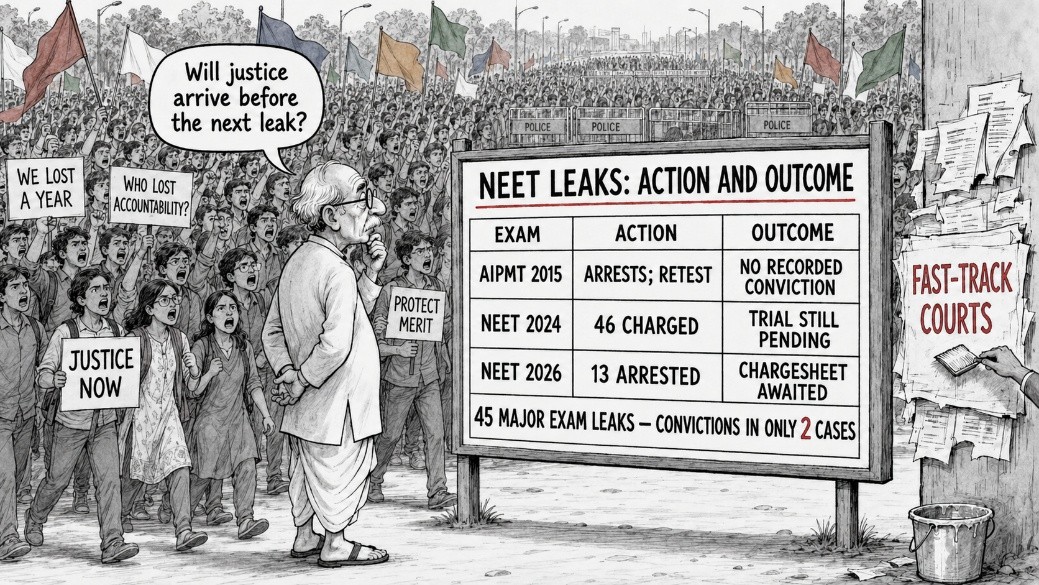
An investigation by The Indian Express into 45 major examination leaks over two decades found at least 1,658 arrests and 925 charge sheets. Yet convictions were secured in only two cases.
The NEET-UG 2024 trial remains pending. The 2026 investigation is still at the stage of arrests and an impending first charge sheet.
Arrests receive publicity. Ministers promise exemplary punishment. Committees are appointed. But trials drag on, evidence weakens, accused persons obtain bail and public attention moves elsewhere.
Then another paper leaks.
How many times must India’s students be asked to believe the same assurance?
The NEET crisis did not erupt yesterday. The Government has had two years since the 2024 leak—and ample warning from earlier examination scandals—to dismantle these networks, prosecute those responsible and create a genuinely fail-safe examination system.
Why was that not done?
What we are witnessing today is not a lone case or an accidental slip-up. Investigations reportedly point towards teachers, coaching-centre operators, middlemen and even individuals associated with the examination process.
The very people expected to protect the integrity of the examination are under suspicion of compromising it.
What greater warning did the Government require?
More than 22 lakh students were affected in 2026. The examination was cancelled and a retest conducted. Students lost months of preparation. Parents bore additional expenses. Families were pushed through anxiety and uncertainty.
A retest may replace a question paper. It cannot return a student’s lost time, confidence or peace of mind.
Why, then, did the Prime Minister and his Cabinet allow the anger to grow this big?
Why did the Government wait until students occupied the streets, political parties joined them and Parliament was disrupted?
The pattern is disturbingly familiar. During the farmers’ agitation too, genuine grievances were allowed to accumulate. Protesters were viewed as people to be contained rather than citizens to be heard. Engagement came only after mistrust had hardened into a national confrontation.
Is the Government repeating the same mistake?
A strong government does not become weak by admitting failure. It becomes credible by acknowledging pain and correcting mistakes before citizens are forced onto the streets.
But when political vanity makes every criticism appear hostile, governments lose their ability to listen. Every protest becomes an inconvenience. Every question is dismissed as politics. Every demand for accountability is treated as an attack.
The Prime Minister may promise fast-track courts. But courts can decide only the cases placed before them. What confidence can people have when investigations are delayed, evidence is inadequate and prosecutions continue for years without visible consequences?
A fast-track court cannot repair a weak investigation. Nor can it compensate for years of administrative complacency.
The issue is no longer merely who leaked a paper.
It is who allowed a national examination system to remain repeatedly vulnerable—and why those responsible for protecting it have faced so little accountability.
The political consequences are already visible. Governments such as Tamil Nadu can now argue:
“This is precisely why we want NEET scrapped. This is why education must return to the State List.”
Whether one agrees with that demand or not, the Central Government has strengthened it through its own failures. NEET was defended as a national guarantee of uniformity, merit and fairness. When its integrity is repeatedly compromised, the moral case for centralisation begins to collapse.
This is not Tamil Nadu winning political brownie points.
It is the Union Government losing face.
Governments rarely lose mandates because of one scandal. They lose them when students, farmers, jobseekers and ordinary families reach the same conclusion: that the Government does not listen until their pain becomes politically dangerous.
If vanity continues to replace accountability and indifference continues to answer injustice, NEET will not be the only reason this Government may lose the mandate.
It will merely be the clearest evidence that the Government has lost the plot.

 Business and Economy
  Education
  Food
Food  Government
  Lifestyle
  Politics
  Travel
  World
World