
Politics, business or cricket – the danger is the same
By Ravishankar Kalyanasundaram
Success is wonderful. But it is also a dangerous teacher.
It tells us that our decisions were right, our strategy worked and people believed in us. Repeated success, however, can slowly create another belief: that we cannot lose.
That is when confidence becomes complacency. Criticism begins to irritate us. Bad news is dismissed. People around us become reluctant to speak uncomfortable truths.
Is this danger now confronting the BJP Government in its third consecutive term?
The Government has much to its credit—political stability, infrastructure, digital public services, welfare delivery and a stronger global presence for India. Winning three successive national elections is a remarkable achievement.
But has this very success made the Government less willing to listen?
When Problems Are Allowed to Grow
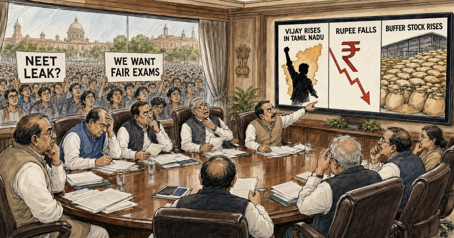
NEET showed how an administrative failure, when met with complacency, can become a national crisis—damaging the Government’s credibility, attracting adverse international coverage and handing the Opposition valuable political ammunition. It also allowed State Governments that had warned against excessive centralisation of entrance examinations to say, with some justification: “We told you so.”
Announced with great fanfare, the Bullet Train’s repeated delays have now invited criticism even from a former Japanese minister—making the gap between announcement and execution internationally visible. See what complacency can do.
Painfully slow agricultural-infrastructure development is another warning. India loses an estimated ₹1.53 lakh crore annually through post-harvest losses across crops and allied produce; in Punjab alone, around 14 million tonnes of rice was occupying depots in early 2026 while another 6.2 million tonnes awaited delivery. Production has grown faster than storage and movement.
The rupee remains under considerable pressure despite India’s substantial foreign-exchange reserves. Oil prices and geopolitical tensions matter greatly, but becoming the world’s fourth-largest economy does not automatically make us economically secure.
These are different problems, and not every failure can be blamed on one Government. But together they raise a fair question: has repeated electoral success weakened institutional self-examination?
Business Has Seen This Before
Complacency is not unique to politics or governance. Corporate history is full of once-invincible companies that became prisoners of their own success—and paid heavily for ignoring change.
Kodak dominated photography—and even invented an early digital camera—but protected its profitable film business until digital photography destroyed it. Nokia ruled mobile phones but failed to understand that the phone was becoming an ecosystem of applications. BlackBerry believed its corporate customers and keyboard would remain loyal forever. Intel’s dominance in personal computers did not prepare it sufficiently for smartphones, advanced chip manufacturing and artificial intelligence.
None of these companies lacked money, technology or talented people. Their success simply made the warning signs easier to ignore.
Cricket Is No Different
How else can we explain Ireland’s first-ever series victory over India—a humiliating 2–0 defeat for the reigning T20 world champions—except as a warning that complacency had set in?
IPL success, enormous contracts and instant celebrity may have created a sense of invincibility. But a hungrier and less celebrated Irish team exposed the difference between reputation and readiness.
A swinging ball in Belfast does not know a player’s auction price.
When Success Changes Sides
Politics, business and cricket may appear to have little in common. But the danger is the same.
Success can make institutions stop listening.
It can persuade political leaders that electoral victory is permanent approval. It can persuade companies that customers will never leave. It can persuade cricketers that celebrity is capability.
The crisis that eventually defeats a successful institution is rarely invisible. The warning signs are usually there—but yesterday’s victories make them easier to dismiss.
The BJP’s third term should therefore become its most self-questioning term. A confident Government should not fear criticism. It should actively search for uncomfortable truths.
Success is not a permanent address. It is only temporary confirmation that yesterday’s decisions worked. The moment we begin believing that success has made us invincible, it quietly changes sides.
It ceases to be our achievement—and becomes our enemy.

 Business and Economy
  Education
  Food
Food  Government
  Lifestyle
  Politics
  Travel
  World
World