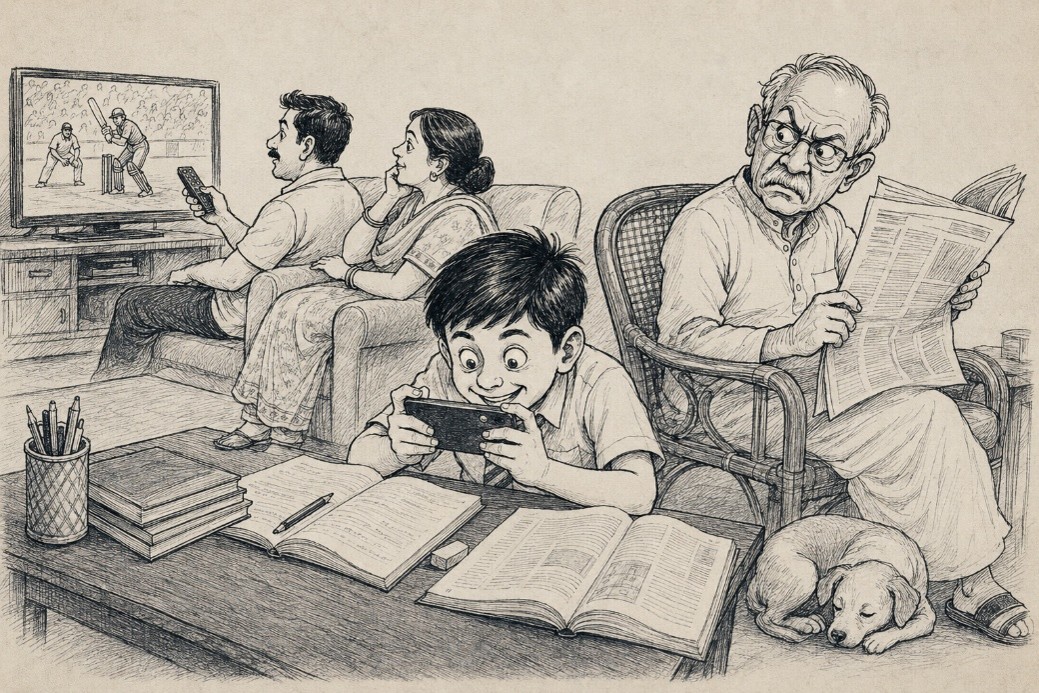

Are screens quietly stealing our children’s capacity to concentrate?
By Ravishankar Kalyanasundaram
A recent nationwide study by the National Council of CBSE Schools produced deeply worrying findings. It reported that 74% of participating students spent more than two hours every day on screens for non-academic purposes, while 21% spent over four hours. More troublingly, 69% of teachers observed declining concentration and classroom attention. Teachers also reported anxiety, irritability and reduced outdoor activity among children. The study reportedly drew 6.3 lakh responses from across India, according to The Times of India.
Who bears responsibility when the commercial objective of “engagement” begins to damage a child’s capacity to engage with real life?
Have we responded adequately to this growing danger? Some countries have begun to act. Australia requires major platforms to prevent children below 16 from holding social-media accounts. Indonesia has restricted access to major platforms for children under 16, while France has approved a prohibition for those below 15. Spain, Greece and several other European countries are considering similar protections.
These measures may be difficult to enforce and will invite debate over privacy and digital freedom. Yet they recognise one essential truth: childhood cannot be left entirely to the commercial judgment of technology companies. India, however, is yet to respond.
UNESCO reports that by March 2026, 114 education systems—58% of those it tracks worldwide—had national restrictions on mobile phones in schools. It argues that smartphones should be allowed in classrooms only when they clearly support learning.
This is no longer merely a family complaint. It is becoming an educational and public-health problem.
“My child can spend four hours on a mobile phone but cannot study for twenty minutes.”
How many Indian parents have said this in frustration? How many teachers now struggle to hold a classroom’s attention without animation, videos and continuous activity?
We often blame children for lacking discipline. But are they entirely responsible? A book requires patience and effort, while a phone offers a new reel, game or message every few seconds. Children may still concentrate for hours on a screen; what they are losing is the slower, sustained attention needed to read, reason and learn. That is the real danger.
The damage is not confined to the hours spent online. Screens increasingly accompany children to the dining table, the school bus and even the bed. Late-night scrolling reduces sleep, and a tired child naturally struggles to listen, remember and learn the next morning. Notifications interrupt homework, while the mere presence of a phone creates the temptation to check it.
More importantly, every additional hour on a screen may replace something essential: outdoor play, conversation, boredom, imagination or uninterrupted reading. These ordinary childhood experiences help build patience, language, emotional balance and social confidence.
We proudly speak of Digital India and technology-enabled education. But digital access without digital discipline can become another form of deprivation. A child surrounded by information may still lose the ability to think deeply. Are we creating a generation that can find every answer within seconds—but cannot remain with a difficult question long enough to understand it?
WHO-backed research found that the proportion of adolescents displaying problematic social-media behaviour increased from 7% in 2018 to 11% in 2022. These young people struggled to control their use, experienced withdrawal-like feelings, neglected other activities and continued despite negative consequences.
India needs more than parental advice. Schools should introduce phone-free hours and give greater space to reading, sport and conversation. Governments must enforce credible age limits and regulate addictive digital features aimed at children. Parents must also lead by example by making dining tables and bedrooms screen-free.
We regulate food, medicines and toys to protect children. Why not the digital products occupying their minds for hours every day?
The greatest victims of the battle for attention are not consumers.
They are our children.




 Business and Economy
  Education
  Food
Food  Government
  Lifestyle
  Politics
  Travel
  World
World