
In international politics, wars rarely begin with explosions. They begin with certainty.
By Ravishankar Kalyanasundaram
The moment a nation convinces itself that it already knows the answer, dialogue becomes an inconvenience and institutions become obstacles. What follows is then described not as conflict, but as necessity.
Today the world again hears the language of regime change in Iran, and even casual discussions about eliminating a head of state or a spiritual leader. The words are spoken in television studios and policy briefings with disturbing calmness, as though the targeted removal of governments is an accepted instrument of modern diplomacy. It is presented as strategy, deterrence, even moral responsibility.
But history is uncomfortable company for such confidence.
Twenty-two years ago, the United States led a coalition into Iraq with near total support from much of the Western world. The claim was clear and repeated endlessly: Saddam Hussein possessed weapons of mass destruction. Governments endorsed it, intelligence was cited as conclusive, and public opinion was persuaded that a pre-emptive strike was necessary for global safety. A head of state was captured, tried and executed. Only later did the central claim collapse. The weapons did not exist. What remained instead was a fractured society, sectarian violence, millions displaced, and a region destabilised for decades. The war ended a regime, but it did not produce order.
Vietnam earlier had taught the same lesson at a terrible human cost. Afghanistan repeated it again, after twenty years of intervention that concluded almost exactly where it began. The Soviet Union had learnt it there before. Military power demonstrated capacity, but not resolution. Governments were removed, cities destroyed, but the political problems survived every bombardment.
Yet the world seems to approach each new crisis as though history were a set of unrelated incidents rather than a pattern.
The idea of killing leaders to produce stability rests on a comforting illusion — that states are machines and replacing the operator fixes the malfunction. Nations, however, are societies, memories and grievances layered across generations. Removing a leader rarely removes the anger that created him. Often it multiplies it.
It was precisely to prevent such spirals that the United Nations was formed after the Second World War. Humanity had witnessed two global catastrophes born from unilateral calculations and alliances acting without collective restraint. The UN was meant to slow down decisions, to force nations to argue before they fought, and to make legitimacy a shared process rather than a national declaration. Dialogue was not a weakness; it was a deliberate pause inserted into human impulsiveness.
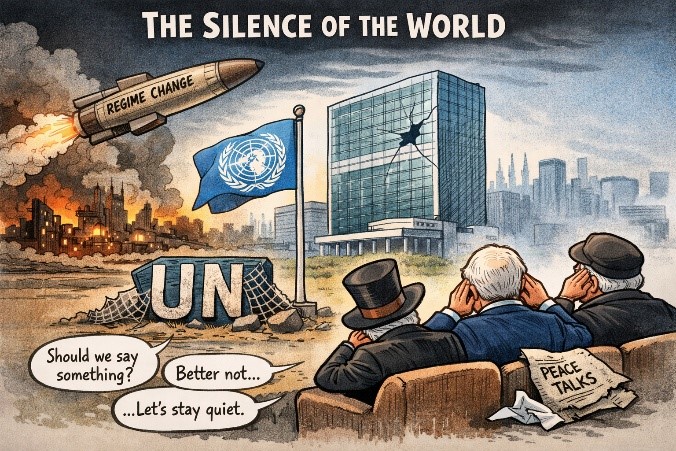
Today that pause is increasingly bypassed.
Major military decisions are discussed outside the UN framework and later justified rather than debated. International opinion is consulted selectively, not collectively. The world is informed, not involved. The institution created to prevent escalation is treated as a formality once escalation has already begun.
Even more troubling is the silence of many global leaders. Some remain quiet out of strategic dependence, some out of domestic political calculations, and others out of the fear of choosing the wrong side. But silence in moments of escalation is not neutrality; it is permission. When powerful nations act alone and others simply adjust themselves to the consequences, the rules-based order becomes a phrase without content.
The moral difficulty is not whether Iran, Iraq, Afghanistan, or any state has internal problems. Every nation does. The question is who decides the remedy and by what authority. If individual countries reserve the right to remove governments they distrust, then the principle applies to all countries, not merely a few. A world where regime change becomes an acceptable policy tool is not a stable order; it is permanent insecurity.
There is also a deeper contradiction. The same nations that speak of sovereignty in trade, technology and borders often suspend sovereignty when confronting adversaries. The language of international law becomes conditional. Yet global stability depends precisely on consistency — on rules that apply even when inconvenient.
Peace cannot be built by repeatedly proving military superiority. Every pre-emptive strike may solve an immediate security anxiety, but it also creates a longer political resentment. Societies remember humiliation more persistently than they remember agreements. A bomb ends a conversation instantly; it also begins another conversation that lasts generations.
The tragedy is that diplomacy is slow and unspectacular, while military action appears decisive. Leaders operate under domestic pressure to act quickly, to demonstrate strength and resolve. But civilisation was built on the discovery that restraint is sometimes the greater strength. The UN was humanity’s institutionalised restraint — an acknowledgement that no single nation, however powerful, can safely become judge, jury and executioner in international affairs.
When unilateral decisions replace collective deliberation, the world quietly returns to an older era — not of rules, but of influence; not of agreements, but of alignments. The League of Nations once faded in precisely this way, not through collapse but through irrelevance, as nations chose speed over consensus.
The question before the world today is not about one country or one conflict. It is whether we still believe international legitimacy matters. If dialogue is abandoned because it is slow, then conflict will return because it is fast.
History has already answered what regime change through force achieves. It removes governments, but rarely produces peace. The lesson is not hidden; it is simply uncomfortable.
Power can end a war. Only conversation can end a cycle.
And the longer the world postpones that conversation, the more fragile the idea of a shared civilisation becomes.


 Business and Economy
  Education
  Food
Food  Government
  Lifestyle
  Politics
  Travel
  World
World