
India did not lose this battle because it lacked schemes, subsidies or meetings. It lost because nobody was held accountable for the outcome while billions of dollars left the country and millions of farmers were left behind.
By Ravishankar Kalyanasundaram
Every morning, millions of Indian households begin their day with a spoonful of edible oil. It disappears into breakfast, lunch and dinner without a second thought. Yet hidden inside every litre is one of the greatest untold stories of modern India’s economic management — a story of missed opportunities, neglected farmers, rising import dependence and billions of dollars quietly flowing out of the country.
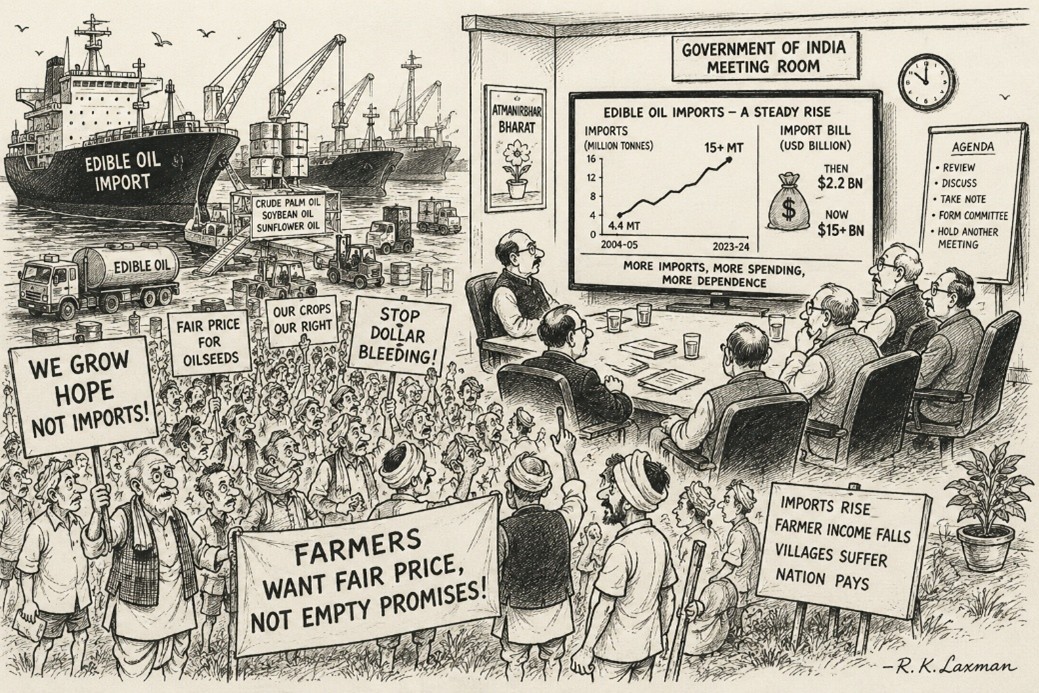
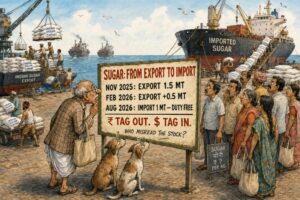
Today, India imports nearly sixty percent of its edible oil requirement. Over the past two decades, edible oil imports have risen from about 4.4 million tonnes to more than 15 million tonnes annually. The import bill, once measured in a few billion dollars, now exceeds $15 billion in many years.
These are not merely import statistics.
They represent farmer incomes that were never earned.
They represent rural jobs that were never created.
They represent foreign exchange that left India instead of circulating through village economies.
And they represent one of the largest missed opportunities in Indian agriculture.
The remarkable part is that this did not happen because governments ignored the sector.
In fact, successive Central and State Governments launched programme after programme for oil palm, mustard, soybean, sunflower and groundnut cultivation. Subsidies were announced. Targets were fixed. Reviews were conducted. Committees were formed. Mission statements were drafted.
The machinery of government was active.
Yet the outcome steadily deteriorated.
How does a country spend decades promoting oilseeds and still end up importing nearly sixty percent of its edible oil requirement?
The answer may lie in a simple but uncomfortable truth.
India measured activities.
It forgot to measure outcomes.
Officials reported hectares planted.
Departments reported seedlings distributed.
States reported expenditure incurred.
Ministries reported schemes implemented.
But who reported dollars saved?
Who stood before Parliament and declared that edible oil imports had fallen by two million tonnes?
Who was held accountable for reducing dependence from sixty percent to forty percent?
The answer appears to be nobody.
Somewhere along the journey, India became satisfied with measuring effort instead of achievement.
The tragedy becomes even more striking when viewed through history.
There was a time when groundnut farmers in Gujarat, mustard growers in Rajasthan, sunflower cultivators in Karnataka and oilseed farmers across the country formed an important pillar of the rural economy. Domestic production may not have been perfect, but self-reliance remained a visible national objective.
Then came liberalisation and easier access to global markets.
Imports increased.
Consumers benefited from lower prices.
Governments found it easier to manage inflation through imports than through the harder task of transforming domestic productivity.
There is nothing wrong with imports. Every successful economy imports products it cannot efficiently produce.
The problem arises when imports stop being a bridge to self-reliance and become a substitute for it.
For three decades, India increasingly relied on imported edible oils without building an equally determined mission to expand domestic production, improve yields, modernise processing and assure farmers attractive returns.
What appeared to be a convenient solution slowly became a strategic weakness.
As imports rose, farmer opportunities shrank.
As imports rose, rural employment potential diminished.
As imports rose, foreign exchange outflows expanded.
As imports rose, India became vulnerable to global price shocks, supply disruptions and geopolitical tensions.
Yet the policy response remained largely unchanged.
Then came another meeting.
Commerce Minister Piyush Goyal recently convened discussions to identify one hundred products where India must reduce import dependence and strengthen domestic manufacturing. It is an important and necessary initiative.
But the edible oil story stands before the nation as a cautionary tale.
Because if there is one lesson from the last three decades, it is that India does not suffer from a shortage of meetings.
It suffers from a shortage of outcomes.
The country has held meetings on edible oils.
It has launched missions on edible oils.
It has announced incentives on edible oils.
It has reviewed progress on edible oils.
And still, ship after ship continues to unload imported oil at Indian ports while farmers watch one of the largest income opportunities in Indian agriculture drift away.
That is why the real question before policymakers today is not merely which hundred products should be indigenised.
The real question is who will be accountable for ensuring that indigenisation actually happens.
The White Revolution offers a powerful lesson.
India did not become the world’s largest milk producer because government departments issued circulars.
India became the world’s largest milk producer because somebody owned the outcome.
Farmers were connected to procurement systems. Procurement systems were connected to processing facilities. Processing facilities were connected to markets. Markets were connected to consumers. Every participant understood the objective.
Milk production had to grow. Farmer incomes had to improve. The mission was measurable. The outcome was visible.
Success was counted in litres produced, not meetings conducted.
Someone woke up every morning thinking about milk.
Who wakes up every morning thinking about edible oils?
Certainly not the fragmented system that exists today.
The Centre designs schemes. States implement them. Agriculture departments focus on acreage. Importers focus on imports. Processors focus on refining.
Everyone participates. Nobody owns the result.
The uncomfortable reality is that India’s incentive structure often appears more aligned to managing imports than eliminating the need for them.
Major edible oil importers possess extensive logistics networks, processing facilities, market intelligence and capital. They understand demand patterns better than most institutions. Yet the burden of self-reliance falls overwhelmingly on agriculture departments and small farmers.
Why should major participants in the value chain not carry measurable indigenisation obligations?
Why should the country’s largest edible oil companies not be encouraged to invest aggressively in farmer productivity, seed development, procurement ecosystems and domestic oilseed expansion, just as dairy cooperatives once transformed milk production?
Imagine a ten-year National Edible Oil Mission on the scale of Operation Flood.
Imagine district-wise production targets linked to import reduction targets.
Imagine annual public scorecards measuring dollars saved, imports reduced, farmer incomes increased and rural jobs created.
Imagine a single institution empowered and held accountable for outcomes.
The benefits would extend far beyond agriculture.
A reduction of even one-third in edible oil imports could retain billions of dollars within the Indian economy each year. Expanded cultivation would support millions of farmers. Rural processing, warehousing, transport and logistics networks would generate employment across districts. Foreign exchange pressures would ease. The rupee would become marginally stronger and less vulnerable to global commodity shocks.
Most importantly, India would replace dependence with resilience.
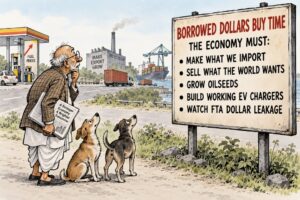
At a time when policymakers worry about the rupee, foreign exchange reserves, oil prices and external vulnerabilities, edible oils sit at the intersection of every one of those concerns.
This is not merely an agricultural issue.
It is a farmer income issue. It is a rural employment issue. It is a foreign exchange issue. It is a national resilience issue.
And perhaps one day history will ask a simple question.
How did a country that transformed itself from a milk-deficient nation into the world’s largest milk producer fail to achieve similar success in a sector that touched every kitchen, every farmer and every household?
The answer cannot be that India lacked schemes. The answer cannot be that India lacked meetings. The answer cannot be that India lacked committees.
The answer may simply be that nobody was asked to own the outcome.
And while governments counted hectares, the nation kept counting ships.
 Business and Economy
  Education
  Food
Food  Government
  Lifestyle
  Politics
  Travel
  World
World