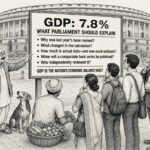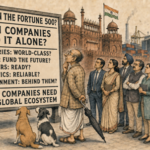

As artificial intelligence and digital media reshape how we consume information, newspapers face their greatest challenge in two centuries. Their survival will depend not on reporting news faster than smartphones, but on helping citizens understand the forces shaping their future.
By Ravishankar Kalyanasundaram
Weekday newspaper circulation in the United States has fallen by more than sixty percent since the beginning of this century. Thousands of local newspapers have disappeared, leaving entire counties without a dedicated newspaper to question those in authority or explain decisions that shape people’s lives. Researchers now call many of these places “news deserts.” The consequences extend far beyond the media business. Studies have linked the decline of local journalism to lower voter participation, weaker civic engagement, reduced public accountability and even higher borrowing costs for local governments. When fewer journalists ask difficult questions, fewer difficult answers emerge.
The real cost is not borne by newspapers.
It is borne by society.
India has not witnessed a collapse on this scale, but the direction is unmistakable. The country remains one of the world’s largest newspaper markets, yet circulation has softened in many cities since the pandemic, advertising revenues have steadily migrated to digital platforms, editions have become thinner, newsrooms leaner and financial pressures more acute. Young readers increasingly discover the world through mobile phones, social media, podcasts and AI-generated summaries long before the morning newspaper reaches their doorstep.
The economics of journalism have changed forever.
The thought behind this article emerged during dinner with a senior journalist friend whose understanding of world affairs I have admired for decades. Our discussion turned to the fading habit of reading newspapers. His explanation was simple. Readers today seek instant gratification, and yesterday’s newspaper cannot compete with today’s smartphone. I agreed—but only partly. Perhaps newspapers are not losing readers because information reaches people faster. Perhaps they are losing readers because they have stopped offering what smartphones cannot.
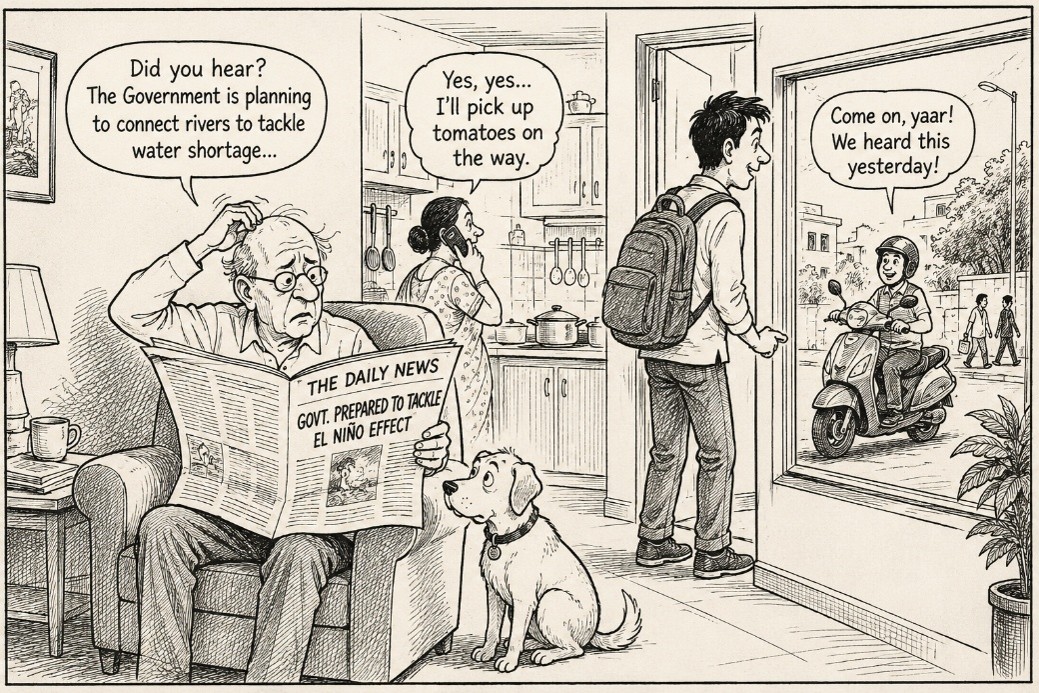
A recent news report carried the statement of a Union Minister assuring the nation that the Government was fully prepared to deal with the possible effects of El Niño.
It was an important announcement.
But that is precisely where journalism should have begun.
How many districts in India are already under water stress? How much groundwater has disappeared over the last two decades? How much monsoon water still flows into the sea every year without being harvested? Why have river-linking projects moved so slowly? Why are desalination plants not expanding fast enough to secure drinking water for coastal cities while releasing freshwater for agriculture? Which countries have successfully confronted similar challenges, and what lessons can India adopt?
The headline occupies a few square centimetres of newsprint.
The answers deserve the remaining pages.
That is the opportunity newspapers have overlooked.
Artificial intelligence has fundamentally altered the economics of research. A single editor, assisted by AI, can retrieve twenty years of rainfall data within minutes, analyse Parliamentary debates, compare groundwater trends across states, examine international experience, summarise technical research and generate visual explanations that once demanded days of painstaking work. Technology has dramatically reduced the cost of acquiring knowledge.
The true scarcity today is not information.
It is editorial curiosity.
Tomorrow’s newsroom therefore cannot resemble yesterday’s. Alongside reporters should work economists who explain inflation instead of merely reporting prices, engineers who decode infrastructure announcements, agricultural scientists who interpret monsoon forecasts, environmental experts who connect climate events to local realities, historians who provide perspective and data analysts who transform scattered statistics into meaningful public knowledge.
Even this need not become an expensive undertaking. India’s universities already possess an extraordinary reservoir of intellectual capital. Newspapers can build enduring partnerships with universities, research institutions and professional bodies, inviting professors, researchers and domain experts to illuminate the day’s most important stories. Let journalists tell the story. Let experts explain its significance.
Every major news report should answer five questions every reader silently asks: What happened? Why did it happen? How did we reach here? What does it mean for me? What happens next?
Many newspapers already publish opinion pages and expert columns. Yet these often stand apart from the day’s news instead of enriching it. Readers are not looking for isolated opinions. They are searching for connected understanding.
The future of newspapers will not be determined by faster printing presses or more sophisticated mobile applications. It will be decided by a far simpler question every reader asks before spending twenty minutes with a newspaper.
“Will I understand the world better after reading this?”
If the answer is merely yesterday’s headlines, the battle has already been lost.
But if every important story explains the background, connects the dots, presents reliable data, brings expert knowledge to the reader and illuminates the road ahead, newspapers will offer something that no social media feed, search engine or AI summary can ever replace.
Democracies do not weaken because newspapers sell fewer copies. They weaken when citizens stop understanding the forces shaping their lives. In the age of artificial intelligence, the printed newspaper has found a new purpose—not to be the first to report the news, but to be the first to explain it.
The newspaper of tomorrow will not be judged by how quickly it reports yesterday’s events. It will be remembered for how deeply it prepares society for tomorrow’s challenges.

 Business and Economy
  Education
  Food
Food  Government
  Lifestyle
  Politics
  Travel
  World
World