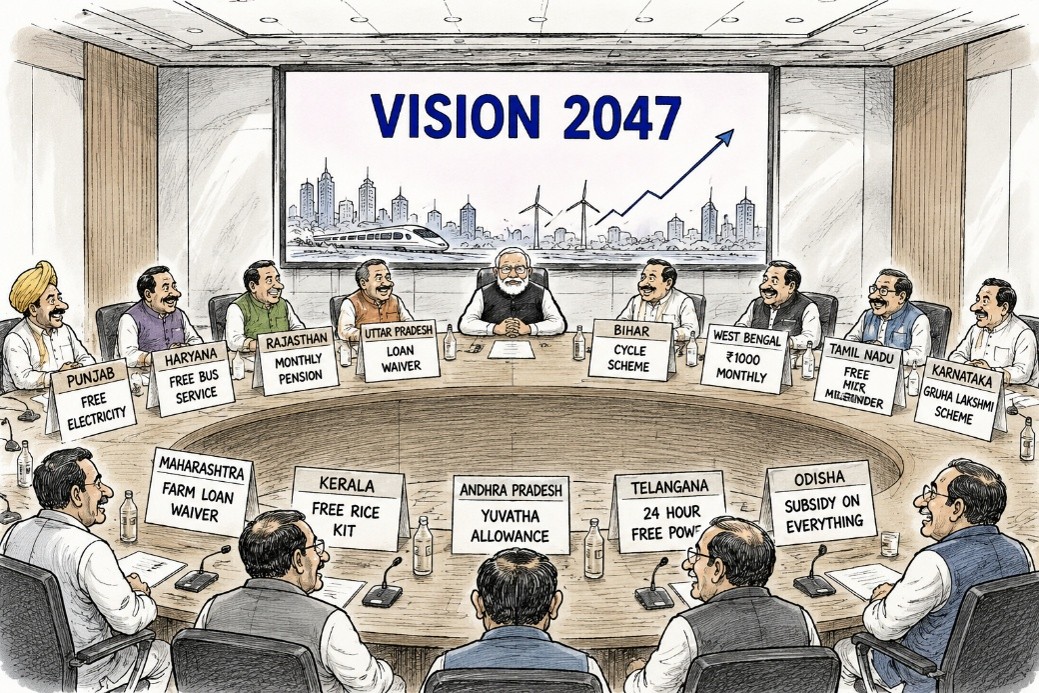

Before imagining the India of 2047, the Centre and the States must unite to solve the pressing challenges of food, energy, manufacturing, technology and economic resilience that threaten growth today.
By Ravishankar Kalyanasundaram
The Prime Minister’s meeting with Chief Ministers is one of the few occasions when the entire leadership of India sits around one table. It is a rare opportunity to build national consensus, align priorities and accelerate action across states. That is why one cannot help feeling that the discussion should have focused less on where India should be in 2047 and more on the pressing challenges that confront the country today.
There is nothing wrong with Vision 2047. Every nation needs a destination. But destinations are reached only when the obstacles on the road are removed. India today faces a series of economic and developmental challenges that require urgent cooperation between the Centre and the States. These are not problems that can be postponed to the next decade. They require action now.
Consider rice.
India today holds more than 38 million tonnes of rice in the central pool against a buffer requirement of roughly 10 million tonnes for this period. At an economic cost approaching ₹40 per kilogram, these stocks represent over ₹1.5 lakh crore of public resources tied up in procurement, storage, handling, transportation and financing. At the same time, global rice prices have weakened sharply, with export prices falling to around ₹25 per kilogram in several markets. The difference between carrying cost and market value is approximately ₹57,000 crore.
The issue is not whether farmers should be supported or food security protected. Both are essential. The real issue is whether inventories four times the buffer requirement represent the best use of scarce national resources and whether the response should remain confined to the Food Corporation of India. This is fundamentally a Centre-State issue. Rice-producing states must work with the Centre on improving productivity, encouraging diversification where appropriate, expanding food processing, strengthening export linkages and improving inventory management. Excess stocks should not be viewed merely as an FCI problem. They should be treated as a national policy issue requiring coordinated action by the Prime Minister and Chief Ministers.
Energy presents another challenge of similar magnitude.
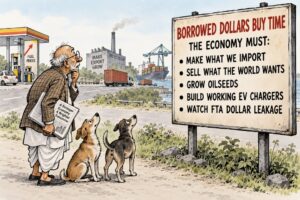
India imports nearly 85 per cent of its crude oil requirements. The annual oil import bill often exceeds $150 billion and remains vulnerable to geopolitical events over which India has little control. Every increase in oil prices widens the trade deficit, weakens the rupee, fuels inflation and places additional pressure on public finances. Yet this challenge cannot be addressed by the Centre alone. It requires a national mission involving every state.
The Prime Minister should have used the meeting with Chief Ministers to establish measurable targets for renewable energy generation, battery energy storage systems, transmission networks and distribution reforms. India requires more than 400 GWh of energy storage over the coming decade, yet deployment remains far below what is required. States should compete in creating renewable energy capacity, facilitating storage projects, accelerating approvals and expanding electric mobility. Equal urgency is required in building charging infrastructure and strengthening public transport systems. Every electric bus deployed, every battery installed and every unit of renewable energy generated reduces dependence on imported oil. This is not merely an environmental agenda. It is an economic security agenda.
The same urgency is required in mining and manufacturing.
India’s ambitions in electric vehicles, renewable energy, electronics and advanced manufacturing will require enormous quantities of copper, lithium, rare earths and other critical minerals. Demand for copper alone is expected to rise sharply over the next decade. Yet India continues to face delays in mining approvals, exploration and project execution. Several opportunities have already been lost due to prolonged decision-making. The Prime Minister should have worked with Chief Ministers to establish clear timelines for approvals, exploration and investment. Industrial growth cannot be achieved if the raw materials required for that growth remain trapped beneath the ground.
There is another challenge that receives far less attention than it deserves.
India currently receives more than $120 billion annually in remittances from Indians working abroad. These inflows have become one of the country’s most important sources of foreign exchange. Yet tightening immigration policies across developed economies, combined with the growing impact of automation and artificial intelligence, could affect future employment opportunities for overseas workers. India must therefore prepare for a future in which remittance growth cannot be taken for granted. The answer lies in creating productive employment within India through manufacturing, services, technology and exports. This too requires active collaboration between the Centre and the States.
Artificial intelligence deserves similar urgency.
Around the world, governments are treating AI as a transformative force that will reshape productivity, education, healthcare, governance and industry. India cannot afford to remain a passive observer. The Prime Minister should have challenged every Chief Minister to present state-level plans for AI adoption, workforce reskilling and digital productivity. The states that successfully integrate AI into governance, agriculture, education and healthcare will enjoy significant competitive advantages over those that do not.
Against this backdrop, the question of public expenditure becomes increasingly important.
Across India, welfare commitments continue to expand. Karnataka’s guarantee schemes cost more than ₹50,000 crore annually. Tamil Nadu’s welfare programmes, subsidies and social commitments absorb a similar magnitude of expenditure. Other states have adopted comparable approaches. Collectively, recurring welfare commitments across major states now exceed ₹3 lakh crore annually and continue to grow.
No responsible government can ignore vulnerable citizens. Welfare has an important role in society. But welfare cannot become a substitute for development. Every rupee spent on recurring consumption is a rupee unavailable for energy storage, irrigation systems, logistics infrastructure, industrial corridors, mining development, technology adoption or export competitiveness. The challenge is not whether welfare should exist. The challenge is whether sufficient resources remain available to create the productive assets that ultimately sustain welfare itself.
This is why the Prime Minister’s meeting with Chief Ministers should have focused first on a common national agenda for the next five years. How will states reduce import dependence? How will they expand manufacturing? How will they improve logistics? How much energy storage will they create? How will they increase exports? How will they adopt artificial intelligence? How will they improve agricultural productivity while reducing fiscal burdens? These questions may not be as inspiring as Vision 2047, but they are far more urgent.
India cannot afford to let its future be shaped by competitive politics between the Centre and the States, or by competition among states to outbid one another through ever-expanding welfare promises while productive investment struggles for resources. The challenges before the country are too significant and too interconnected for fragmented responses.
The Prime Minister’s role in such a moment must extend beyond that of an arbiter balancing competing interests. He must act as the nation’s chief accelerator, building consensus around priorities that strengthen India’s economic resilience, productive capacity and competitiveness. Vision 2047 is important. But the foundations of that vision will be laid not in 2047 but in the decisions taken over the next five years.
India does not need less vision. It needs greater urgency. If the Centre and the States can align around food security, energy security, critical minerals, manufacturing, artificial intelligence, exports and productive investment, Vision 2047 will become an achievable destination. If not, we risk discovering that while we were debating the future, the challenges of the present quietly overtook us.
 Business and Economy
  Education
  Food
Food  Government
  Lifestyle
  Politics
  Travel
  World
World