
Across the world, voters are not merely changing governments. They are questioning whether traditional politics still understands their lives.
By Ravishankar Kalyanasundaram
The story initially sounded like satire.
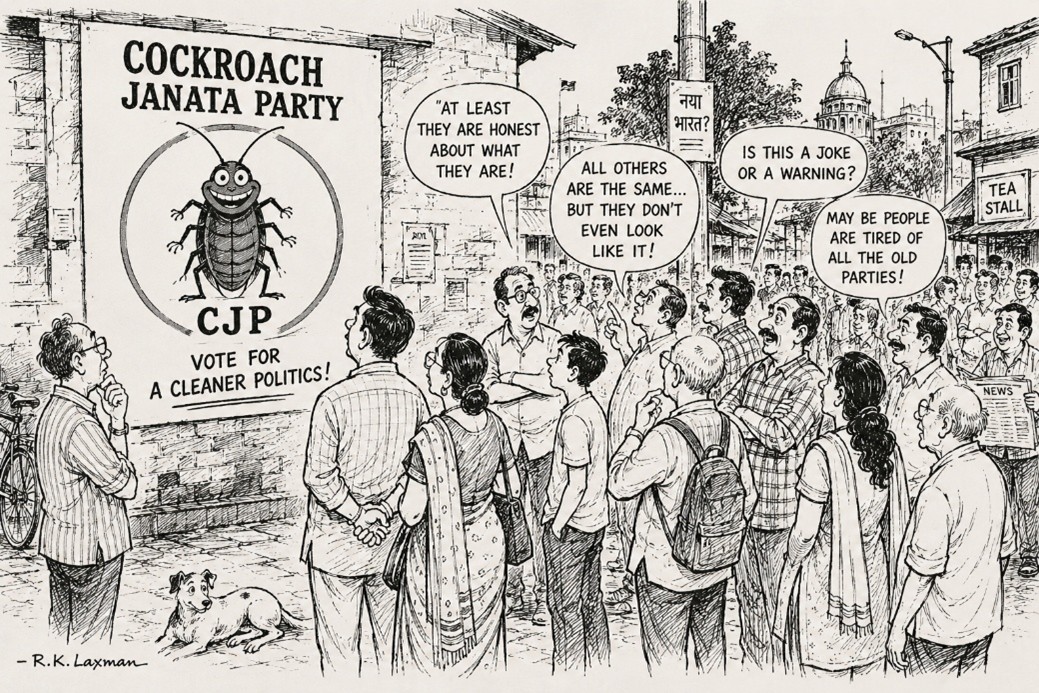
A group of frustrated citizens rallied around what came to be known as the “Cockroach Party.” Social media erupted. Memes spread rapidly. Political commentators laughed it off. Established politicians dismissed it as another passing internet joke.
But perhaps they missed the point. The issue was never the cockroach. The issue was the frustration. The issue was the message being sent by citizens who increasingly feel that politics is speaking a language different from their own.
Social media has fundamentally changed the psychology of aspiration.
People today see success constantly.
Every day they are exposed to images of entrepreneurs, influencers, professionals, celebrities and ordinary citizens apparently living better lives. They see opportunities, lifestyles, careers and experiences that previous generations never knew existed.
And when success appears visible but unreachable, disappointment begins to grow.
This disappointment does not always appear in GDP numbers, inflation statistics or employment reports.
It appears in conversations. It appears around dining tables. It appears in family gatherings. It appears in social media comments. It appears in growing cynicism toward institutions.
Eventually, it appears in politics.
That is precisely what governments across the world are confronting today.
The old voter was often concerned about survival. The new voter is concerned about progress.
The old voter wanted security. The new voter wants opportunity.
The old voter compared his life with his neighbours. The new voter compares his life with the entire world.
And that changes everything.
A young graduate in a village in Tamil Nadu is no longer measuring his prospects against those of his father. He is comparing himself with a software engineer in Bengaluru, a content creator in Mumbai, a data scientist in Singapore and a startup founder in California. A young woman in Chennai is not simply evaluating government welfare schemes. She is asking whether she can travel safely at night, whether she can build a career after motherhood, whether affordable childcare exists and whether the city around her supports her ambitions.
Politics has not fully adjusted to this shift.
For decades, governments around the world built political strategies around welfare programmes, subsidies and targeted benefits. Those remain important. No responsible government can ignore the needs of the poor.
But a new challenge has emerged.
Citizens increasingly seek pathways rather than promises.
They seek mobility rather than maintenance.
They seek participation rather than patronage.
And nowhere is this more visible than among women and youth.
Take urban women.
Every political party speaks about women’s empowerment. Yet millions continue to navigate unsafe streets, inadequate public transport, insufficient childcare facilities and workplaces that still struggle to accommodate motherhood. The result is that many women feel they must choose between family and career, a choice that many developed economies have spent decades trying to eliminate.
The political consequences of this are rarely measured.
Yet they are real.
A woman who feels unsupported by the system carries that perception into every interaction with government.
The same story unfolds across rural India.
Families invested heavily in education because they believed it would create opportunities. Degrees expanded. Coaching centres multiplied. Expectations rose. But employment creation has often struggled to match the scale of aspiration.
The result is not merely unemployment. It is disappointment. And disappointment is politically powerful.
A generation that was promised mobility becomes frustrated when mobility appears slow. A generation connected to the world through smartphones becomes impatient when governance appears disconnected from reality.
This is why unusual political movements are emerging across the world.
Whether in Europe, the United States, Latin America or Asia, voters are increasingly willing to experiment with alternatives. Sometimes they support outsiders. Sometimes they support protest candidates. Sometimes they rally around causes that seem irrational to political establishments.
Yet beneath all these movements lies the same question. “Can you hear us?”
The real danger for governing parties is therefore not the emergence of strange new political formations.
The danger is failing to understand what is producing them.
Are citizens searching for a new leader? Or are they expressing frustration with existing leadership?
Are they demanding a greater role in governance? Or are they signalling that they feel excluded?
Are they rejecting policy? Or are they rejecting indifference?
Those are the questions that matter.
Because history shows that governments rarely lose power because of a single issue.
They lose power when small disappointments accumulate into a larger feeling that nobody is listening.
The Cockroach Party may disappear tomorrow.
But the aspiration gap that gave birth to it will not.
And unless governments learn to bridge that gap, more such movements will continue to emerge—not because citizens have become unreasonable, but because their expectations of governance have changed faster than governance itself.
 Business and Economy
  Education
  Food
Food  Government
  Lifestyle
  Politics
  Travel
  World
World