
When an Examination Becomes More Important Than the Students It Is Meant to Serve
By Ravishankar Kalyanasundaram
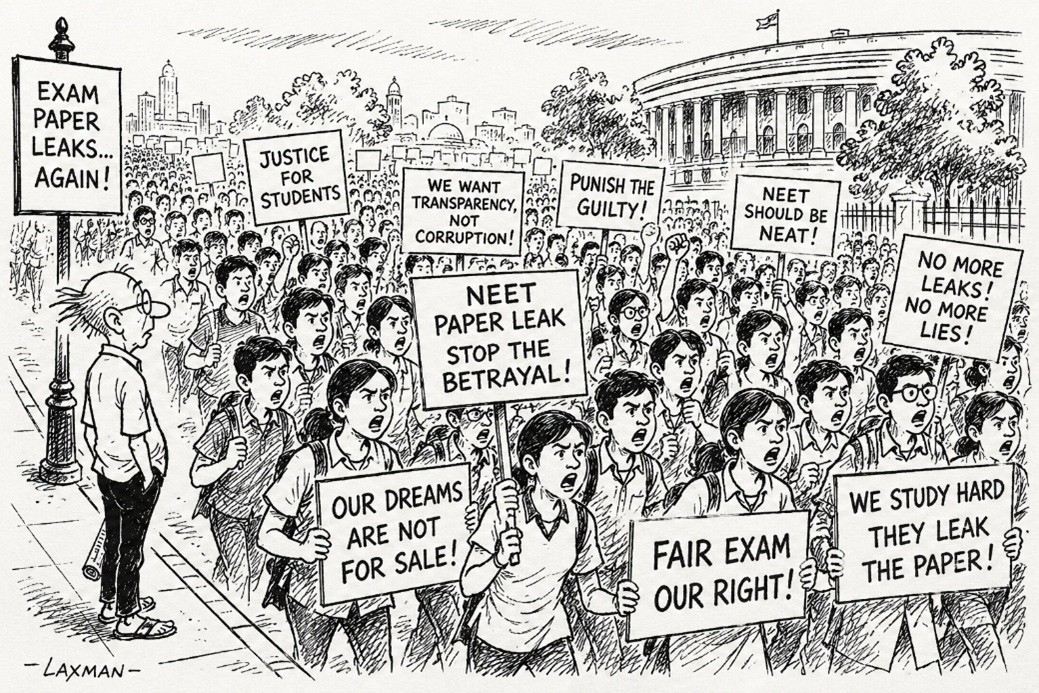
Every year, millions of young Indians walk into examination halls carrying far more than admit cards. They carry family hopes, years of sacrifice, financial burdens, emotional anxieties and dreams of becoming doctors. For many families, NEET is not merely an entrance examination. It is a life-defining event.
That is precisely why every paper leak is not simply an administrative lapse. It is a betrayal.
The latest NEET controversy has once again shaken public confidence. Investigations have revealed alleged leaks, arrests across states, coaching-centre links, and the cancellation of examinations affecting more than twenty lakh aspirants. The Central Bureau of Investigation continues to make arrests, and the probe is widening.
Yet the larger question remains unanswered.
Why does this keep happening?
According to compilations based on investigations and media reports, India has witnessed at least five major NEET-related leak controversies between 2015 and 2026. The 2024 controversy alone led to nationwide protests, arrests, CBI investigations and Supreme Court hearings. The Court acknowledged that at least 155 candidates had benefited from the leak, even while declining a nationwide re-test.
The disturbing reality is that every scandal follows a familiar script.
A leak is reported… Authorities deny it…Investigations begin…Arrests are made.
Committees are formed…Promises of reform are repeated.
And then the country moves on until the next scandal arrives.
Students, however, do not move on so easily.
A lost year in the life of a seventeen-year-old cannot be compensated by a press conference.
A cancelled examination cannot be repaired through a bureaucratic explanation.
Anxiety cannot be erased by announcing another committee.
The tragedy is not merely that papers leak. The tragedy is that the system appears to have become accustomed to leaks.
Across India, there have been reports of more than seventy examination leak incidents affecting nearly 1.7 crore aspirants over recent years. Yet there is little publicly available evidence demonstrating that the masterminds behind these networks have faced swift and exemplary punishment. Many investigations continue for years. Trials move slowly. Public memory fades.
The deterrence value becomes negligible.
Contrast this with what happens elsewhere.
Every year, students from across the world compete for admission into institutions such as Harvard University, University of Cambridge and University College London. Their admissions processes involve globally administered examinations, externally validated assessments and tightly controlled systems. Harvard, for example, relies on internationally recognised standardised assessments such as the SAT, ACT, AP, IB and national leaving examinations that are conducted under robust security frameworks.
Even more striking is the example of China.
More than thirteen million students appear annually for the Gaokao, one of the world’s largest and most competitive examinations. Yet China treats examination integrity as a matter of national importance. Authorities deploy facial recognition, drones, AI monitoring systems, metal detectors and extensive surveillance. Examination papers are treated as state secrets. Organised cheating can attract severe criminal penalties, including imprisonment. More than 11,000 individuals faced penalties between 2015 and 2024 for examination-related offences.
The message is unmistakable.
An examination is only as credible as the fear of punishment for those who attempt to corrupt it.
India has unfortunately sent the opposite signal.
The recurring appearance of coaching-centre links in leak investigations raises further uncomfortable questions. Certain centres repeatedly advertise extraordinary success rates. When leak investigations point toward the same geographies that have become coaching hubs, public suspicion inevitably grows. Even if most institutions are entirely innocent, the burden of restoring trust falls upon the system itself.
Trust cannot survive merely on official assurances…Trust requires transparency.
Trust requires accountability…Trust requires visible consequences.
The political implications are equally significant.
In states such as Tamil Nadu, opposition to NEET has remained one of the most powerful educational and political issues of the past decade. Abolition of NEET or exemption from it has featured prominently in election manifestos. Every irregularity strengthens the argument of those who believe that the examination disadvantages students and lacks credibility.
What makes the situation particularly dangerous is that NEET originally sought to create fairness through a uniform national standard. If students begin believing that the examination itself is vulnerable to manipulation, the very objective of standardisation collapses.
The consequence may not merely be outrage.
It may become a wider movement questioning centralised control of education itself.
Demands for greater state authority over admissions and educational administration could gather momentum. Protests could intensify. Parents who once accepted NEET as a difficult but fair system may begin asking whether fairness truly exists.
None of this was inevitable.
Most of it is the consequence of repeated administrative complacency.
The Central Government and examination authorities must now recognise a simple truth. The issue is no longer about one leak or one examination cycle. It is about institutional credibility.
A national examination that determines the future of millions must be designed to withstand not ordinary scrutiny but extraordinary abuse.
Perhaps the old saying deserves to be rewritten for our times:
“Any institution entrusted with the dreams of millions must be built not merely to function under normal use, but to survive relentless scrutiny, organised attack, and public doubt. Its true strength is measured not by how it performs when everything goes right, but by how it withstands everything that can go wrong.”
That is the standard India must now demand of NEET.
Nothing less will restore trust. Nothing less will reassure students. And nothing less will protect the future of a generation that deserves certainty, fairness and dignity in the most important examination of their young lives.


 Business and Economy
  Education
  Food
Food  Government
  Lifestyle
  Politics
  Travel
  World
World