
The real challenge facing India is not wealth creation. It is transforming domestic demand into technological capability before external dependence becomes a permanent economic vulnerability.
By Ravishankar Kalyanasundaram
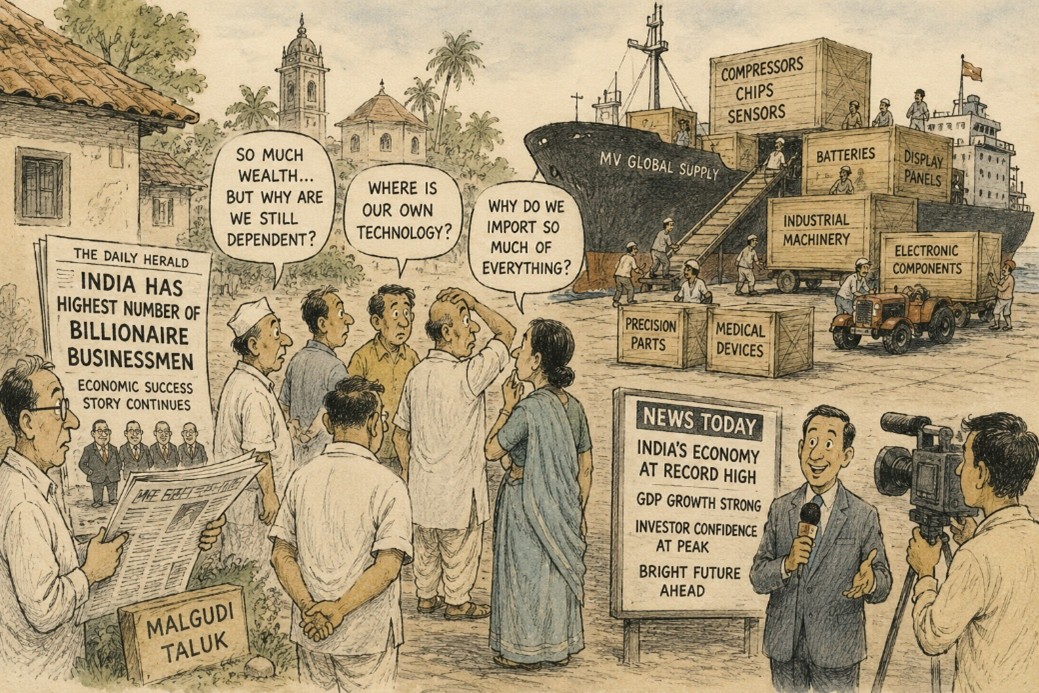
If India has created so much wealth, why does it still depend on somebody else’s technology for so much of modern life?
It is an uncomfortable question because it challenges one of the most celebrated narratives of modern India.
Over the past three decades, India has produced some of the world’s wealthiest businessmen. Corporate groups have expanded into airports, ports, power plants, telecom networks, logistics parks, renewable energy projects, industrial parks, data centres and countless other sectors. Market capitalisations have soared. Balance sheets have expanded. Every year new billionaires join global rich lists.
Yet perhaps India spent three decades creating larger balance sheets when it should also have been creating larger industrial ecosystems.
When one looks beneath the surface of India’s economic success, a different story begins to emerge.
Walk through any modern Indian airport. The airport may be owned by an Indian company, financed by Indian banks and used by Indian passengers. Yet much of the technology that keeps it functioning—from baggage handling systems and airport automation to specialised software, navigation equipment and design systems—originates elsewhere. Ownership changed hands. Technology often did not.
The same pattern repeats itself across the economy.
India is among the world’s fastest-growing air-conditioning markets. Rising temperatures, urbanisation and rising incomes are expected to drive demand for tens of millions of additional units over the coming decade. Yet the compressor, the technological heart of every air conditioner, continues to be dominated by ecosystems developed in Japan, South Korea and China. Despite decades of demand and one of the world’s largest consumer markets, India has not produced a globally dominant compressor manufacturer capable of challenging the world’s leaders.
The opportunity was Indian. The market was Indian. The technology remained foreign.
The story becomes even more revealing when one looks at India’s rapidly growing skyline. Every year thousands of apartment towers, office complexes, hospitals and hotels rise across the country. Yet when one steps into the lift, the names are familiar. Finnish, Swiss, American, Japanese and Chinese companies dominate the sector. Decades of urbanisation created one of the world’s largest construction markets. Yet India has not built a globally recognised elevator technology company.
The automobile industry offers another example. India has been manufacturing vehicles for nearly a century. It possesses one of the world’s largest domestic markets and an enormous pool of engineering talent. Yet it took Japanese and Korean companies to transform India into a major automobile export base. Even today many of the technologies that define modern mobility—from advanced electronics and sensors to battery systems and specialised components—continue to emerge from ecosystems developed elsewhere.
India built the market. Others built much of the ecosystem.
The same pattern is visible in sectors often celebrated as manufacturing success stories. Mobile phone exports have risen dramatically, and India has become an important assembly hub. This is undoubtedly progress. Yet the processor, memory chip, display technology, camera system and semiconductor equipment inside those devices originate largely outside India. Much of the value addition remains elsewhere.
Solar energy presents another paradox. India rightly celebrates every new solar park and renewable energy project. Yet for years much of the technology ecosystem behind those installations—from wafers and cells to manufacturing equipment—was dominated by China. Data centres tell a similar story. India builds the facilities, but the advanced chips, servers, graphics processors, networking systems and cooling technologies that make them valuable are overwhelmingly imported.
Even sectors that should have evolved naturally through domestic necessity continue to depend heavily on imported technologies. India remains one of the world’s largest agricultural producers, yet modern grain storage systems have advanced far more rapidly elsewhere than within the country. Electricity distribution networks still rely on technologies that have seen limited domestic innovation despite decades of deployment. Warehousing, industrial automation, specialised machinery and precision engineering continue to depend significantly on foreign know-how.
The result appears every month in India’s trade data.
India now imports more than $700 billion worth of goods annually. Oil accounts for a large share of that figure, but hidden beneath the headline number is a less visible story. Compressors, battery cells, industrial machinery, automation systems, sensors, medical devices, electronics, engineering equipment and speciality materials arrive at Indian ports every day. Each shipment represents a capability that somebody else developed and India chose to purchase.
There is nothing wrong with imports. Every successful economy imports. The concern arises when decades of strong domestic demand fail to create strong domestic capability.
This is where the distinction between businessmen and industrialists becomes important.
Over the past three decades, India became exceptionally good at creating businessmen. Many built enormous enterprises by acquiring, consolidating and operating assets. There is skill in that, and the country benefited from it. But industrial history suggests that nations become powerful not when assets change hands, but when capabilities are created.
An industrialist leaves behind more than a balance sheet. He leaves behind suppliers, engineers, patents, technologies and ecosystems that continue creating value long after the original investment has been recovered.
Much of India’s corporate success has involved bringing existing businesses under larger umbrellas. Airports join portfolios that already contain ports. Logistics joins industrial parks. Power assets join infrastructure platforms. Data centres join renewable energy portfolios. Balance sheets expand and shareholders prosper.
But a nation does not become technologically powerful by expanding balance sheets alone. It becomes powerful by expanding capabilities.
Yet the solution to this challenge will not emerge from another ministry meeting, another industry consultation or another announcement that imported products will be substituted.
India has been making such declarations for decades.
Industrial ecosystems are not created by notifications, committees or conference speeches.
No country ever became an industrial power by announcing indigenisation in a ministry conference room. They are created by missions.
The Green Revolution was not a meeting. It was a national mission that connected science, farmers, irrigation, procurement systems, finance and political commitment over many years. The White Revolution was not an incentive scheme. It was a sustained effort that linked technology, institutions, producers and markets into a single ecosystem.
India now needs a similar mission for industrial capability.
Not a compressor policy, but a Compressor Mission.
Not periodic reviews of battery imports, but a Battery Ecosystem Mission.
Not another discussion on semiconductor dependence, but a Semiconductor Capability Mission.
Not isolated incentive schemes, but a coordinated national effort to build capabilities in industrial automation, power electronics, medical devices, warehouse technologies, agricultural engineering, advanced materials and precision manufacturing.
Most importantly, the objective cannot merely be import substitution.
Import substitution is too small an ambition for a nation of India’s scale.
The objective must be to create globally competitive ecosystems capable of supplying not only India, but the world.
That is what South Korea achieved in automobiles and electronics. It is what Taiwan achieved in semiconductors. It is what China achieved in batteries, solar equipment, telecommunications, industrial machinery and advanced manufacturing. None of these countries succeeded because they wanted to replace imports. They succeeded because they wanted global leadership.
The distinction is important.
A country focused only on replacing imports often creates protected industries. A country focused on building ecosystems creates world-class industries.
India possesses every ingredient required for such a transformation. It has the market. It has the capital. It has the entrepreneurial energy. It has the engineering talent. What it lacks is a relentless national mission to convert domestic demand into domestic capability.
Until that happens, every new airport will create demand for imported systems. Every new air conditioner will create demand for imported compressors. Every new electric vehicle will create demand for imported battery technologies. Every new solar park will create demand for imported equipment. Every new data centre will create demand for imported electronics.
Growth will continue to expand the economy. But growth will also continue to expand dependence. And dependence eventually becomes vulnerability. It weakens the trade balance. It increases pressure on foreign exchange reserves. It makes the economy vulnerable to supply chain disruptions, currency fluctuations and geopolitical shocks. It quietly undermines the resilience that a nation of India’s scale should possess.
The strongest defence against those vulnerabilities is not a tariff, a subsidy or a central bank intervention. It is industrial capability. It is the ability to design, manufacture and improve the technologies that power modern life.
The countries that dominate the twenty-first century will not necessarily be those with the biggest stock markets or the largest number of billionaires. They will be those that own the technologies, supply chains and industrial ecosystems upon which the rest of the world depends.
India has the market. India has the talent. India has the capital.
What remains is the will to make ecosystem creation a national mission.
The Green Revolution fed India. The White Revolution nourished India. The next great national mission must be an Industrial Revolution that equips India.
Because nations become wealthy when they create businesses.
But they become powerful when they create industries.
We have enough businessmen. It is time India produced more industrialists.
 Business and Economy
  Education
  Food
Food  Government
  Lifestyle
  Politics
  Travel
  World
World