
The future does not belong to companies that predict it. It belongs to companies that build it.
By Ravishankar Kalyanasundaram
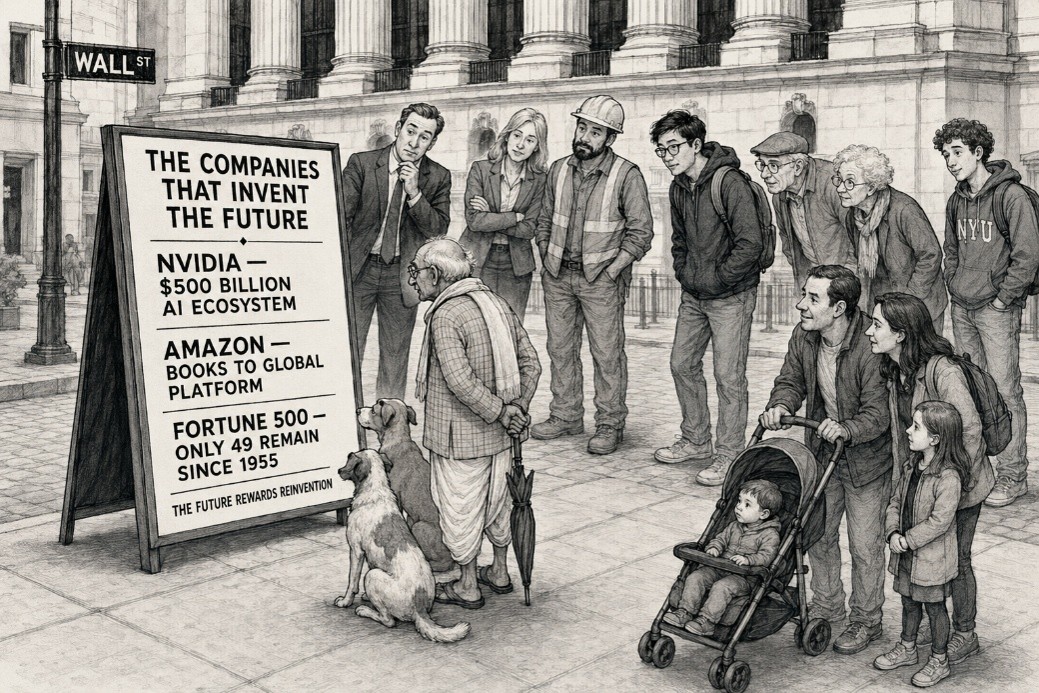
Nvidia made an announcement last week that should make every corporate board sit up. It was not about a faster chip. It was about partnering with Apollo, BlackRock, Blackstone, Brookfield, Goldman Sachs and KKR to mobilise more than $500 billion for artificial-intelligence infrastructure. The proposed platforms will bring together computing, software, data centres, power and long-term finance. Nvidia is no longer merely supplying the machinery of artificial intelligence. It is helping finance, construct and organise the economy around it.
That is what companies that invent the future do. They do not wait for the market to arrive. They assemble the technology, capital, suppliers, developers and customers needed to create it.
Nvidia began in 1993 as a graphics-chip company serving video games. Three decades later, its chips are training artificial-intelligence models, running data centres, accelerating scientific research and powering autonomous machines. But its real fortress is not the chip alone. CUDA, introduced in 2006, enabled developers to use Nvidia’s processors for purposes far beyond graphics. Around it grew hundreds of software libraries, development tools and specialised applications. Each new developer strengthened the platform; every new application increased demand for its hardware.
The results are extraordinary. Nvidia’s revenue reached $215.9 billion in fiscal 2026, an increase of 65% in one year. Data-centre revenue alone reached approximately $194 billion. In the first quarter of the following year, revenue surged another 85% to $81.6 billion. The company’s market value is now around $5.3 trillion—larger than the annual GDP of every country except the United States and China. Market capitalisation and GDP are different measures, but the comparison demonstrates the scale of value that investors believe can be created by a company controlling a critical technological platform.
The corporate graveyard is filled with companies that once appeared equally invincible.
When the first Fortune 500 was published in 1955, General Motors stood at the top with revenue of about $9.8 billion. The commanding heights of corporate America were occupied by automobile manufacturers, oil companies, steel producers, chemical businesses and electrical-equipment giants. They owned enormous factories, employed armies of workers and appeared to possess unassailable market power.
In 2026, Amazon displaced Walmart at the top of the Fortune rankings with revenue of approximately $717 billion. Amazon began as an online bookseller in 1994. It then built a marketplace, warehouses, logistics, subscriptions, advertising and cloud computing. Today, the infrastructure it created for itself is being offered to other businesses—from computing capacity through AWS to an increasingly integrated global supply chain.
The contrast is startling. The largest company in 1955 manufactured cars. The largest today orchestrates millions of buyers, sellers, developers, advertisers, merchants and businesses across an interconnected platform.
Across the 72 editions of the Fortune 500, more than 1,800 companies have appeared. Only 49 have remained on the list every year. Exxon Mobil, Chevron, General Motors, Ford, IBM and Procter & Gamble are among the rare survivors. The statistic is more revealing than any management
textbook: corporate greatness is common; corporate reinvention is rare.
The fallen were not necessarily badly managed. Many were profitable, respected and technologically accomplished. Their danger was comfort.
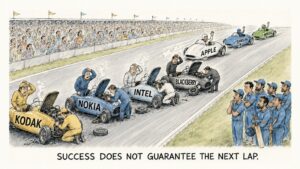
Kodak invented the first digital camera but remained emotionally and financially attached to photographic film. Nokia once dominated mobile phones but underestimated how quickly the smartphone would become a software and application ecosystem. BlackBerry perfected secure mobile email but failed to recognise that customers would soon expect the phone to become a marketplace, camera, entertainment centre and computer. Sears possessed stores, catalogues, distribution centres and generations of customer trust—but could not translate those formidable assets into the digital age.
They did not disappear because the future was invisible. Often, they could see it. They faded because embracing it would have disturbed the profits, structures and certainties of the present.
The winners asked different questions.
Apple did not stop with a better mobile phone. It combined the iPhone, operating system, App Store, payments, music, cloud storage, accessories and services into an ecosystem. Its annual revenue has crossed $416 billion, while its active-device base has reached another record. Every device sold becomes an entry point into a continuing commercial relationship.
Amazon did not ask how many more books it could sell. It asked whether the infrastructure created for its own business could become infrastructure for everybody. AWS emerged from that question. Amazon reports that three years after AWS was launched, it had an annualised revenue rate of only $58 million. Three years into the present AI wave, AWS’s AI business had already reached an annualised rate exceeding $15 billion—nearly 260 times as large at the comparable stage.
Microsoft transformed Windows from its destination into one component of a larger cloud, subscription and AI platform. Netflix cannibalised its own DVD business before somebody else could. Tesla treated the automobile not as a finished mechanical product but as software, batteries, charging, data and energy management on wheels. SpaceX did not merely build rockets; it reimagined launch economics through reusability and then used that capability to construct a satellite-communications network.
The common thread is unmistakable. The great companies of today did not simply invent new products. They redefined the business they were in. They converted internal capabilities into external platforms. They attracted partners instead of trying to manufacture every component themselves. They used an ecosystem to move faster, spread risk and avoid reinventing what others had already perfected. In the new economy, collaboration is not an admission of weakness. It is an instrument of speed.
That also explains the enormous cost of inaction. Every year spent protecting an established business model allows somebody else to acquire the technology, suppliers, talent, customer relationships and operating data that will define the next market. The loss is not confined to one company’s revenue. Delayed reinvention weakens productivity, exports, skills, supply chains and ultimately the competitiveness of the economy around it.
And now we must ask where India’s companies stand in this story. Hyundai entered India only in the late 1990s but treated its Indian factories as a base for serving the world; exports now account for roughly one in four vehicles from its Indian operations. After six decades of building an automobile industry largely around domestic demand, that contrast demonstrates what changes when a factory is conceived from the beginning as part of a global production system. India does not have to invent every technology or rebuild every capability independently. Partnerships can bring technology, markets, capital and operating knowledge together with Indian manufacturing, talent and scale—saving years otherwise lost in reinventing the wheel.
The same principle must guide privatisation. Its core objective should not be the immediate sale proceeds received by the government. India already possesses companies with manufacturing plants, pipelines, depots, terminals, rail connections, distribution networks and customer reach painstakingly built over decades. BPCL, CONCOR and BEML are examples of valuable platforms capable of being repurposed by innovative strategic owners and partners. The real return from privatisation will come when this inherited infrastructure is used to create new energy systems, export networks, advanced engineering businesses and globally competitive supply chains. Every year of indecision carries an invisible economic cost: opportunities postponed, technologies not absorbed, exports not created and infrastructure left serving yesterday more efficiently instead of serving tomorrow differently.
The world will not wait while India completes its files. Nvidia is turning computing into an infrastructure asset class; Amazon has converted its internal machinery into a global platform; Apple has built an economy around a device; and Hyundai has shown how an Indian factory can serve international markets. The warning to every comfortable legacy company—and to those deciding the future of India’s public enterprises—is simple: the future does not belong to those who own the largest inheritance. It belongs to those who know how to reinvent it.

 Business and Economy
  Education
  Food
Food  Government
  Lifestyle
  Politics
  Travel
  World
World