
Can India Create a Million New Exporters?
By Ravishankar Kalyanasundaram
A brass artisan in Moradabad may have a product the world wants—and still never become an exporter.
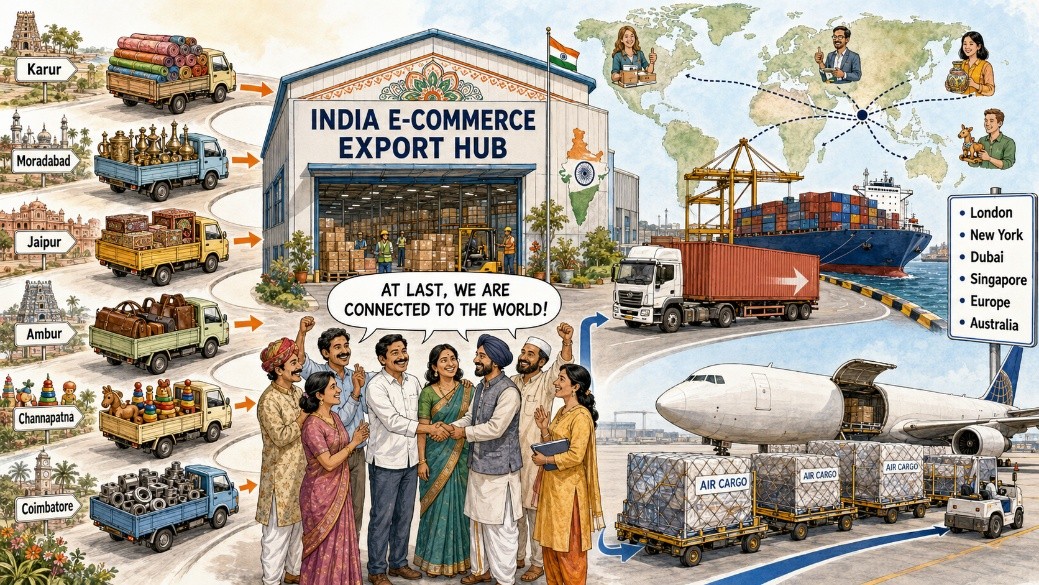
On 23 July, India made a policy change that could begin to change that. Foreign-funded e-commerce companies can now buy goods made in India, hold them as inventory exclusively for export, and sell them directly to customers abroad. A seemingly technical reform could unlock a very large economic opportunity.
Why does this matter? Suppose the artisan wants to sell twenty handcrafted products in London. The artisan must find customers, advertise overseas, meet product standards, complete export documentation, arrange packaging and transport, collect foreign currency and manage returns. For twenty products, the process may cost more than the profit. The product is good; the system defeats the producer.
Now imagine that an e-commerce company buys those products for export. It also buys textiles from Karur, jewellery from Jaipur, leather goods from Ambur and toys from Channapatna. At an export hub, it can consolidate thousands of small orders into economical shipments, complete the paperwork, use overseas warehouses and deliver through its existing network.
That is the power of this reform. The artisan can concentrate on craftsmanship. The MSME can concentrate on quality, design and production. The platform can provide what a small producer cannot build alone: global customers, technology, logistics, payments, compliance and returns management.
The scale is already visible. Amazon says its Global Selling programme has registered more than 200,000 Indian exporters across 18-plus international marketplaces. Between 2015 and 2025, these exporters sold over 750 million product units and crossed $20 billion in cumulative e-commerce exports. Amazon now aims to enable $80 billion by 2030. If that ambition is realised, it would add another $60 billion—roughly ₹5 lakh crore—in just five years.
The gains will travel far beyond the platforms. More exports mean larger orders for small factories, better use of production capacity, new jobs, foreign-exchange earnings and higher tax revenues. They also create demand for export warehouses, testing laboratories, packaging, labelling, customs services, freight forwarding, air cargo, ports and last-mile networks. A single overseas sale can support work across an entire Indian value chain.
Other countries show what is possible. China did not merely ask small factories to “go global.” It built cross-border e-commerce pilot zones, simplified customs clearance, consolidation centres and overseas warehouses. China’s official data show that cross-border e-commerce trade reached 2.75 trillion yuan in 2025—about $380 billion—and was nearly 70% higher than in 2020.
The United States offers another lesson. Small and medium-sized firms represent over 97% of identified American goods exporters and nearly 35% of known export value. Digital platforms help such businesses test foreign markets without first creating costly international distribution networks. The lesson is simple: countries export more when small firms can use shared infrastructure.
India has an extraordinary product base—handicrafts, garments, home furnishings, leather goods, jewellery, toys, spices, ayurvedic products, processed foods, kitchenware and engineering components. Our recent trade agreements can lower tariffs, but an agreement only opens the door. E-commerce can carry the product through it and place it in the customer’s hands.
Safeguards are essential. Export inventory must remain completely separate from domestic retail. Producers must receive fair prices and timely payments, while platforms must not misuse their bargaining power. Clear digital records, traceability and strict penalties can protect the domestic market without suffocating the export opportunity.
UPI placed the payment infrastructure of a large corporation in the hands of a roadside vendor. Can e-commerce do the same for exports—giving an artisan in a small Indian town access to the global market once reserved for multinationals?
India’s next export revolution need not be led only by a handful of giant companies. It can be carried by a million ambitious entrepreneurs—making in our small towns, selling to the world and earning for India.
 Business and Economy
  Education
  Food
Food  Government
  Lifestyle
  Politics
  Travel
  World
World