
This is not merely an election story. It is a warning signal from the future.
By Ravishankar Kalyanasundaram
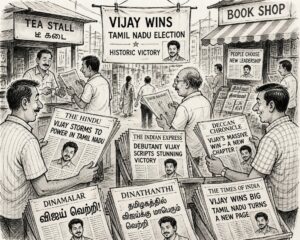
In one stunning electoral moment, Tamil Nadu’s voters appear to have brushed aside half a century of political habit.
The old flags still fluttered. The familiar campaign songs still echoed through the streets. Veteran leaders still spoke the language of legacy, sacrifice, ideology, and movement. Yet somewhere beneath the noise, the public mood had already shifted. And when the votes were counted, a debutant political force led by actor Vijay stood at the centre of power, while the parties that had dominated Tamil Nadu for generations were left confronting an uncomfortable question: what happens when a society emotionally moves on before its political establishment realises it?
This is not merely an election story. It is a warning signal from the future.
For decades, India’s regional political systems rested on stable foundations. Party cadres, district secretaries, newspapers, television channels, welfare networks, cinema influence, caste alliances, and ideological memory created deeply rooted political ecosystems. In Tamil Nadu particularly, politics was not just about governance. It was culture, identity, language, emotion, and inheritance woven together over generations.
But the voter of 2026 is no longer the voter of 1996.
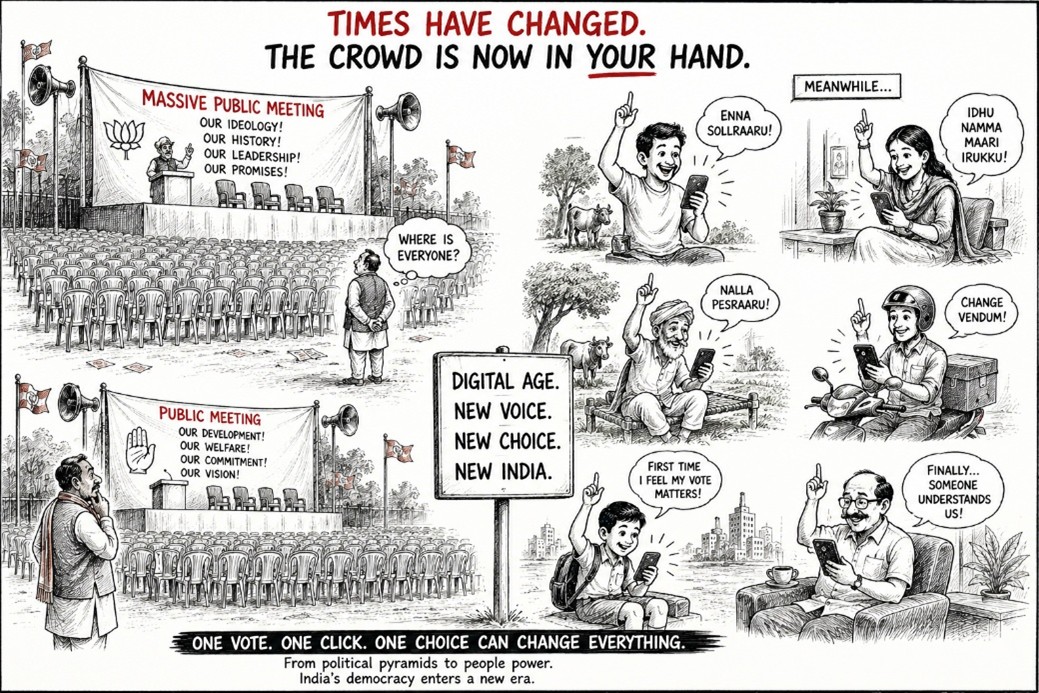
A younger India has emerged — impatient, digitally connected, emotionally restless, and far less loyal to political history. Large sections of voters no longer carry the emotional memory of earlier ideological struggles with the same intensity as their parents did. Their anxieties are immediate and personal: jobs, urban congestion, corruption fatigue, quality of life, aspirations, visibility, opportunity, and the search for a future that feels exciting rather than merely administered.
And social media has changed politics permanently.
Earlier, political legitimacy flowed downward from party structures, newspapers, television networks, and local hierarchies. Today, legitimacy can emerge horizontally and instantly through digital influence. A celebrity, influencer, activist, or outsider can speak directly to millions without depending on the traditional political machine. Narrative itself has become decentralised.
The world has already seen this transformation. Italy’s Five Star Movement rose from digital anger and anti-establishment sentiment. France witnessed Emmanuel Macron dismantle traditional party structures almost overnight. Ukraine elevated Volodymyr Zelensky from television celebrity to President. Bangladesh and Nepal too have seen how digital mobilisation and youth frustration can rapidly weaken long-standing political establishments.
India is not insulated from this.
In fact, India may be entering the most vulnerable phase of this transformation because it combines massive youth demographics, intense smartphone penetration, celebrity-driven public culture, and rising impatience with conventional politics. Tamil Nadu’s political tremor may therefore become part of a much larger national story.
But this moment also carries danger.
Political disruption is easy. Governance is difficult.
Winning attention is not the same as running a state. A government cannot operate entirely on charisma, emotional mobilisation, cinematic symbolism, or viral communication. States are sustained by institutions — fiscal discipline, administration, infrastructure, law and order, public finance, bureaucracy, coalition management, and difficult compromises that rarely fit into slogans.
This is where many outsider movements across the world have struggled after victory. The same emotional energy that helps dismantle the old order does not automatically create institutional capability.
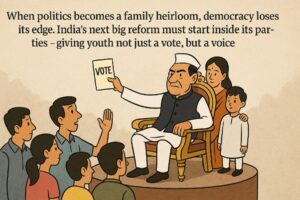
Yet the old parties cannot dismiss this uprising as temporary excitement either. Their decline has deeper roots. Many regional parties have slowly transformed from movements into establishments. Leadership succession narrowed. Internal democracy weakened. Public imagination faded. Welfare politics remained, but inspiration diminished.
And when politics ceases to inspire, societies begin searching elsewhere.
That is precisely what Tamil Nadu may have revealed this week.
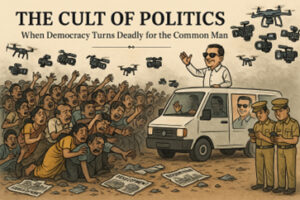
The crowds cheering Vijay are not merely cheering a film star entering politics. They are expressing exhaustion with predictability itself. They are searching for disruption, freshness, emotional connection, and the hope — however uncertain — that someone outside the old system may alter the direction of public life.
Whether that hope matures into governance remains unknown.
But one truth is already visible.
India’s political future may no longer belong automatically to those with the strongest party offices, the oldest symbols, or the deepest organisational history. It may increasingly belong to those who can command imagination in a digital age while still possessing the discipline to build institutions stronger than themselves.
And that will determine whether this new era renews the Republic — or unsettles it.
 Business and Economy
  Education
  Food
Food  Government
  Lifestyle
  Politics
  Travel
  World
World