
The warning lights are beginning to blink across the horizon
By Ravishankar Kalyanasundaram
There are moments in history when warning signals begin to flash quietly across the global landscape. None of them alone may appear decisive, but taken together they tell a story that nations ignore at their own peril.
We may be living through such a moment.
Across the world, the old assumptions that shaped international stability are beginning to fray. Wars break out with shifting justifications. Trade rules change overnight. Supply chains that once symbolised global cooperation are now being used as instruments of political pressure. Economic sanctions are deployed as weapons. Strategic technologies are restricted. Even financial systems are increasingly influenced by geopolitical choices.
Most troubling of all is the quiet erosion of institutions that were once meant to act as the world’s guardrails.
The United Nations was created after the devastation of two world wars to ensure that military action would not become the unilateral decision of powerful nations. The global trading system was built to provide predictable rules for commerce. Multilateral institutions were designed to prevent economic shocks from cascading into geopolitical crises.
Yet today we see wars erupting with limited collective oversight, global trade becoming more fragmented, and supply chains increasingly shaped by strategic rivalries rather than economic efficiency.
These developments should not be viewed by India as distant events unfolding somewhere else. They are early warning signals.
For decades India benefited from a relatively stable global order. Energy markets remained broadly predictable. International trade routes were largely secure. Foreign capital flowed with increasing confidence. Our economic rise took place within a system where rules, however imperfect, were still recognised.
But the world that enabled that growth is beginning to change.
If oil supplies become uncertain, if shipping routes are disrupted, if currencies become volatile or if financial sanctions become more common tools of statecraft, the consequences will be felt immediately in countries like India that are deeply connected to the global economy.
Preparing for such a world requires more than speeches about resilience. It requires discipline.
Energy security must become a strategic priority rather than a periodic concern whenever oil prices rise. Strategic petroleum reserves must be expanded and diversified supply partnerships strengthened. Defence modernisation must accelerate, not merely to deter conflict but to ensure technological readiness in an era where warfare increasingly spans cyber space, autonomous systems and artificial intelligence.
Equally important is the protection of India’s digital infrastructure. In an interconnected global economy, financial systems, logistics networks and communication platforms are as critical to national security as physical borders.
But perhaps the most difficult reform lies closer to home.
Public finances must be placed on a sustainable footing.
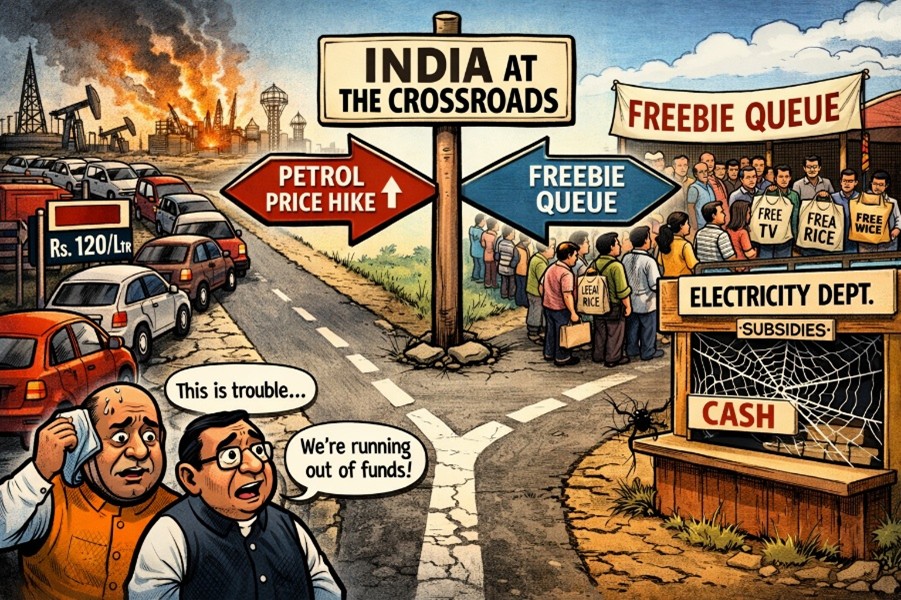
Across many states, competitive populism has produced a cycle of ever-expanding promises—free electricity, loan waivers, cash transfers and subsidies—often announced without clear revenue backing. While social protection is essential for vulnerable populations, unchecked fiscal concessions gradually erode the financial strength of the state itself.
When government resources are stretched thin by short-term political commitments, the nation’s ability to invest in long-term strategic priorities diminishes. Defence modernisation, infrastructure resilience, energy security and technological capability all require sustained investment.
A state that struggles to fund its own strategic needs cannot hope to navigate an uncertain world confidently.
This is where political courage becomes necessary. If fiscal discipline requires difficult decisions, they must be taken. If irresponsible spending threatens national solvency, the Union government may need to use its constitutional authority to restore balance. A Republic cannot allow its financial foundations to weaken simply because electoral competition rewards extravagance.
Institutions must also rediscover their sense of urgency. Courts that rightly guard constitutional freedoms must also recognise that the reckless diversion of public resources is not merely a political matter; it can become a structural threat to national stability.
History has rarely been kind to nations that ignored early warning signals. The decades before the First World War were filled with rising tensions that many leaders dismissed as manageable. The financial excesses preceding the global crises of the twentieth century were often visible long before they erupted.
The lesson is simple: stability rarely collapses overnight. It erodes gradually while societies convince themselves that tomorrow will look much like yesterday.
India stands today at a moment of extraordinary promise. It is one of the fastest-growing major economies, a pivotal player in global supply chains and a nation whose demographic strength offers enormous potential.
But promise alone is not protection.
If the global order is entering a period of uncertainty, India must prepare with clarity and seriousness. Fiscal discipline, energy security, technological capability and defence readiness are not abstract policy choices. They are the foundations upon which national resilience rests.
The warning lights are beginning to blink across the horizon.
The question before us is not whether the world is changing.
It is whether we will prepare before the storm arrives.

 Business and Economy
  Education
  Food
Food  Government
  Lifestyle
  Politics
  Travel
  World
World