
What an ancient Sanskrit maxim taught me about India’s enduring talent for making simple things complicated
By Ravishankar Kalyanasundaram
A few days ago, I borrowed from my cousin, a Sanskrit scholar, an old book with an irresistible title: Laukikanyāyāñjali—A Handful of Popular Maxims Current in Sanskrit Literature. Compiled by Colonel G. A. Jacob and published in three parts in the early twentieth century, it brings together hundreds of Sanskrit nyāyas.
I expected to browse through it for an hour. Instead, it kept me at my desk for days.
Colonel George Adolphus Jacob (1840-1918) was himself an unusual combination of soldier and Sanskrit scholar. He arrived in India in 1857 as a young officer of the Bombay Army and later became Superintendent of Army Schools in Poona. Along the way, he learnt Urdu and Marathi before spending decades studying Sanskrit poetry, drama and philosophy. After retiring to England in 1890, he devoted himself fully to Sanskrit scholarship, producing works on Vedanta, the Upanishads and the Bhagavad Gita. Cambridge University awarded him an honorary Doctor of Letters in 1914.
A British Army officer collecting the everyday wisdom and humour of Sanskrit is itself an interesting story.
Indian philosophy grew from questions raised in the Vedas and explored in the Upanishads: What is truth? How do we acquire knowledge? What is the self? Over time, these enquiries developed into different schools of thought.
One of them was Nyāya, traditionally associated with the sage Akṣapāda Gautama and his Nyāya Sūtra. Nyāya examined how we know something, how an inference is established and what makes an argument valid.
Its familiar illustration was wonderfully simple. We see smoke on a distant hill. From experience, we know that smoke is associated with fire. We therefore infer that there is fire on the hill.
Ancient India had established rules requiring an assertion to be supported by observation and inference—centuries before television debates retained the assertion and discarded the other two.
The great strength of Indian teaching was its ability to bring an abstract idea down to everyday life. A student might struggle with a long philosophical explanation, but would immediately understand a frog trapped in a well, a crow landing as a fruit fell, or a single grain taken from a cooking pot. Familiar objects and common observations became instruments of reasoning.
The word nyāya therefore also came to describe such a maxim—a small, memorable illustration carrying a much larger truth. It was not merely a proverb, but a compact teaching device: philosophy converted into a picture that the student could understand, remember and apply. Difficult ideas thus entered the mind through frogs, crows, cooking pots and elephants.
There is no final or universally accepted count of these nyayas. Different collections contain hundreds of them, gathered from philosophy, logic, grammar, law, medicine, literature, ethics and ordinary social conduct. Their subjects range from cause and effect, perception and evidence to human pride, ignorance, cooperation, chance and sheer foolishness. Let us look at a few of the most popular ones.
A few popular nyayas
Kūpa-maṇḍūka Nyāya is the frog in the well, believing that its little well is the entire world. Today, it might describe someone whose knowledge comes entirely from one WhatsApp group.
Kākatālīya Nyāya concerns a crow landing on a palm tree just as a fruit falls. The events occur together, but one need not
have caused the other – a useful warning in politics and the stock market.
Sthālī-pulāka Nyāya describes testing one grain of rice to determine whether the whole pot is cooked. Modern auditors may recognise an early form of sampling.
Andha-gaja Nyāya, the blind men and the elephant, reminds us that each person may possess only part of the truth while confidently describing the whole. It remains a remarkably accurate account of many committee meetings.
I was enjoying these gems when one expression made me stop and laugh:
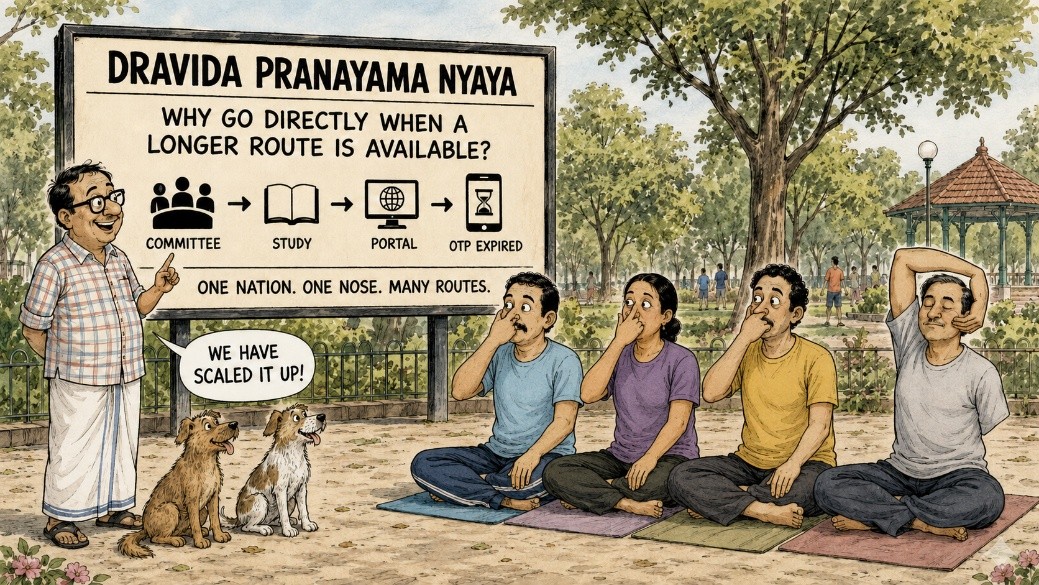
Drāviḍa Prāṇāyāma Nyāya
Prāṇāyāma involves the regulation of breathing, sometimes by closing the nostrils with the fingers. The easiest way to reach the nose is to move the hand directly towards it.
But in Drāviḍa Prāṇāyāma, the hand travels around the head before finally reaching the nose.
The maxim describes doing a simple thing by an unnecessarily complicated and roundabout method.
Why was it attributed to the Drāviḍa?
The honest answer is that we do not know. It may have arisen from a variation in ritual practice, an old regional joke or the imagination of a forgotten scholar.
The word Drāviḍa has referred for many centuries to southern peoples and regions; it long predates modern political movements. The name may therefore preserve no more than an old regional joke.
But that is only a passing historical smile. It would be unfair to turn an amusing maxim into evidence against an entire region.
Whatever its regional origin, the practice has now been adopted nationally – and substantially improved.
A citizen seeking one approval is directed to four departments. The fourth sends him back to the first—with an acknowledgement from the third.
A simple problem is referred to a committee. The committee recommends a study. The study proposes a portal. The portal asks for an OTP. The OTP arrives after it has expired.
Our ancestors merely took the hand around the head to reach the nose.
We have improved the technique. We take it through the ministry, committee, consultant, portal and helpdesk—only to discover that the nose is “temporarily unavailable due to a technical error.”
So, the next time somebody takes the longest route to accomplish the simplest task, do not accuse him of inefficiency.
He is preserving an ancient intellectual tradition.
And please do not blame the South. The whole country has enthusiastically scaled it up.
That, perhaps, is the real spirit of national integration:
One nation. One nose. Many routes.



 Business and Economy
  Education
  Food
Food  Government
  Lifestyle
  Politics
  Travel
  World
World