
How the world’s second-largest sugar producer went from exports to duty-free imports—and added another counter to India’s Dollar Mela
By Ravishankar Kalyanasundaram
India has decided to import one million tonnes of raw sugar without duty. Such an import has not been seen in nearly a decade.
The reason given is understandable. Sugar supplies are tight, prices are rising and the festival season is approaching.
But India is the world’s second-largest producer of sugar. How did a country producing more than 30 million tonnes suddenly find itself searching overseas for another million tonnes?
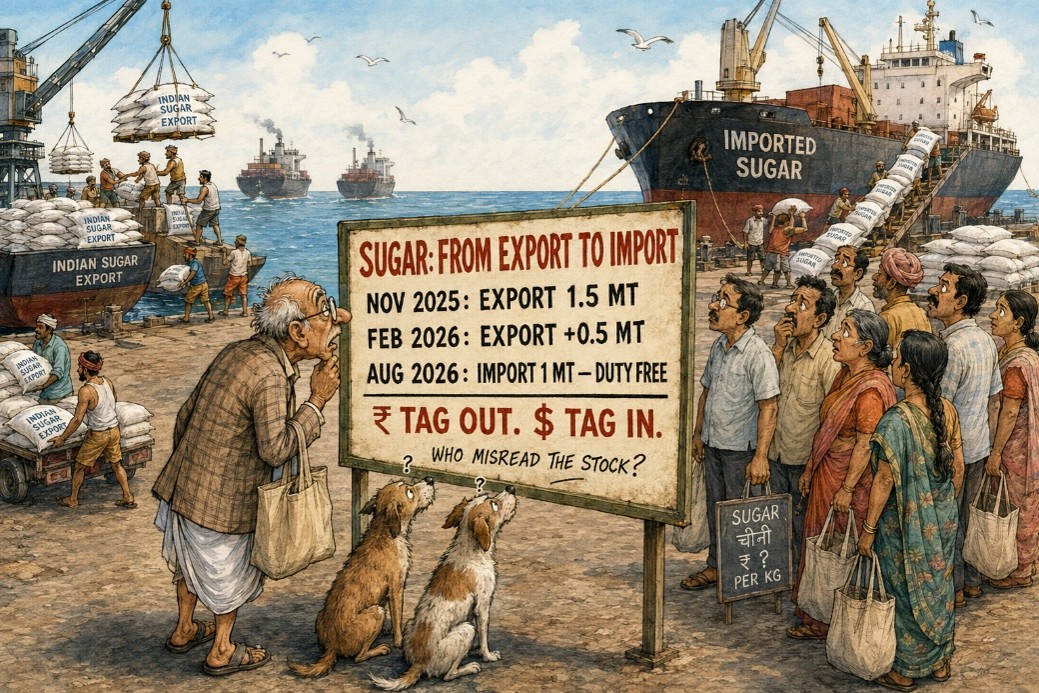
At current prices, the basic import could cost about $550 million—nearly ₹5,000 crore—before freight, insurance and refining expenses.
Another rupee price tag has been replaced by a dollar one, just when the rupee is already under pressure.
What makes the story disturbing is the speed of the U-turn. In November 2025, India permitted the export of 1.5 million tonnes of sugar. In February 2026, it added another 500,000 tonnes. By March, production estimates had fallen sharply. Exports were prohibited in May, stock limits followed, and by August India was preparing to import one million tonnes without duty. In barely six months, we moved from exporting more sugar to searching for it overseas.
In February, India was willing to export more sugar. Six months later, it was preparing to import sugar.
Even if the entire export quota was not used, what produced such a dramatic reversal? Was the crop information poor? Did different government agencies fail to speak to one another? Were decisions influenced by those who stood to benefit?
There may be reasonable explanations. But when exports, bans and imports follow one another within months, citizens are entitled to ask for them.
This reflects poorly on a government committed to doubling farmers’ incomes. Farmers cannot plan cultivation when policy moves between surplus and shortage. Consumers cannot understand why prices rise in one of the world’s largest sugar-producing countries. The country finally pays in dollars for the confusion.
We have watched similar episodes in pulses.
India is the world’s largest producer of pulses, but it is also their largest importer. A shortage develops, prices rise and import restrictions are suddenly removed. India then enters a relatively small international market with a large and urgent requirement. Exporters immediately know that we cannot wait.
Our pulse import bill reached a record $5.54 billion in 2024–25.
By the time the imported pulses arrive, the domestic crop may also enter the market. Prices fall, farmers suffer, cultivation becomes unattractive and the next shortage begins to form.
Jute has shown another strange contradiction. India has had large stocks of raw jute and farmers receiving prices below the minimum support price. Yet mills have complained about shortages of the grades they require, and imports have continued.
How can there be surplus stocks, distressed farmers and factories without adequate material at the same time?
The answer lies somewhere between procurement, quality, storage, transportation and coordination.
Is ethanol responsible for the sugar shortage?
The Government says no. It says sugar diversion to ethanol has declined and grain now provides most of India’s ethanol. Let us accept that explanation—but with a pinch of salt.
When sugar production estimates began falling, could more ethanol have been made from damaged grain, broken rice and the huge surplus rice held by the Food Corporation of India? Could cane diversion have been reduced earlier to protect the sugar buffer?
These questions require simple answers.
India has already shown that it can successfully connect millions of farmers with millions of consumers. Look at milk.
India produced nearly 248 million tonnes of milk in 2024–25—about 68 crore litres every day. Much of it comes from small farmers scattered across thousands of villages. Milk is far more perishable than sugarcane, sugar, jute or pulses. It cannot wait in a village for a committee to meet or a file to move.
Yet every morning and evening, milk is collected near the farmer. Its quality is tested. The farmer is paid. It is chilled, transported, processed, packed and delivered to cities and towns.
Dairy cooperatives alone procure around 6.5 crore litres a day. This enormous movement happens every day—not once a season.
What made it possible?
The cooperative model brought procurement close to the farmer. Processing capacity and chilling facilities were created alongside production. Transportation connected villages to dairies and dairies to markets. The farmer, processor and consumer became part of one chain.
This five-decade spectacle is one of India’s greatest management achievements.
Sugarcane is not milk, and the same structure cannot simply be copied. But the principle can: reliable local information, assured procurement, immediate quality assessment, adequate processing, scientific storage and an uninterrupted connection to the final market.
If India can move 68 crore litres of highly perishable milk every day, surely it can build a dependable national system for sugar, pulses, jute and foodgrains.
India cannot enter global commodity markets like a distressed household visiting the neighbourhood shop after its kitchen shelf is empty. Our demand is too large, our arrival too visible and the rupee already too vulnerable.
Sugar may add only half a billion dollars to the import bill. But it exposes a much larger weakness.
We produce abundantly, store inefficiently, forecast separately, export prematurely and import urgently.
When governments do not explain such contradictions, they should not be surprised when citizens view every policy decision—and every public protest—with growing concern.
In a country searching everywhere for dollars, better coordination may be the cheapest source of foreign exchange.
 Business and Economy
  Education
  Food
Food  Government
  Lifestyle
  Politics
  Travel
  World
World