
Selling shares may balance this year’s accounts. But can it build the capabilities India needs for a turbulent world?
By Ravishankar Kalyanasundaram
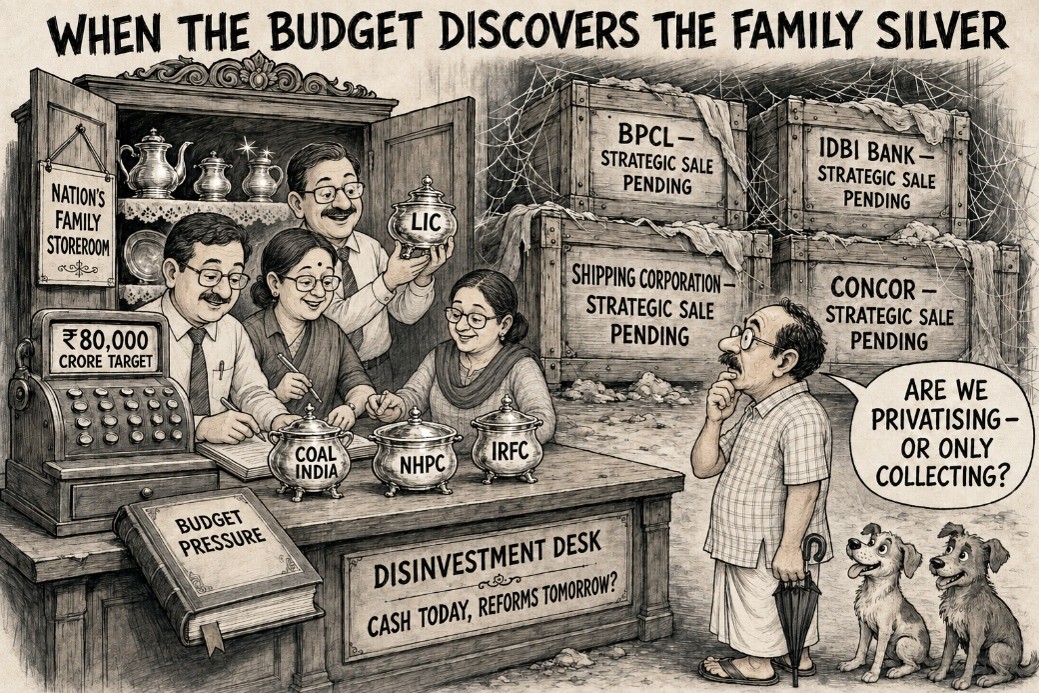
Last week, the Government raised about ₹31,550 crore by selling a 6.5% stake in Life Insurance Corporation of India—the country’s largest-ever Offer for Sale. Together with earlier sales in Coal India, NHPC and Indian Railway Finance Corporation, the Government now expects to exceed its ₹80,000 crore target for disinvestment and asset monetisation.
That is an impressive financial achievement. But has India moved any closer to the transformation it urgently needs?
We are witnessing Tsunami of events, technology, geopolitics and we cannot meet this turbulence by preserving yesterday’s institutions exactly as they are. We need enterprises with fresh capital, new technology, professional freedom and the ability to compete in global markets. That was supposed to be the larger purpose of strategic disinvestment.
Instead, whenever the Budget comes under pressure, an old cupboard seems to attract attention. Inside it lies the family silver—valuable, familiar and available for sale.
Disinvestment sells a few shares while the Government retains control. Privatisation transfers control to an owner capable of bringing capital, technology, global reach and accountability. Asset monetisation unlocks money from mature infrastructure to build new assets. All three are useful—but raising cash cannot be presented as progress on privatisation when ownership, management and performance remain unchanged.
In 2021, the Government announced an ambitious strategic-disinvestment programme. BPCL, Air India, Shipping Corporation, CONCOR, IDBI Bank, BEML, Pawan Hans and Neelachal Ispat Nigam were expected to be completed in 2021–22. Two public-sector banks and one general insurer were also to be privatised.
Air India and Neelachal Ispat Nigam were successfully transferred to the Tata Group—meaningful because control actually changed. But five years later, much of the list remains unfinished. BPCL is still government-owned. The CONCOR sale was never launched. Shipping Corporation became entangled in restructuring. BEML and Pawan Hans remain caught in prolonged processes.
The case for privatisation is not about selling companies for cash. It is about unlocking the value of strategic assets built over decades. CONCOR’s rail terminals and port connections could become the backbone of agricultural exports—linking scientific storage, cold chains and packhouses directly to global markets. BPCL’s pipelines, depots and retail network could accelerate biofuels, green hydrogen and electric mobility, reducing oil imports and creating rural income. Shipping Corporation could strengthen India’s maritime resilience, while BEML could expand in defence, metro systems and advanced engineering.
These are not dying companies awaiting auction. They are national platforms waiting to be reinvented.
Government management understandably concentrates on continuity, procedure, vigilance and avoiding controversy. Transformation demands freedom to invest quickly, attract global talent, discontinue obsolete activities and enter new markets. Status quo management protects what exists. Strategic ownership asks what the same assets could become.
The question is not:
“How much can we get by selling CONCOR or BPCL?”
It is:
“How much value, employment, exports and foreign-exchange savings are we losing every year by leaving them unchanged?”
The LIC sale has legitimate advantages. It broadens ownership, improves liquidity and takes public shareholding towards the required 10%. But selling another block of LIC shares is much easier than transferring control of a public enterprise. It raises money without confronting the political, administrative and valuation difficulties of genuine reform.
It may help manage this year’s accounts. It may even quieten criticism in Parliament and the press. But it cannot compensate for the years lost in building national capability.
Selling shares is an accounting transaction. Privatisation is an economic reform. The first produces immediate receipts; the second requires political conviction, realistic valuation, regulatory clarity and the willingness to let go.
 Business and Economy
  Education
  Food
Food  Government
  Lifestyle
  Politics
  Travel
  World
World