
India does not suffer from a shortage of research budgets, laboratories or announcements. It suffers from institutions that are rarely asked one simple question: what usable product emerged, who adopted it, and how much waste, hardship or foreign exchange did it save?
By Ravishankar Kalyanasundaram
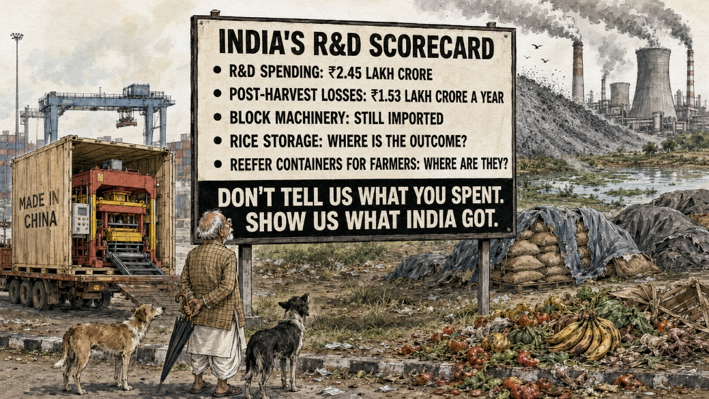
India reportedly spent ₹2.45 lakh crore on research and development in 2023–24, up from ₹2.13 lakh crore the previous year. The figure is impressive only until we look outside the conference hall. Agricultural produce continues to be lost, factories import machinery that Indian institutions should have designed, and the world’s largest banana producer remains a marginal exporter. Are we celebrating money spent or problems solved?
The Government has advised industry to spend more, and yes Industry must do more, but should the Government not first demand outcomes from the institutions under its own control?
My concern is not theoretical. In the 1980s, I worked with one of India’s premier technical institutions to develop a dependable machine for manufacturing concrete blocks from fly ash. My NRI chairman was willing to fund it. Thermal plants were creating an environmental problem, construction needed affordable materials, and private money was available to convert waste into wealth.
What emerged was an archaic contraption that was not even fully fabricated. It was taken to a leading port for trial and rejected. Forty years later, visit our concrete-block factories and ask where their dependable automated machinery comes from; From China. The problem, waste, market and funding were Indian, but the usable machine did not emerge. What was the value of the research?
India’s thermal plants generated about 340 million tonnes of fly ash in 2024–25. After decades of experience, where are the affordable Indian machines that can turn it into high-quality blocks, panels, pavers and prefabricated components?
The cost becomes more painful when we turn to food. A government-cited study estimated post-harvest losses across major agricultural commodities at about ₹1.53 lakh crore. Cereals alone accounted for 12.49 million tonnes valued at over ₹26,000 crore. The farmer completes the hardest part, and the country then allows his produce to go waste.
The Food Corporation of India has handled grain for more than sixty years. It knows where moisture enters and how repeated bagging, stacking and loading cause damage. Why has this experience not produced an affordable Indian system for automated handling, scientific storage and real-time quality monitoring? These are problems inside FCI’s warehouses, not mysteries on the Moon. Even a small reduction would save thousands of crores, yet we admire procurement and storage capacity without demanding proof of grain preserved.
The failure becomes impossible to ignore when we look at bananas. India is the world’s largest producer, accounting for about 26% of global production. In 2022–23, we produced 35.36 million tonnes, but exported only 0.36 million tonnes worth $176 million, giving India barely 1% of the global export market.
Ecuador exported bananas worth about $3.79 billion in 2023, while Guatemala exported more than $1.12 billion. They do not defeat India in production; they defeat us in what follows—grading, packhouses, refrigeration, specialised containers, shipping schedules and dependable connections to buyers.
Where is CONCOR in this story? It has terminals, containers, railway connectivity, logistics expertise and access to ports. Should it not have been the architect of a national supply chain carrying bananas from Andhra Pradesh, Maharashtra and Tamil Nadu to markets in Europe, Russia and East Asia? Why has it not designed affordable multimodal refrigerated containers suited to Indian distances, temperatures, power conditions and farmer economics?
The farmer cannot build packhouses, refrigerated rail services, specialised containers and overseas distribution networks. That is why India created national institutions. CONCOR should not wait for cargo to reach its terminal; it should design the journey from the farmer’s field to the global consumer. One functioning banana corridor would be worth more than a hundred presentations on agricultural logistics.
The common thread is institutional risk aversion. A public-sector manager who funds an experiment that fails may face audit objections and years of questioning, while the manager who permits an old loss to continue is rarely troubled. Inertia becomes the safest career decision even when it is the costliest decision for the country.
India needs a protected framework for honest, approved experimentation. Every major government agency and public-sector company should publish its ten costliest unresolved problems, quantify their national cost and state how it will solve them. IITs, startups and private engineers should receive
operating data, trial facilities and a path to procurement when a solution works. Executives should be judged not only by grain procured, containers moved or electricity generated, but by waste prevented, imports replaced and public money saved.
A better grain silo is research. An affordable banana container is research. A machine that turns fly ash into a reliable building product is research. These may not produce the spectacle of a rocket launch, but they can protect farmers, conserve dollars, reduce pollution and improve everyday lives.
The ₹2.45 lakh crore figure tells us what India spent. Until it tells us what India saved, what import it replaced and whose hardship it removed, it remains only expenditure. India has funded enough research to demand something more than papers, pilots and promises. It is time India demanded delivery.
 Business and Economy
  Education
  Food
Food  Government
  Lifestyle
  Politics
  Travel
  World
World