
India occasionally announces a bold reform—and then appears to become nervous about its own courage.
By Ravishankar Kalyanasundaram
The recent decision permitting foreign-funded e-commerce companies to own Indian-made inventory for exports was one such bold move. It could have connected thousands of small Indian manufacturers to global consumers. E-commerce companies could identify promising products, aggregate supplies from different regions, test them in foreign markets, maintain stocks nearer to customers and handle delivery and returns professionally.
That was the promise.
Then came the fine print.
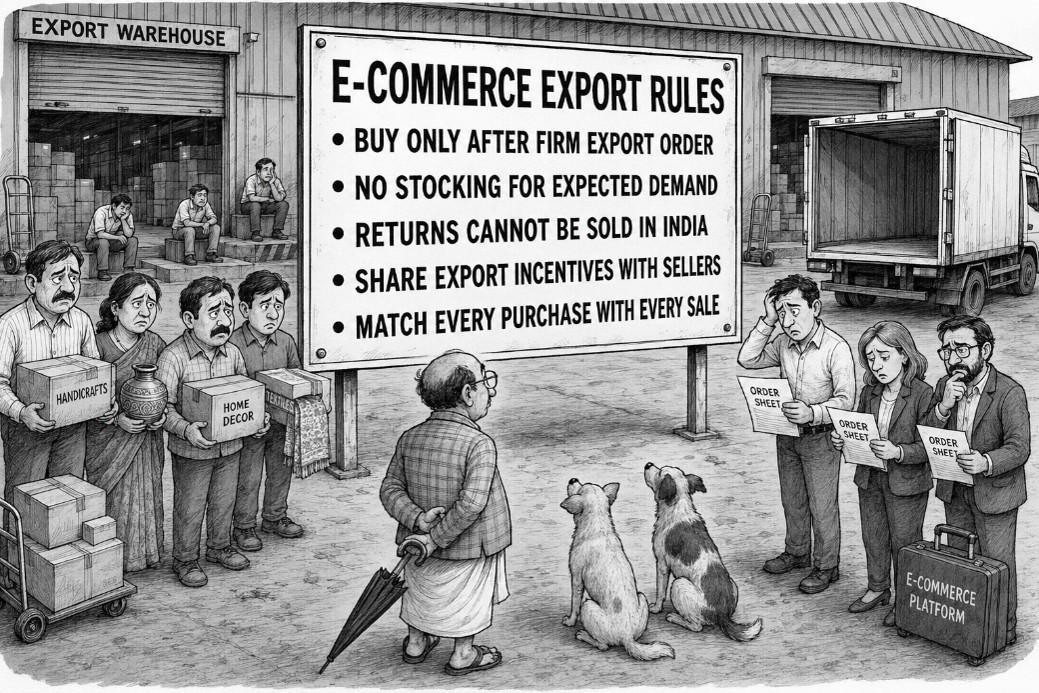
Under the framework notified by the Directorate General of Foreign Trade, an e-commerce exporter can acquire goods from an Indian seller only after receiving a confirmed order from an overseas buyer. It cannot purchase goods merely because it believes there will be demand.
But is that not the very meaning of holding inventory?
A supermarket does not wait for a customer to order a packet of biscuits before buying it from the manufacturer. A fashion retailer does not procure a shirt only after someone has selected its colour and size. Modern commerce works because someone studies the market, anticipates demand, takes a commercial risk and keeps the goods ready.
Cross-border e-commerce works in exactly the same way—only speed and product availability matter even more.
Suppose an e-commerce company discovers attractive handicrafts from Rajasthan, garments from Tiruppur, footwear from Agra and kitchenware from Rajkot. It should be able to consolidate these products, place a trial quantity in an overseas warehouse and learn what sells. One product may succeed in Germany, another in America and a third may find no buyers at all.
That process is not misuse. It is market discovery.
By insisting upon a confirmed foreign order before ownership can pass, we are effectively asking the exporter to find the customer before it is allowed to build the shop.
The treatment of returns is equally troubling. Goods exported under this arrangement and subsequently returned cannot be sold in India.
Returns are not an exception in e-commerce. They are part of the business model. A foreign customer may return a product because of size, colour, delayed delivery, damaged packaging or simply a change of mind. The platform may already have refunded the buyer. If the product still has economic value, who is better placed than the e-commerce company to inspect, refurbish, repackage or resell it?
Preventing its sale in India does not protect Indian commerce. It merely converts usable merchandise into avoidable waste. Suitable safeguards can certainly be imposed—payment of applicable duties and taxes, proper disclosure and digital tracking. But destroying value should never become a regulatory objective.
The requirement that export incentives and refunds be passed back proportionately to the Indian sellers also sounds attractive until we examine the economics.
Once the e-commerce company purchases the goods, pays the supplier and assumes the risks of storage, marketing, discounting, freight, foreign exchange and returns, the export incentive should logically form part of the exporter’s economics. If the Government wants the original manufacturer to receive the benefit, it could prescribe that this be reflected transparently in the procurement price. Asking the exporter to calculate and distribute incentives afterwards across thousands of sellers and transactions will create reconciliations, disputes and another industry of certificates.
The requirement to digitally match every purchase with the corresponding overseas sale may help prevent diversion into the Indian market. That objective is understandable. But if implemented as a rigid one-to-one matching exercise, it could become operationally exhausting when products are consolidated, repacked, bundled, discounted or partially returned.
Contrast this with China.
China does not merely permit businesses to export through overseas warehouses; it actively promotes them. Its policies allow goods to be shipped abroad and stocked before the final customer has purchased them. From 2025, eligible exporters using overseas warehouses could claim a preliminary tax refund when the goods left China—even when they remained unsold. China has also simplified the return of cross-border e-commerce goods by allowing them to enter through designated customs locations rather than necessarily returning through the original export point and show a government trying to remove commercial friction.
The United States regulates exports seriously, particularly restricted products, sanctioned destinations and prohibited end-users. But for ordinary merchandise, its system focuses on what is exported, where it is going and whether the transaction complies with export-control and customs laws. It does not generally tell an exporter that goods may be acquired only after a foreign buyer has placed an order. Indeed, the US Commercial Service advises businesses to conduct market research, formulate pricing strategies and develop overseas distribution systems—the normal activities of enterprises taking market risk.
China says: build warehouses, test markets and go global.
America says: comply with the law, but go and compete.
India appears to say: go global—but first show us the customer, the order, the seller, the incentive calculation, the product trail and what you will do if the customer sends it back.
Safeguards are necessary because the relaxation should not become a back door for foreign-funded inventory-based retail within India. But safeguards must target diversion and abuse, not eliminate commercial freedom itself.
A more sensible framework would permit procurement based on reasonable demand forecasts, impose aggregate inventory limits, require a clear digital audit trail, allow returned goods to be re-exported or sold domestically after taxes are paid, and let procurement contracts determine how export incentives are shared.
India’s manufacturers do not need another carefully controlled experiment. They need businesses willing to take their products to the world—and, importantly, willing to take the risk.
We opened the door to a promising export initiative. Let us not now block the doorway with files, registers and fine print.
 Business and Economy
  Education
  Food
Food  Government
  Lifestyle
  Politics
  Travel
  World
World