
From currencies and oil prices to wars, migration and artificial intelligence, the world is confronting multiple crises simultaneously — and for the first time in decades, even governments appear uncertain whether the turbulence can truly be contained.
By Ravishankar Kalyanasundaram
There was a time when the world feared one crisis at a time. A war. A recession. An oil shock. A banking collapse. Governments mobilised around visible emergencies and citizens at least understood what they were confronting.
Today, that clarity itself appears to be disappearing.
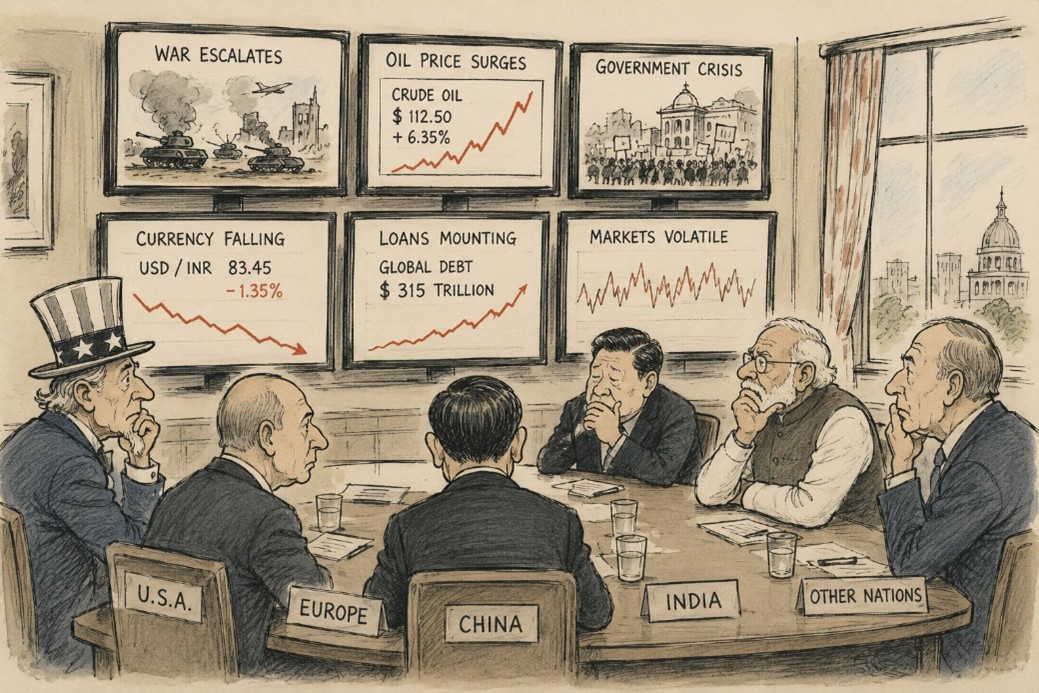
The modern world is entering what policymakers increasingly describe as an age of “polycrisis” — a dangerous phase where multiple crises erupt simultaneously, feed into one another and create a continuous atmosphere of uncertainty from which no country seems fully insulated.
Currencies are under pressure. Bond markets are nervous. Oil prices react instantly to missile strikes and shipping disruptions. Freight rates fluctuate with geopolitical tensions. Interest rates remain elevated across major economies. Public debt has exploded across continents. Even countries once considered symbols of stability now appear financially stretched and politically anxious.
America itself carries debt exceeding $36 trillion while investors increasingly watch US Treasury yields with concern. Europe struggles with weak growth, energy insecurity and political fragmentation. China faces slowing growth, demographic decline and prolonged stress in its property sector. Japan continues under the weight of enormous public debt and a weakening yen. Emerging economies battle volatile capital flows, currency depreciation and rising import costs.
Even India, despite remaining among the world’s fastest-growing major economies, is not insulated. Oil prices, global capital movements, supply-chain disruptions and currency pressures now influence inflation, fiscal planning and investment decisions almost continuously.
And unlike earlier crises, there is no clear centre of control anymore.
During the 2008 financial crisis, the world knew the problem was banking contagion. During Covid, humanity identified a visible enemy. During world wars, nations mobilised around defined conflict.
But what exactly is the world fighting today?
War in Europe continues to reshape energy and defence priorities. The Middle East remains inflamed. Climate shocks are damaging agriculture and food systems across continents. Artificial intelligence is disrupting assumptions about employment and economic security. Migration pressures are reshaping domestic politics. Cyberattacks now carry the ability to disrupt ports, logistics systems, pipelines and banking infrastructure remotely.
Everything now appears connected to everything else.
One election moves currencies. One drought pushes food inflation globally. One military escalation affects shipping costs, aviation fuel and bond markets. One cyberattack can disrupt supply chains across multiple countries simultaneously.
The old assumption that economics, geopolitics, technology and security could be managed separately is quietly collapsing.
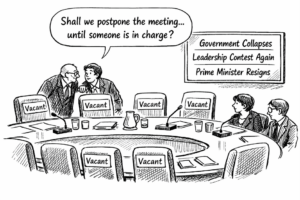
And perhaps the most unsettling part of this moment is the visible uncertainty among world leaders themselves.
Across the world, governments appear reactive rather than decisive. Meetings are held. Summits are announced. Statements are issued. Yet conflicts continue to spread, debt continues to rise, societies continue to polarise and markets continue to remain fragile.
This raises an uncomfortable question now quietly emerging across societies.
Is it that world leaders themselves no longer fully understand the solutions? Or are the crises now so interconnected that even powerful nations are unable to resolve them decisively?
The wars remain unresolved. Inflation remains persistent. Migration pressures continue. Climate targets drift further away. Global institutions increasingly appear weakened. Even diplomatic engagement now seems more focused on containing instability rather than solving it.
Perhaps governments also fear speaking too openly about the scale of uncertainty because societies themselves already appear fatigued and anxious. Publicly, leaders continue to speak the language of resilience and confidence. Privately, however, nations are preparing for prolonged instability by increasing defence spending, securing supply chains, protecting energy systems and strengthening cyber capabilities.
That contradiction itself may define this era.
The public narrative still speaks of recovery. But the underlying systems increasingly prepare for disruption.
And this may explain why societies across democracies feel restless even when economic numbers appear respectable on paper. People sense uncertainty before institutions formally acknowledge it. They see prices fluctuating unpredictably, jobs becoming fragile, technology moving too quickly and politics becoming angrier.
For decades humanity believed globalisation, technology and interconnected markets would steadily reduce uncertainty and create stability. Instead, interconnectedness itself now appears to be amplifying vulnerability.
And so perhaps the greatest fear emerging across the world today is no longer merely war, inflation or recession.
It is unpredictability itself.
What happens to businesses when forecasting becomes unreliable? What happens to democracies when anxiety becomes permanent? What happens to societies when citizens slowly lose confidence that anyone is fully in control?
That may ultimately become the defining question of our age.
 Business and Economy
  Education
  Food
Food  Government
  Lifestyle
  Politics
  Travel
  World
World