
How will India reduce a $100-billion trade deficit without a strategy to manufacture what it imports?
By Ravishankar Kalyanasundaram
India’s economic relationship with China presents a curious contradiction.
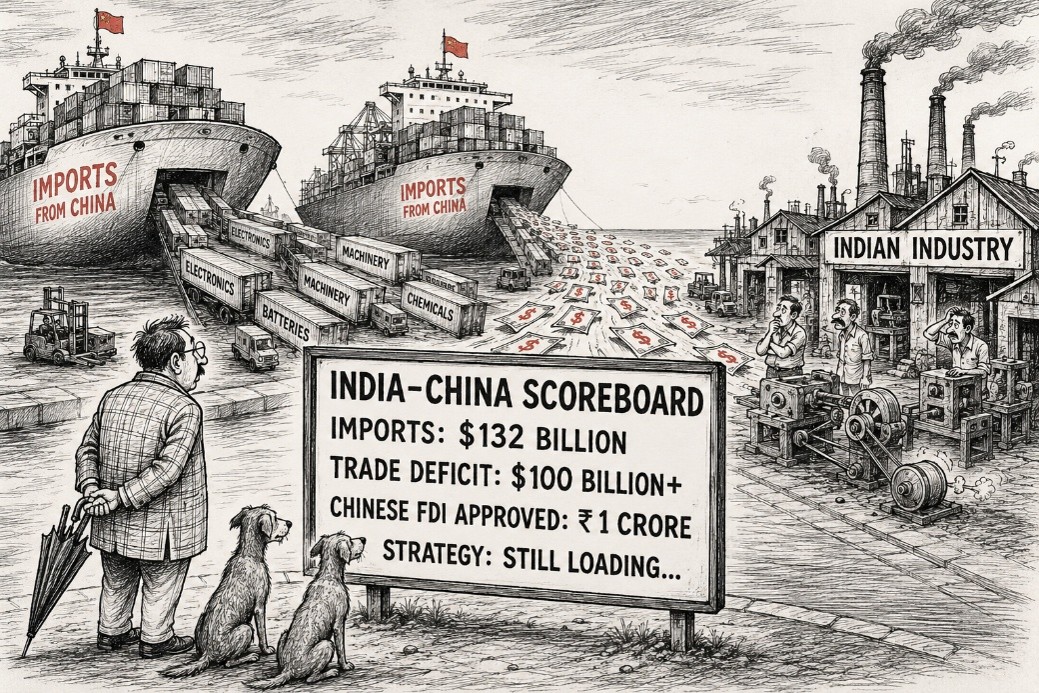
In FY2025–26, India imported goods worth nearly $132 billion from China, while total bilateral trade stood at around $151 billion. The resulting trade deficit crossed $100 billion.
Yet, during the same year, India reportedly approved only one direct Chinese investment proposal—worth just ₹1 crore.
We are reluctant to allow Chinese companies to establish factories in India. But we have no similar hesitation in buying billions of dollars of goods from their factories in China. China gets the investment, technology, employment and value addition. India gets the goods—and the invoice.
Where is the strategy in this?
How deep is this dependence? Of the $132 billion imported from China in FY2025–26, nearly two-thirds comprised electronics, machinery, chemicals and metals. China supplies 66–86% of India’s imports in several critical pharmaceutical ingredients and dominates solar cells, battery components and rare-earth magnets. India’s mobile-phone production has impressively risen from ₹18,900 crore to ₹6.27 lakh crore in eleven years, with exports reaching ₹2.60 lakh crore. Yet domestic value addition across electronics remains only around 20–23%, as chips, displays, batteries and other valuable components are still largely imported.
We proudly announce gross exports, but rarely disclose the imported content or the net value India retains. Should we continue sending dollars to Chinese factories—or strategically bring those factories, technologies and jobs to India?
If we measure only production and exports, we may celebrate assembly while overlooking the continuing leakage of dollars.
When caution begins to cost India
Security concerns following the border clashes were understandable. But caution without a long-term economic strategy can itself become costly.
BYD’s proposed $1-billion automobile investment was rejected. Great Wall Motor abandoned a similar $1-billion plan after approvals did not arrive. SAIC had to reduce its ownership and bring JSW into MG Motor, while further investments faced delays.
Did these decisions reduce India’s need for Chinese automobile technology, battery cells, electronic systems or machinery?
Or did they merely ensure that more of them continued to be imported?
Restrictions on Chinese machinery and delays in issuing business visas created shortages of technicians and held up production in Indian factories. Access to rare-earth magnets and other critical Chinese inputs has remained unpredictable.
The result is extraordinary. We keep Chinese investment outside the gate, but allow Chinese components to enter through the loading dock.
Indian manufacturing bears the delay and additional cost. China still makes the product and earns the foreign exchange.
Incentives without measuring the outcome
Production-linked incentives have increased investment and output, but where is the regular public scorecard showing the reduction in import dependence, foreign exchange saved, critical components localised and technology transferred? Policies are announced, targets displayed and incentives disbursed with great enthusiasm; their deeper outcomes are rarely monitored with the same urgency. India cannot build an industrial economy by rewarding production without measuring indigenisation.
Use Chinese investment to reduce Chinese imports
India does not need to open every sector without safeguards.
All the same, India should identify the products responsible for the largest and most persistent imports from China. Chinese and other global manufacturers should then be invited to establish factories here under carefully structured arrangements.
The business model must be attractive enough for Chinese companies to see greater and more sustainable revenue from manufacturing in India than from merely exporting to us. We cannot always insist on Indian ownership and management control if that makes the investment commercially unattractive. The structure should vary by sector: strategic industries will require firm security safeguards, while non-sensitive manufacturing can permit meaningful foreign ownership, operational freedom and reasonable returns.
The need of the hour is commercial pragmatism—welcoming capital and technology where India urgently needs them, without compromising long-term national security.
Where is the urgency?
India has had an automobile industry for more than eight decades, but it took companies such as Hyundai to make the country a serious passenger-car exporter. In FY2025–26, Hyundai exported 1,90,125 vehicles—nearly one in every four it sold. Mobile phones tell a similar story. Foreign investment brought not only money, but technology, scale, production discipline and global markets. We must honestly recognise that Indian enterprise alone may take too long to build every critical capability.
Technology is advancing rapidly while tariffs, immigration barriers, wars and geopolitics threaten our exports. Yet reports diagnosing import dependence continue to appear, while the urgent, measurable programme for localisation and foreign-exchange savings remains unclear. We celebrate modest FTAs without asking what India will competitively manufacture and sell through them.
Every year of hesitation sends more dollars abroad, leaves technology outside and creates jobs elsewhere. Dollar conservation is now the need of the hour. India must attract capital and technology—including strategically selected Chinese investment—to manufacture here what we presently import.
The border must certainly be guarded, but the nation’s balance sheet must be guarded with equal urgency.


 Business and Economy
  Education
  Food
Food  Government
  Lifestyle
  Politics
  Travel
  World
World