
If those who spent their youth building this nation must spend their final years battling isolation, uncertainty and neglect, perhaps the question is not whether India is becoming a developed nation, but whether it is becoming a compassionate one.
By Ravishankar Kalyanasundaram
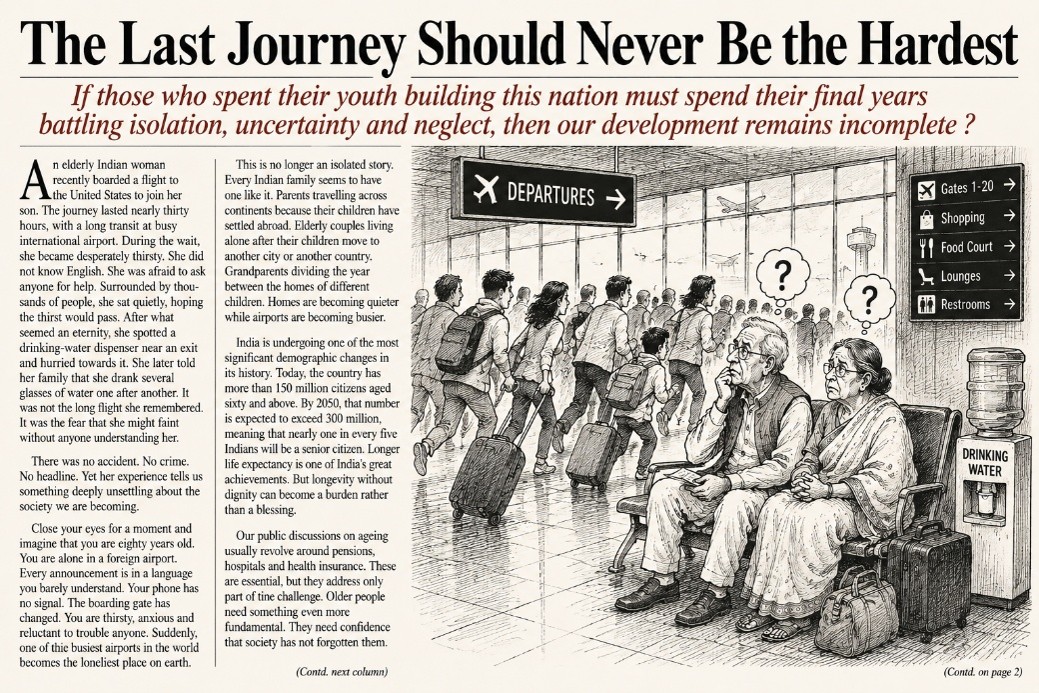
An elderly Indian woman recently boarded a flight to the United States to join her son. Family circumstances had left her with little choice. The journey lasted nearly thirty hours, with a long transit at a busy international airport. During the wait, she became desperately thirsty. She did not know English. She was afraid to ask anyone for help. Surrounded by thousands of people, she sat quietly, hoping the thirst would pass. After what seemed an eternity, she spotted a drinking-water dispenser near an exit and hurried towards it. She later told her family that she drank several glasses of water one after another. It was not the long flight she remembered. It was the fear that she might faint without anyone understanding her.
There was no accident. No crime. No headline. Yet her experience tells us something deeply unsettling about the society we are becoming.
Close your eyes for a moment and imagine that you are eighty years old. You are alone in a foreign airport. Every announcement is in a language you barely understand. Your phone has no signal. The boarding gate has changed. You are thirsty, anxious and reluctant to trouble anyone. Suddenly, one of the busiest airports in the world becomes the loneliest place on earth.
This is no longer an isolated story. Every Indian family seems to have one like it. Parents travelling across continents because their children have settled abroad. Elderly couples living alone after their children move to another city or another country. Grandparents dividing the year between the homes of different children. Homes are becoming quieter while airports are becoming busier.
India is undergoing one of the most significant demographic changes in its history. Today, the country has more than 150 million citizens aged sixty and above. By 2050, that number is expected to exceed 300 million, meaning that nearly one in every five Indians will be a senior citizen. Longer life expectancy is one of India’s great achievements. But longevity without dignity can become a burden rather than a blessing.
Our public discussions on ageing usually revolve around pensions, hospitals and health insurance. These are essential, but they address only part of the challenge. Older people need something even more fundamental. They need confidence that society has not forgotten them.
Think of the countless ordinary situations that become extraordinary challenges with age. Navigating immigration counters, reading digital boarding passes, changing flights, booking railway tickets through mobile applications, renewing pensions online, updating identity documents, registering at hospitals or simply understanding automated announcements. Technology has simplified life for many, but for millions of elderly citizens it has quietly erected barriers that did not exist a generation ago.
Equally important is the emotional burden. Many elderly parents leave behind lifelong friendships, familiar neighbourhoods and cherished routines to live with their children abroad. They arrive in comfortable homes but often find themselves confined by language, climate, unfamiliar surroundings and dependence on others for even the smallest daily tasks. Material comfort cannot always compensate for the loss of belonging.
The challenge extends far beyond families separated by oceans. Millions of India’s lower and middle-income senior citizens face an equally uncertain future. Many continue to work well into their seventies, not because they seek purpose but because their savings are inadequate. Widows live alone with little financial security. Elderly couples struggle to navigate digital banking, healthcare systems and government services that increasingly assume technological literacy. Some countries have recognised that ageing requires coordinated public policy rather than isolated welfare schemes. Singapore, for instance, has steadily developed age-friendly housing, integrated healthcare, community support and active-ageing programmes that enable seniors to live independently with dignity for longer. India, too, must begin looking beyond pensions and hospitals. The question is no longer whether we can afford to invest in our elderly; it is whether we can afford not to.
If reports that states are considering dedicated institutional mechanisms for senior citizens gather momentum, they deserve serious national attention. Such initiatives should not be viewed merely as the creation of another government department. They should become a commitment to coordinate healthcare, transport, housing, legal protection, digital assistance, social participation and emergency support for one of the fastest-growing sections of our population.
Government, however, cannot replace society. Schools can encourage students to spend time with elderly neighbours. Resident welfare associations can organise volunteer support for those living alone. Airports and railway stations can provide multilingual assistance for senior travellers. Banks and hospitals can simplify procedures instead of assuming every customer is digitally confident. Businesses can build products and services that help older adults live independently rather than merely survive. Small acts of consideration often restore more dignity than expensive schemes.
A nation becomes developed not when its airports become larger, its expressways faster or its skylines taller. It becomes truly developed when an elderly woman can travel across the world without fear, when an old couple can grow old without becoming a burden, and when advancing age is met not with loneliness but with respect. Every bridge, factory and technology that India builds is ultimately meant to improve human life. If those who spent their youth building this nation must spend their final years battling isolation, uncertainty and neglect, then our development remains incomplete.
Somewhere today, another elderly mother will board a flight to join her children. Another elderly father will struggle to read a digital boarding pass. Another grandparent will quietly hide their fear so as not to worry the family waiting at the other end.
They do not ask for luxury. They do not ask for privilege. They ask only for what they spent a lifetime giving us—care, patience and a reassuring hand when the journey becomes difficult.
The last journey should never be the hardest.

 Business and Economy
  Education
  Food
Food  Government
  Lifestyle
  Politics
  Travel
  World
World