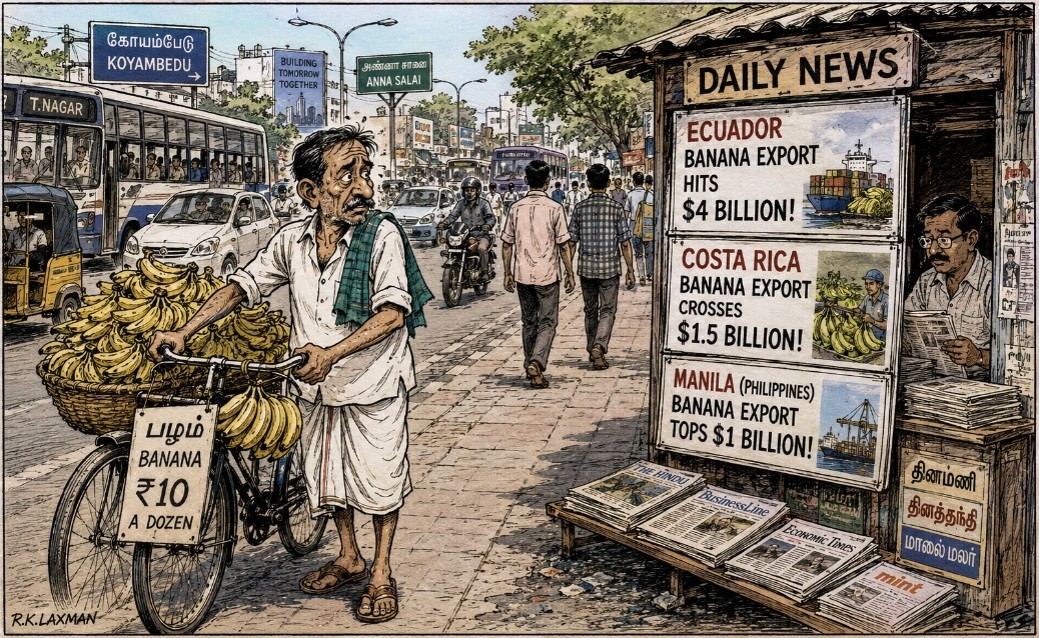

If small countries can build billion-dollar export industries around a single fruit, what is preventing India and Tamil Nadu from doing the same?
By Ravishankar Kalyanasundaram
The new Chief Minister Vijay’s initiative to promote banana exports deserves attention because it addresses a simple but important question. Why does India, the world’s largest producer of bananas, earn so little from a product that has created billion-dollar export industries in several much smaller countries? At a time when India is searching for every possible source of foreign exchange, rural employment and farmer prosperity, the answer may lie not in what we produce, but in what we fail to export.
We produce over 35 million tonnes of bananas every year, accounting for roughly one quarter of global production and no other country comes close and yet our exports remain dismal, barely USD 176 million.
The contrast with even small countries elsewhere in the world.
Ecuador, a country with a population of barely 18 million people, exports more than USD 4 billion, Philippines well over USD 1 billion from and Costa Rica and Guatemala each generate more than a billion dollars a year from the same banana. These countries are not agricultural giants. They do not possess India’s scale, domestic market or production capacity. Yet they have succeeded in transforming bananas into a significant source of foreign exchange and rural prosperity.
If these small countries that produce far less than India can earn billions of dollars from banana exports, What holds us back?
The challenge begins after the crop leaves the farm. A fruit destined for international markets requires a seamless chain of collection, grading, packing, cold storage, refrigerated transportation, quality certification and reliable logistics. Weakness in any one of these links can destroy value. Unfortunately, this is precisely where India has underinvested for decades.
The Netherlands offers a useful lesson. The country is smaller than Tamil Nadu and has a population of only around 18 million people. Yet it exports agricultural products worth more than €137 billion annually. The Dutch did not achieve this because they possess better weather, cheaper labour or larger farms. They achieved it because they built world-class systems connecting farmers to consumers across the globe. Every stage, from cultivation to logistics and market access, is professionally managed with a relentless focus on quality, consistency and speed.
Tamil Nadu now has an opportunity to learn from such examples and build a model that can be replicated across India. The state should identify major banana-producing clusters and develop integrated cold-storage infrastructure close to the farms. Dedicated reefer transportation networks should connect these production centres to ports and airports.
Equally important is the need to rethink how export promotion is approached. For decades, agricultural exports have largely been driven through government departments, committees and schemes which yielded marginal outcomes. Tamil Nadu should think afresh and engage powerful international consulting firms with deep global market connections. They should structure the entire approach to compete successfully in international markets.
The global opportunity extends well beyond bananas and could well be the answer to the constant challenge of foreign exchange. The promotion benefits directly the farmers and rural economy. Few sectors offer such a broad range of economic benefits.
Tamil Nadu has the potential to become India’s benchmark for agricultural export excellence by demonstrating how production can be converted into prosperity through infrastructure, professional management and global market access. If the state succeeds, the rewards will extend far beyond export statistics. It will enrich farmers, generate valuable foreign exchange and establish a model that other states can follow.
“The opportunity is already growing in our fields. What is required now is the infrastructure, professional management and global market access to convert that opportunity into dollars for the nation and prosperity for its farmers.”
For too long, India’s rural promotion schemes were weak, and Tamil Nadu has an opportunity to lead India’s exports in Horticulture like Ecuador, Costa Rica, the Philippines and the Netherlands have demonstrated for decades.
 Business and Economy
  Education
  Food
Food  Government
  Lifestyle
  Politics
  Travel
  World
World