
Every day, nearly 485 Indians lose their lives on our roads. If the same number died in a single aircraft crash, the nation would come to a standstill. Why have we become indifferent to this silent national tragedy?
By Ravishankar Kalyanasundaram
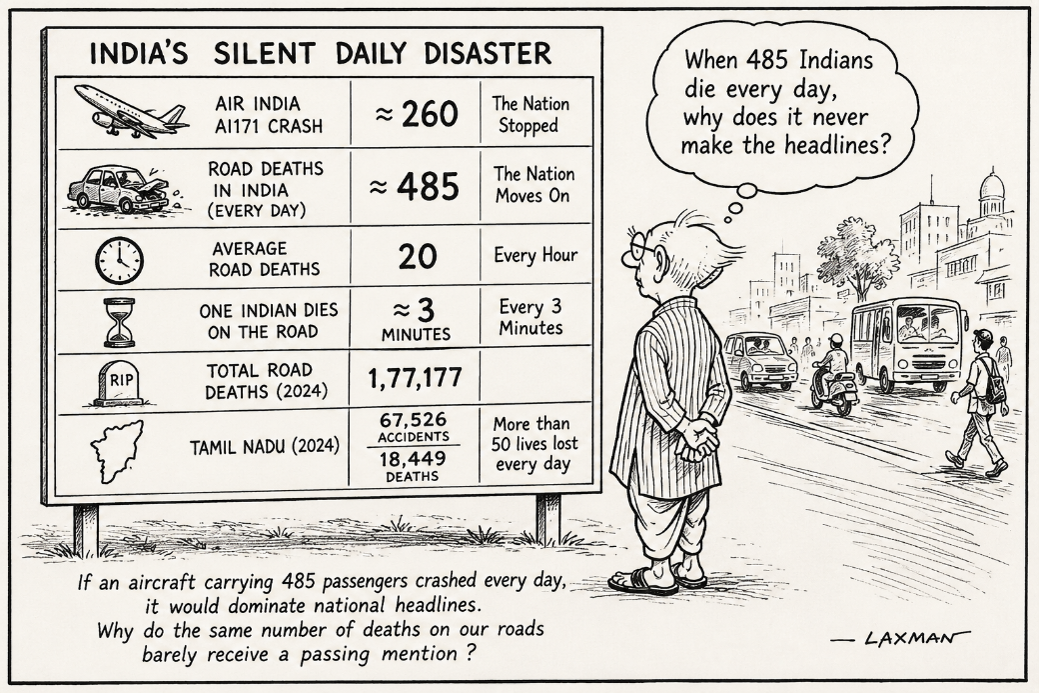
When Air India Flight AI171 crashed in Ahmedabad last year, the nation came to a halt. News channels carried continuous coverage, leaders across the world expressed condolences. Investigations began immediately because every human life mattered. The tragedy claimed 260 lives. Twice that number of Indians continue to die on our roads every day—with scarcely a headline.
Nearly 485 people die on our roads, by the time you finish reading this article, another family somewhere in the country will receive a phone call that will change their lives forever. There will be no breaking news. No national mourning. No prime-time debates. Tomorrow, the same tragedy will repeat itself.
Have we become insensitive to losing almost 1.8 lakh Indians every year?
The latest official data paints a deeply disturbing picture. India recorded 1,77,177 road fatalities in 2024, the highest in recent years. The trend has steadily worsened: 1,38,383 deaths in 2020, 1,53,972 in 2021, 1,68,491 in 2022, 1,72,890 in 2023, and now 1,77,177 in 2024. Every year, another report is released. Every year, the number grows. Every year, we move on.
Tamil Nadu presents an equally sobering picture, it continues to record the highest number of road accidents in the country, with more than 67,500 accidents and over 18,400 deaths in 2024. That translates to more than 50 lives lost every single day in one state alone.
The World Health Organization has repeatedly reminded governments that these are not “accidents.” They are predictable and preventable. Around the world, countries have demonstrated that determined action can reduce fatalities substantially. The European Union now records roughly 44 road deaths per million people, with countries such as Sweden bringing that figure down to nearly 20. India, by comparison, remains among the countries with the highest road fatality burden in the world. Despite representing only a small share of the world’s vehicles, it accounts for a disproportionately large share of global road deaths.
Perhaps the greatest tragedy is not the number itself, but our response to it.
We remember train derailments. We remember aircraft crashes. We remember bridge collapses. But road deaths occur one family at a time, one village at a time, one district at a time. They never happen in sufficient numbers at one location to shock the nation. Yet, by the end of every year, they claim more lives than many disasters combined.
The United Nations declared 2021–2030 as the Decade of Action for Road Safety, calling upon nations to halve road deaths. India has enacted stronger traffic laws, expanded highways and improved emergency response systems. These are welcome initiatives. But the numbers tell us that they are not yet producing the transformation that the country urgently needs.
Road safety must now be treated as a national development priority, not merely a transport department responsibility. Every fatality should be investigated with the same seriousness as an air crash. Every dangerous stretch of road should have a publicly accountable timeline for correction. Every district should publish its road safety performance just as it reports public health indicators. What gets measured, monitored and debated receives attention. What is silently accepted continues to claim lives.
If a passenger aircraft carrying 485 people crashed every day, Parliament would debate it. Governments would mobilise every available resource. Television studios would demand answers. Experts would work relentlessly until the cause was eliminated.
Why should the loss of the same number of lives on our roads deserve any less urgency?
India’s roads should connect lives, livelihoods and opportunities—not become the country’s largest and most ignored daily disaster.
 Business and Economy
  Education
  Food
Food  Government
  Lifestyle
  Politics
  Travel
  World
World