
When every problem waits outside one door, governance becomes reactive instead of strategic. Before we modernise our warehouses, roads and ports, should we first modernise the way government itself works?
By Ravishankar Kalyanasundaram
Last week, I spent several days trying to meet the Food Minister of Tamil Nadu.
It was not for a personal request. I was carrying a proposal that my organisation is willing to pursue at our own cost to help design and develop next-generation sustainable storage systems for paddy and rice. India loses enormous quantities of food because our storage infrastructure has not kept pace with production. I believed the proposal deserved the Government’s consideration.
I had already met the Minister briefly at his residence, where he was gracious enough to ask me to meet him in his Secretariat office.
That simple instruction became a week-long journey.
Several visits to the Secretariat yielded no meeting. Finally, after nearly two hours of persuasion at the entrance, I was allowed into the Minister’s chambers. I explained to his Personal Secretary that I had met the Minister earlier and wished only to present the proposal. He politely requested me to wait.
I waited.
From 10.30 in the morning until 1.30 in the afternoon.
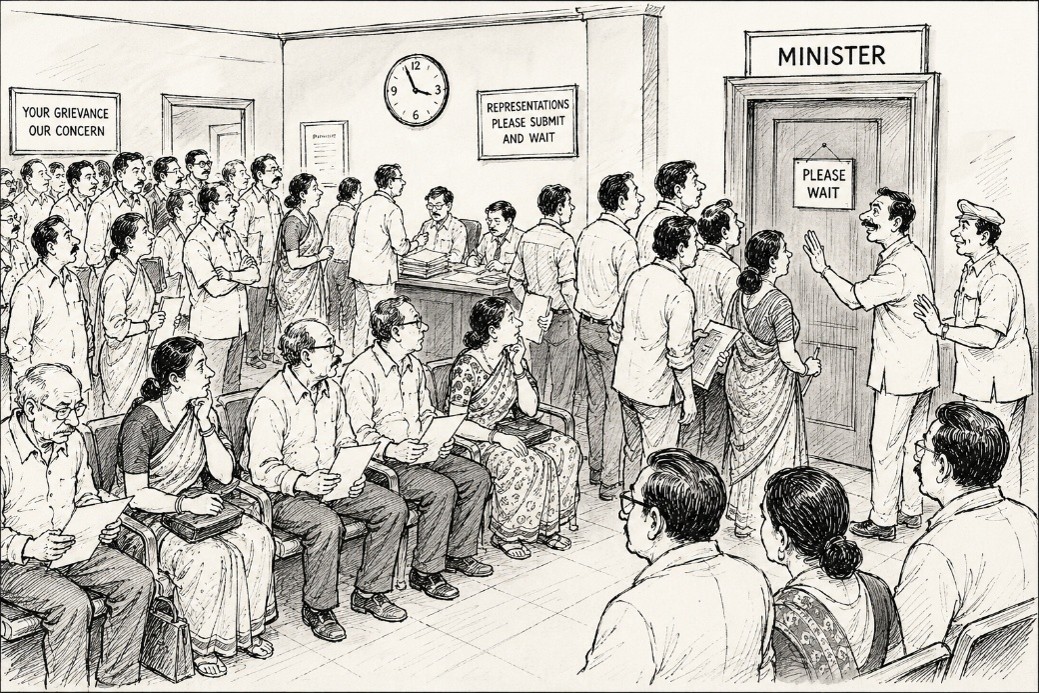
Around me were people carrying petitions for ration cards, requests for jobs, constituency grievances, unpaid Government dues, and countless personal hardships. Looking at them, one could not help but admire their patience. Many had probably travelled long distances. Many perhaps had no influence or connections. Their problems deserved attention.
Eventually I left without meeting the Minister.
But as I drove back, I realised this was not really about me.
It was about the impossible burden we place on our Ministers.
A Food Minister today is expected to oversee procurement, storage, distribution through the Public Distribution System, leakages, audit observations, food security, budget utilisation, policy decisions, legislative responsibilities, constituency matters, departmental administration and public grievances. Every issue eventually reaches the same door.
No individual, however capable, can give adequate attention to such a diverse stream of demands arriving in one waiting room.
Government today needs something that many successful organisations learnt years ago.
The scarce resource is not money.
It is decision-making time.
That time must be protected.
Routine grievances should move through well-designed administrative layers. Citizens should have dedicated grievance days, specialised facilitation centres and empowered officers capable of resolving most matters without requiring ministerial intervention. Representations should be professionally screened, categorised and supported with factual briefs before reaching the Minister.
The Minister’s time should then be reserved for policy decisions, complex cases, strategic reviews and interactions that can create long-term public value.
One aspect particularly deserves attention.
There should be structured opportunities for industry, researchers, universities and innovators to engage with Government. Across India, thousands of professionals are willing to contribute ideas, technology and investment to modernise public infrastructure. Many seek neither contracts nor favours. They simply wish to help solve problems.
Yet if the only route is to wait endlessly outside a Minister’s office, many will quietly give up.
That is a loss not for business.
It is a loss for society.
Our food security challenges demand fresh thinking. Scientific grain storage, modern bulk handling, quality preservation, digital monitoring and climate-resilient infrastructure cannot emerge from yesterday’s administrative processes.
Governments need citizens.
Citizens need governments.
Between them must exist an organised bridge.
Modern governance is not measured merely by how efficiently complaints are received.
It is measured by how effectively ideas are discovered, evaluated and converted into public outcomes.
Perhaps the next great improvement in governance is not another scheme.
It is designing a system that gives every Minister the one thing they desperately need—quality time to make better decisions for the people they serve.
 Business and Economy
  Education
  Food
Food  Government
  Lifestyle
  Politics
  Travel
  World
World