
Why Water Security Must Become India’s Next National Mission
By Ravishankar Kalyanasundaram
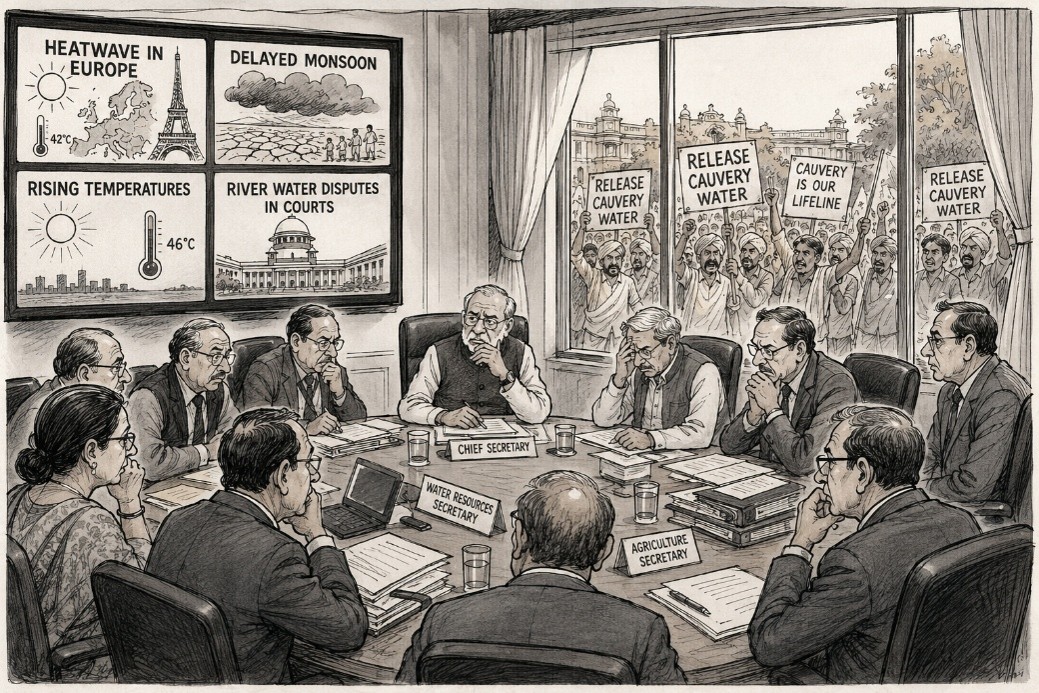
Consecutive years of rising temperatures, increasingly erratic monsoons, falling groundwater tables and growing competition for water are exposing a structural weakness that threatens India’s agriculture, industry and urban development alike. The latest forecasts of below-normal monsoon rainfall should not be treated as another seasonal weather bulletin but as an early warning that India’s future economic growth will increasingly depend on how effectively it secures its water resources.
The warning signs are unmistakable. Nearly 45 per cent of India’s workforce depends on agriculture, yet the sector contributes only around 15–16 per cent of GDP. More than half of India’s cultivated land remains dependent on rainfall rather than assured irrigation, leaving food production vulnerable to every fluctuation in the monsoon. Climate change is magnifying this vulnerability as prolonged heat waves, uneven rainfall and declining groundwater steadily erode the foundations of Indian agriculture.
The consequences are already unfolding across rural India. Rising cultivation costs, uncertain water availability and volatile market prices are forcing many farmers to abandon agriculture in search of more dependable livelihoods. At the same time, fertile farmland is steadily disappearing beneath residential layouts, commercial developments and industrial estates because selling land often yields higher returns than cultivating it. Every acre lost to concrete permanently reduces India’s food-producing capacity, even as the country’s population and food demand continue to rise.
Urbanisation is intensifying the pressure. Every expanding city, industrial corridor and township requires assured water throughout the year, and the easiest source continues to be reservoirs, rivers and groundwater originally intended for irrigation. As cities and industries grow, agriculture is increasingly forced to compete for the same finite resource. No nation can aspire to become a developed economy if its farmers, industries and cities remain locked in permanent competition for water.
Nowhere is this crisis more evident than in the Cauvery delta. For generations, Thanjavur, Tiruvarur and Nagapattinam formed the granary of South India because the Cauvery sustained one of the country’s most productive agricultural regions. Today, delayed river releases, uncertain monsoons and rising temperatures have transformed cultivation into an annual gamble. Sowing is postponed, acreage reduced and fields left fallow because farmers cannot predict whether water will arrive when it is needed. Young people leave villages not because agriculture lacks dignity, but because it no longer offers economic security. If this trend continues, India risks losing not only water but also the farming communities that have safeguarded its food security for generations.
This is not merely a Tamil Nadu problem. Punjab is witnessing declining groundwater, Maharashtra continues to oscillate between drought and floods, while Karnataka, Telangana and several other states are struggling to balance the competing demands of agriculture, industry and expanding cities. Climate change is exposing structural weaknesses across India’s water economy, yet the national response remains fragmented and largely reactive.
India’s infrastructure priorities must now evolve. Highways, airports, ports and renewable energy have transformed the economy, but none of these investments can realise their full potential if water becomes unreliable. Water is no longer simply an environmental concern; it is the foundation upon which agriculture, manufacturing, public health and economic growth ultimately depend.
The time has therefore come to launch Mission Surplus Water 2050. India possesses over 7,500 kilometres of coastline and one of the world’s fastest-growing renewable energy programmes. These strengths should be combined to power large-scale desalination, wastewater recycling, groundwater recharge, scientific reservoir management, micro-irrigation and integrated river basin planning. Coastal cities and industries should progressively shift towards desalinated and recycled water, releasing precious freshwater from rivers and reservoirs for agriculture. Every cubic metre of freshwater conserved strengthens India’s long-term food security.
The Green Revolution secured India’s food supply. The renewable energy revolution is securing its energy future. The next great national mission must secure water. The twenty-first century will not judge nations by the number of airports they build, but by whether they have the foresight to guarantee the four foundations of enduring prosperity—Water, Food, Energy and Data. The countdown has already begun. The real question is not whether India can afford to invest in water security, but whether it can afford to delay any longer.
 Business and Economy
  Education
  Food
Food  Government
  Lifestyle
  Politics
  Travel
  World
World