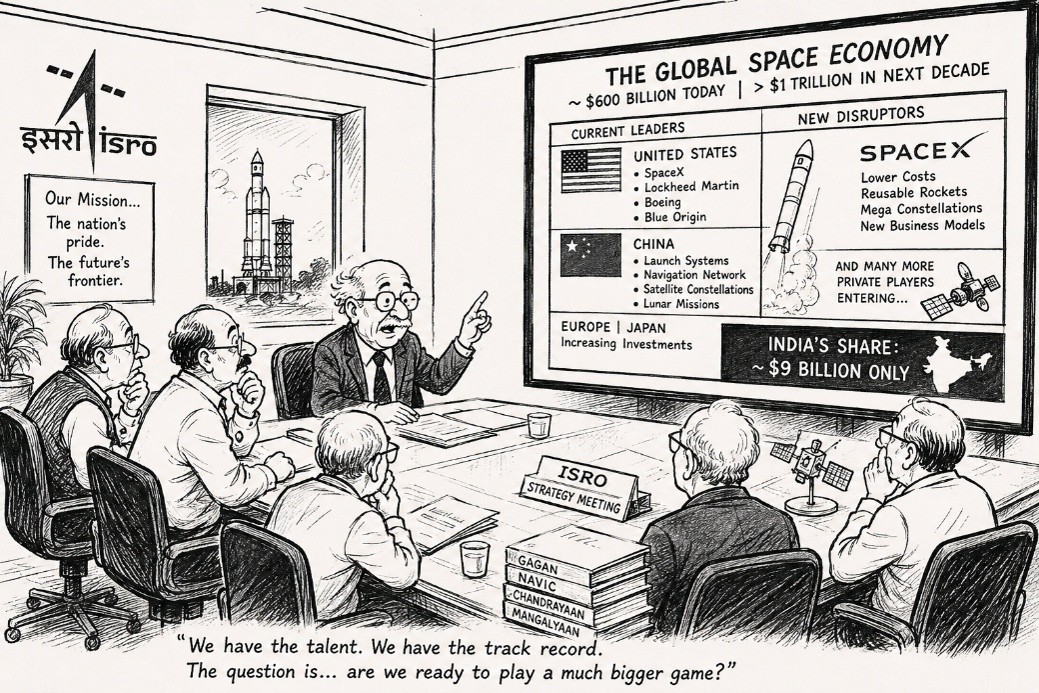

As the world races toward a trillion-dollar space economy, the real opportunity for India lies not merely in launching satellites, but in building an ecosystem of manufacturing, data, communications and services that can generate high-value jobs and recurring foreign exchange earnings for decades.
By Ravishankar Kalyanasundaram
The global space economy is already worth more than $600 billion and is expected to exceed $1 trillion within the next decade.
What is perhaps more remarkable is not the size of the opportunity but the number of new companies rushing to participate in it.
For decades, space was the exclusive domain of governments. Today, private companies are transforming the sector. Companies such as SpaceX have demonstrated that space can be commercially viable and immensely profitable. Hundreds of startups are entering areas ranging from satellite manufacturing and launch services to earth observation, communications, navigation, climate monitoring and space-based data analytics.
Investors are pouring billions of dollars into the sector. Governments are encouraging private participation. New business models are emerging almost every year.
The reason is simple.
The real value in the space economy is no longer confined to rockets and astronauts. It lies in the services built around them. Every satellite launched into orbit creates opportunities in communications, logistics, agriculture, weather forecasting, defence, disaster management, navigation and data analytics.
In many ways, space today resembles the internet in the 1990s.
The infrastructure is being built. The ecosystem is expanding. The biggest winners may ultimately be the companies that build businesses on top of that infrastructure.
Today, the United States and China capture the lion’s share of this opportunity. The United States has built a powerful ecosystem of private enterprises, venture capital and research institutions. China has responded with massive investments in launch systems, navigation networks, satellite constellations and lunar exploration. Europe, Japan and several emerging nations are increasing investments as they recognise that space is no longer merely a scientific frontier. It is becoming critical economic infrastructure.
Against this backdrop, India’s presence in the global space economy remains relatively modest at about $9 billion.
This should not be viewed as a weakness. It should be viewed as an opportunity.
Few countries possess the combination of advantages that India already has. A proven space programme. World-class engineering talent. A thriving software ecosystem. Cost-efficient innovation. A large manufacturing base. And perhaps most importantly, one of the world’s largest domestic markets for space-enabled services.
India has already demonstrated its scientific and engineering capability. From launching satellites for multiple countries to reaching the Moon and Mars, the nation has earned global respect for achieving extraordinary outcomes with limited resources.
The question therefore is not whether India can participate in the space economy.
The question is whether India can lead it. If private companies in the United States can create entirely new industries around space, there is no reason India cannot produce its own generation of globally competitive space enterprises.
Indeed, India for sure possess an advantage that many competitors lack. The country combines engineering capability, software expertise, manufacturing potential and a vast domestic market within a single ecosystem. Very few nations can claim all four.
But this opportunity will not wait indefinitely.
The Government, industry, investors and universities must treat the space economy not as a scientific programme but as a strategic economic sector.
Private participation must be accelerated. Dedicated space manufacturing clusters should be established. Venture capital and patient capital should be encouraged to support long-gestation technology businesses. Universities must strengthen aerospace engineering, robotics, materials science and satellite applications. International partnerships should be pursued aggressively across Asia, Africa and the Middle East.
Most importantly, policymakers must recognise that the space economy is not simply about prestige. It is about economic strength.
A successful space ecosystem can generate tens of billions of dollars in foreign exchange year after year through satellite manufacturing, launch services, communications, navigation systems, earth observation, geospatial intelligence and space-based data services.
Unlike many traditional exports, these are recurring revenue streams. They create enduring relationships with customers. They generate high-value employment. They strengthen technological capability. They enhance strategic influence.
Few industries offer the possibility of creating such a durable stream of dollar earnings while simultaneously advancing national capabilities.
For a country that constantly seeks to strengthen its foreign exchange position, reduce external vulnerabilities and create high-quality jobs for a young population, this opportunity deserves immediate attention.
The first phase of India’s space journey proved that we can reach the stars.
The next phase must prove that we can build an economy around them.
Because the future space race is not merely about who reaches orbit.
It is about who builds enduring industries beneath it.
And if India moves with urgency, the satellites circling above us today could become one of the country’s most important sources of foreign exchange earnings for decades to come.




 Business and Economy
  Education
  Food
Food  Government
  Lifestyle
  Politics
  Travel
  World
World