
Across India’s political landscape an uncomfortable question begins to surface.
By Ravishankar Kalyanasundaram
Can a democracy promise everything to everyone — and still remain financially stable?
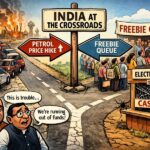
Election manifestos increasingly resemble catalogues of entitlements. Free electricity, loan waivers, cash transfers, consumer goods and subsidies are often promised without credible plans to finance them. Welfare for the vulnerable is a moral responsibility of any civilised society. But when electoral competition turns into a race of ever-expanding promises funded by the public treasury, the consequences can quietly weaken the state itself.
The framers of the Indian Constitution were not blind to this danger.
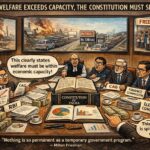
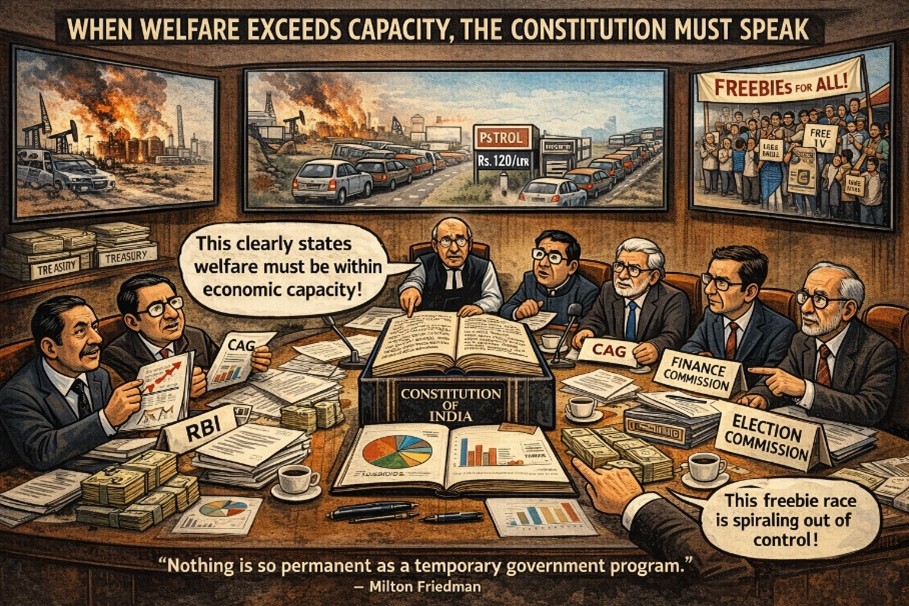
Hidden within the Directive Principles is a sentence that deserves renewed attention today. Article 41 directs the State to provide assistance for citizens in need — but only “within the limits of its economic capacity and development.”
That phrase reflects a profound constitutional insight. Welfare without financial discipline ultimately harms the very citizens it seeks to help.
Dr. B.R. Ambedkar warned the Constituent Assembly that “constitutional morality is not a natural sentiment; it has to be cultivated.” Responsible governance, including responsible budgeting, was always meant to be part of that moral framework.
Few Indian constitutional voices expressed this concern more eloquently than Nani Palkhivala, who reminded the nation that:
“The greatest danger to democracy is not the absence of laws but the absence of restraint.”
Fiscal restraint is precisely what populist competition often erodes.
The Constitution therefore established institutions to safeguard financial stability. The Finance Commission under Article 280 distributes resources between the Union and the states while encouraging fiscal discipline. The Comptroller and Auditor General, under Articles 148–151, audits government expenditure to ensure accountability. The Election Commission, empowered by Article 324, protects fairness in the electoral process — a mandate that could reasonably extend to transparency about the fiscal consequences of manifesto promises.
Even more significantly, Article 293 gives the Union government authority to regulate borrowing by states that are already indebted to the Centre. The framers understood that uncontrolled borrowing by subnational governments could endanger the financial stability of the Republic.
Yet these safeguards often remain underutilised.
Competitive populism persists because its rewards are immediate while its costs are delayed. Voters see the benefit today; the debt appears years later.
India’s elder statesman C. Rajagopalachari once warned:
“Public finance is like a household budget. When expenditure outruns income, ruin is not far away.”
The warning remains relevant.
Singapore’s founding leader Lee Kuan Yew offered an equally sobering observation about democratic leadership:
“If you want to be popular all the time, you will misgovern.”
Democracies rarely weaken only because of external threats. They often erode internally when institutions fail to enforce discipline.
The global environment today is becoming increasingly uncertain. Energy markets are volatile. Supply chains are being weaponised. Geopolitical tensions threaten trade routes and financial stability. In such a world, nations require strong public finances to invest in defence, infrastructure, technology and energy security.
If the public treasury is exhausted by short-term electoral competition, the nation’s long-term resilience inevitably suffers.
The issue before India therefore is not ideological but constitutional.
Can the Republic preserve compassion without sacrificing responsibility?
The Constitution itself offers the answer. Welfare is essential — but it must always operate within the limits of economic capacity.
India today stands at a moment of great opportunity. But opportunity alone does not guarantee resilience.
Fiscal responsibility is not merely an economic principle.
It is a constitutional obligation.

 Business and Economy
  Education
  Food
Food  Government
  Lifestyle
  Politics
  Travel
  World
World