
“The collapse of deterrence and the paralysis of global institutions are creating an era where even small conflicts can become catastrophically lethal.”
By Ravishankar Kalyanasundaram
There was a time when war announced itself with sirens, troop movements and national mobilisation.
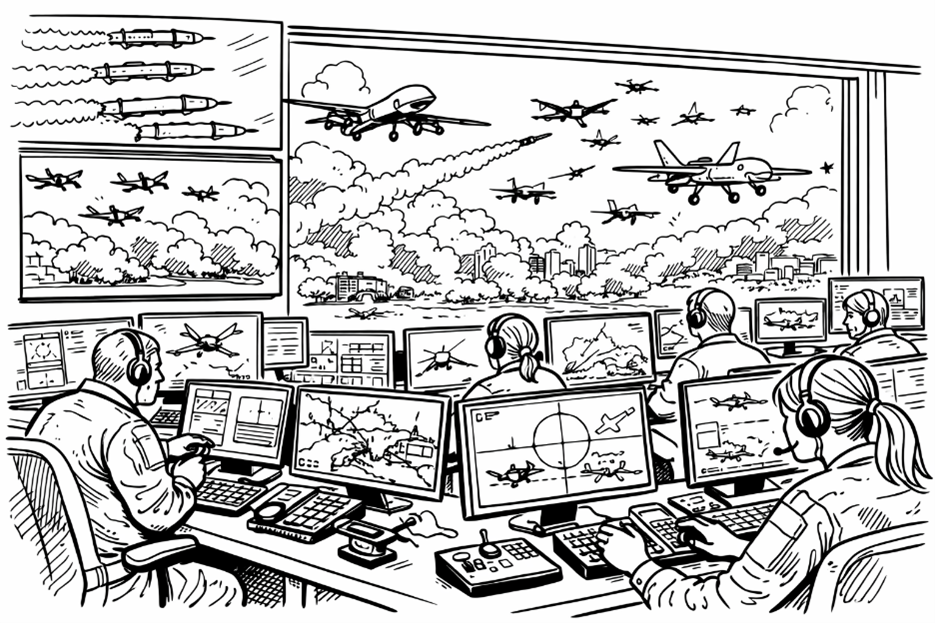
Today it may arrive quietly — in the buzz of a small machine overhead.
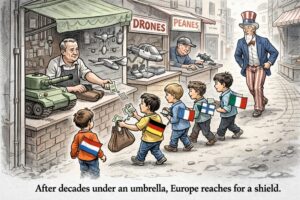
Across the plains of Eastern Europe and the burning urban landscapes of West Asia, a new kind of conflict is taking shape. It is not only more technological. It is more dangerous because it is becoming affordable.
Recent battlefields have revealed a brutal arithmetic.
A drone that costs less than a luxury car can destroy military equipment worth millions. A swarm of such machines can overwhelm defence systems designed for another era. Nations are being forced into a ruinous exchange — firing expensive interceptor missiles to stop weapons that can be mass-produced in workshops and shipped in crates.
War, in effect, is being democratised. The implications are chilling.
When destruction becomes cheap, restraint becomes expensive. Governments may hesitate to escalate, but smaller actors — separatist groups, militias, ideological networks — may not. Technology once monopolised by states is slipping into the marketplace. Software that can guide swarms of autonomous drones is evolving faster than the laws meant to regulate it.
This is not speculation. The lessons are already visible.
In Ukraine, thousands of unmanned attacks have targeted energy grids, logistics hubs and civilian infrastructure. In West Asia, drone strikes have reshaped retaliation cycles, forcing entire cities to live under the constant threat of sudden disruption. Shipping routes have been threatened. Oil facilities have been hit. Insurance costs have surged.
Each incident sends a message across the world: war no longer requires a war machine.
For smaller nations, this transformation is terrifying.
They may not possess the financial depth to maintain layered missile shields or advanced surveillance networks. Yet they remain exposed to low-cost weapons that can cripple ports, shut down airports or ignite urban panic within minutes.
In theory, global institutions should act as buffers against such instability. In practice, they appear increasingly irrelevant. The United Nations was designed to prevent invasions by armies, not attacks by swarms of unmanned devices launched from ambiguous locations. Diplomacy moves at the speed of negotiation. Modern warfare moves at the speed of code.
The result is a widening security vacuum.
Meanwhile, the defence industry faces its own existential dilemma. For decades, prestige and power were tied to massive platforms — ballistic missiles, fighter jets, aircraft carriers. These symbols of deterrence are now being challenged by technologies that resemble consumer electronics. Production cycles measured in years are colliding with innovation cycles measured in weeks.
The danger is not merely that wars will become deadlier. It is that they may become routine.
Affordable warfare reduces the threshold for conflict. It allows actors to strike without formal declarations, without mobilisation and sometimes without accountability. Cities can be paralysed overnight. Economies can be shaken by a handful of coordinated attacks. Fear itself becomes a strategic weapon.
The world is entering an age where peace cannot be taken for granted — not because nations seek war, but because war has become easier to wage.
If global governance fails to adapt, the future may not be shaped by decisive conflicts between powerful states.
It may instead be defined by a thousand smaller confrontations — unpredictable, persistent and deeply destabilising.
Humanity now confronts a stark choice.
Either it builds new frameworks to control the spread of affordable lethal technology, or it learns to live in a century where the hum of distant machines is the sound of fragile peace.

 Business and Economy
  Education
  Food
Food  Government
  Lifestyle
  Politics
  Travel
  World
World