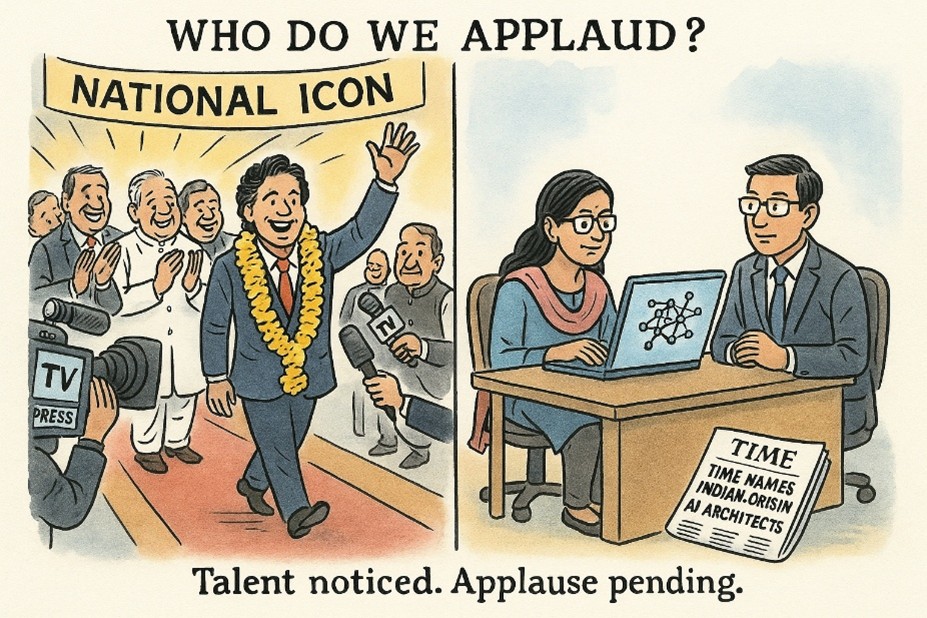

“Nation-building doesn’t come with background music”
By Ravishankar Kalyanasundaram
When TIME named Karandeep Anand and Sriram Krishnan as “AI architects” in its Person of the Year issue, it did more than recognise two individuals. It held up a mirror. And like most mirrors, it revealed something we prefer not to stare at for too long.
India has produced extraordinary technological minds for decades. They have shaped operating systems, global platforms, AI architectures, semiconductor design, biotech breakthroughs, financial algorithms and climate models. And yet, recognition often arrives only after geography changes. Only after the applause comes from elsewhere. Only after the success story is stamped Made in Silicon Valley or Backed by a Western institution.
Karandeep Anand and Sriram Krishnan did not suddenly become capable the moment they crossed borders. Their intellectual foundations were laid here — in Indian classrooms, Indian homes, Indian debates, Indian struggles with scarcity and scale. What changed was not talent. It was attention.
And attention, in India, is a scarce and strangely misallocated resource.
We are a country that can mobilise national celebration for a film’s opening weekend, argue endlessly about box-office numbers, award Padma honours to actors for longevity rather than impact, and turn political discourse into celebrity theatre. Meanwhile, the people building the invisible infrastructure of the future — AI, cloud systems, cybersecurity, quantum research, climate tech — often work in quiet anonymity.
This is not an argument against cinema or sport. Culture matters. Stories matter. Heroes matter. But societies reveal their priorities by who they choose to elevate. And for too long, India’s public imagination has preferred spectacle over substance.
The irony is painful. We speak endlessly about becoming a knowledge economy. We boast about demographic dividends and digital revolutions. We celebrate startups once they become unicorns. But we rarely celebrate the architects of ideas, the people who design systems that reshape how billions live and work.
Why does recognition take so long? Why does it so often require external validation?
Part of the answer lies in our colonial hangover — the unspoken belief that global approval confers legitimacy. Another part lies in political incentives. Scientists, technologists and thinkers do not deliver instant applause. They do not draw crowds. They do not translate easily into vote banks or television debates. Their work is complex, slow, and often invisible until it suddenly becomes indispensable.
There is also a deeper discomfort at play. True innovators challenge systems. They question assumptions. They disrupt hierarchies. They rarely fit neatly into ceremonial frameworks. Celebrating them seriously would require governments and institutions to admit that progress often comes from the margins, not from officialdom.
So innovators leave. Not always physically at first. Sometimes emotionally. Sometimes intellectually. They look outward for ecosystems that value merit over proximity, ideas over connections, contribution over conformity. Immigration, then, is not just about opportunity. It is about oxygen.
The tragedy is not that India loses talent. Talent will always move. The tragedy is that India often loses ownership of its own intellectual narrative. When our brightest minds are celebrated abroad, we react with pride mixed with regret. We forward articles. We say, “He’s Indian-origin.” We rarely ask why he had to become “Indian-origin” rather than simply “Indian.”
Contrast this with earlier eras. India once revered scientists as nation-builders. Names like Homi Bhabha, Vikram Sarabhai, C.V. Raman were part of public consciousness. They were not fringe figures. They were symbols of aspiration. Somewhere along the way, that reverence was replaced by glamour, noise and instant virality.
Today, an AI architect shaping global systems has less public recognition than a celebrity endorsing a product. That imbalance is not accidental. It is cultural.
And culture, unlike talent, is a choice.
The recognition of Karandeep Anand and Sriram Krishnan should not be treated as just another international honour to be proudly shared on social media. It should provoke a harder question:
What kind of Republic do we want to finish building?
One that celebrates visibility over value?
Or one that learns to honour those who quietly shape the future?
If India is serious about being a global knowledge power, the change must begin not with slogans or summits, but with attention. With who we invite to national conversations. With who we honour early, not posthumously or after foreign applause. With teaching young people that impact does not always come with spotlights — but it deserves them.
Innovators do not leave only because of salaries or visas.
They leave when societies fail to see them.
And perhaps the most unfinished part of our Republic is not infrastructure or policy but recognition itself.


 Business and Economy
  Education
  Food
Food  Government
  Lifestyle
  Politics
  Travel
  World
World