
War, Wisdom and the Lessons of an Ancient Epic
By Ravishankar Kalyanasundaram
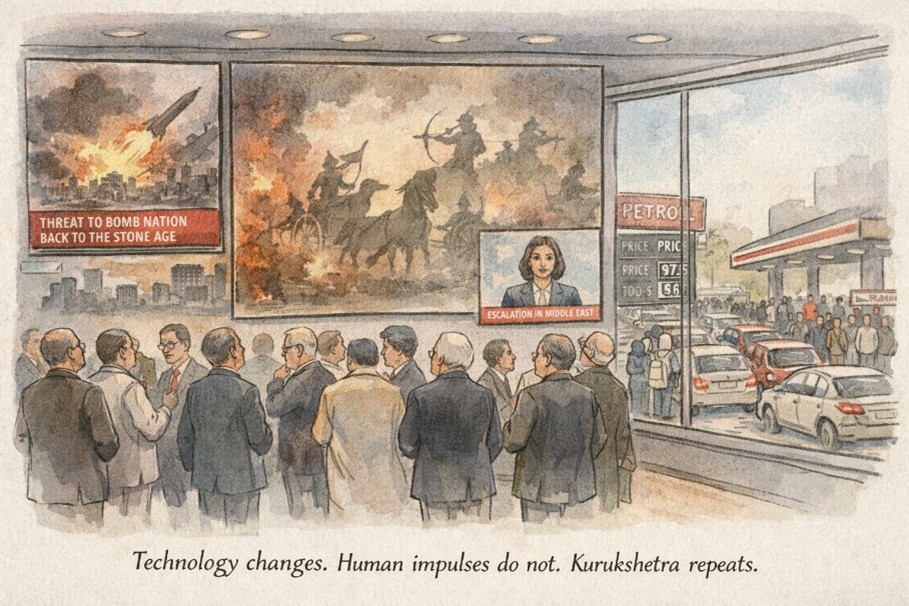
The world heard a disturbing phrase when Donald Trump declared that Iran could be bombed “back to the Stone Age.” It was more than a threat of escalation. It was language that casually invoked the destruction of an entire civilisation. Yet what was perhaps even more unsettling was the quiet that followed. No great chorus of global leaders rose immediately to remind the world that civilisation cannot speak lightly about annihilation. In that moment one could not help recalling the closing scenes of the Mahabharata, where victory itself stands amidst ashes and grief, reminding humanity that wars pursued in anger rarely end in triumph — they end in emptiness.
When one reads the closing chapters of the Mahabharata, the war has already been won. The mighty Kaurava army lies defeated. The Pandavas have secured the kingdom they fought so fiercely for. Yet the epic offers no celebration.
Instead, it pauses over the silence that follows destruction.
The battlefield is covered with broken chariots and fallen warriors. Kings who once commanded armies lie indistinguishable among ordinary soldiers. Yudhishthira, who fought for justice, walks across that field and finds no joy in victory. Mothers search for their sons among the dead. Wives recognise their husbands only by ornaments or armour. A civilisation that had assembled its finest warriors now stands emptied of them.
Among the most haunting moments comes when Gandhari, the mother who lost a hundred sons in the war, is led across the battlefield. Guided by others, she touches the bodies one by one, recognising them by their armour and ornaments. Overwhelmed by grief beyond words, she turns to Krishna himself and curses him, declaring that just as her lineage has perished, his own clan will one day destroy itself. And the epic records something remarkable — Krishna does not resist the curse. Even the divine does not shield the world from the consequences of human hatred once war has run its course.
Reading these passages today, thousands of years later, one cannot escape an uneasy recognition.
War may produce victors, but it rarely produces happiness. The battlefield of Kurukshetra becomes a reminder that when rage overwhelms wisdom, even the greatest triumph can leave behind only sorrow. It is perhaps one of the oldest reflections in human history on a truth that the modern world still struggles to accept: the price of victory in war is often paid by civilisation itself.
Across the world today another conflict unfolds with growing intensity. Nations exchange threats and retaliation. Technology delivers destruction with frightening speed. Artificial intelligence, autonomous systems and remote warfare have made conflict faster and more affordable than ever before. At the same time, the international institutions meant to restrain confrontation appear increasingly fragile.
In such a world the deeper danger before humanity is not merely the outbreak of war. Humanity has endured wars before. The deeper danger lies in losing the moral discipline that prevents wars from destroying everything around them.
The Mahabharata leaves behind a quiet warning that echoes across centuries: the survival of societies does not depend merely on the strength of armies or the victories they claim over their enemies. It depends on whether wisdom and restraint survive the conflict.
Today many of us watch these events from afar. We may be spectators of this war — by choice, by geography, or by circumstance.
But the outcome will not be a matter of choice. When wisdom fails, the consequences will not remain confined to the battlefield, they will travel across nations, economies and generations asking whether the victory was worth the price.



 Business and Economy
  Education
  Food
Food  Government
  Lifestyle
  Politics
  Travel
  World
World