
The greatest risk is not chaos, but the world learning to live with it.
By Ravishankar Kalyanasundaram
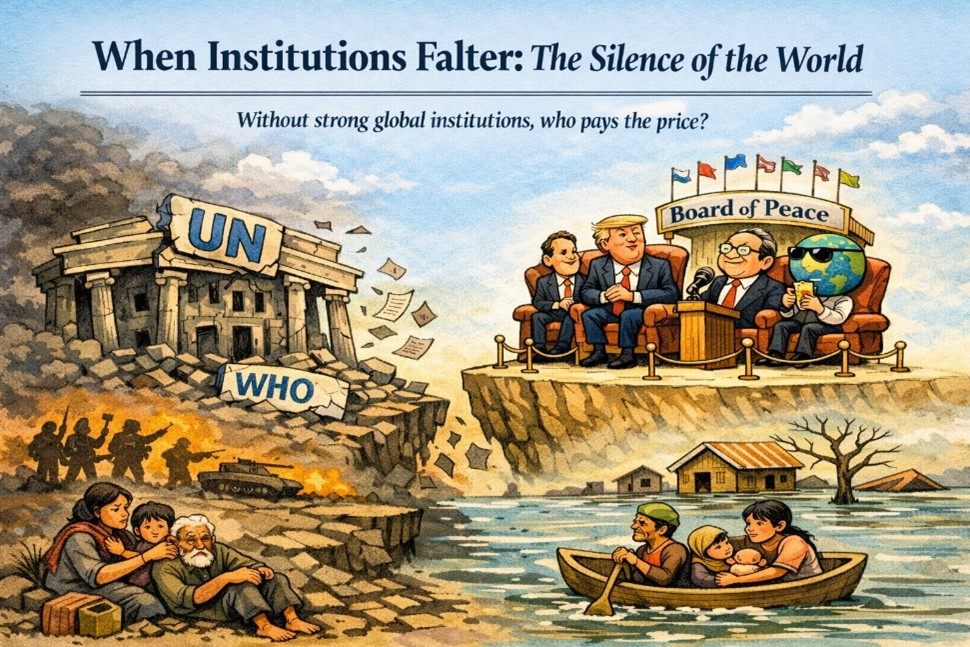
This week, the landscape of global governance shifted in ways that deserve more than passing headlines. The United States — once a founding pillar and largest financier of the World Health Organization — formally exited the agency after nearly eight decades of membership, citing disagreements over the handling of the COVID-19 pandemic and alleged bias in its responses.
Simultaneously, in the snow-dusted chalets of Davos, a flamboyant spectacle unfolded. A new body — the Trump-led “Board of Peace” — was launched with great fanfare, promising to steer conflict resolution and peacebuilding across the world. Yet even here, the reality is far subtler: major Western allies such as the United Kingdom and France stayed clear, wary of an initiative that some fear may rival the United Nations rather than reinforce it.
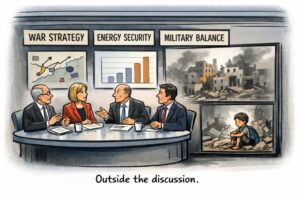
Taken together, these developments invite a deep and uncomfortable question: Why is the world often a silent spectator while institutions we built to safeguard stability and justice are sidelined, hollowed out, or reshaped at will?
Why We Built Institutions in the First Place
After the ravages of two world wars in the twentieth century, world leaders made a profound decision: peace, far from being left to the vagaries of power politics, should be anchored in rules, procedures and collective legitimacy. Bodies like the United Nations, WHO, the Bretton Woods institutions (IMF and World Bank) were designed not only to manage cooperation, but to contain the darkest impulses of nationalism and hubris. They were, in spirit and law, collective bulwarks against unilateral excess.
In those early years, the purpose was clear: sovereignty tempered by shared responsibility. Disputes were aired in assemblies, expertise guided policy, and pre-agreed procedures bound even the powerful. We understood that no single nation — however large or rich — could alone manage pandemics, financial crises or transnational wars.
When the System Gets Ignored
Today, we seem to have forgotten that wisdom. The withdrawal from WHO is not merely a bureaucratic reshuffle; it is a symbolic retreat from collective action in health emergencies. WHO’s global surveillance networks, disease eradication programmes and vaccine coordination efforts — once sustained in large part by U.S. funding and leadership — now face a severe blow. Experts warn that disease surveillance, vaccination strategy, and emergency preparedness will all be weakened by the loss of formal U.S. engagement and financing.
The parallels are stark. In the 1930s, the League of Nations — the predecessor of today’s U.N. — struggled to prevent aggression in Manchuria because powerful members chose their interests over collective action. Japan withdrew from the League after it was criticised for fabricating the “Manchurian Incident”, exposing how fragile such institutions can be when major powers lose faith in them.
And when institutions falter, anarchy tends to fill the void. After World War I, the collapse of international cooperation and economic turbulence helped pave the way for doctrinaire ideologies and global conflict. When the League could not enforce its own principles, smaller states learned that might made right.
Engineered Systems and Prejudiced Outcomes
It is not just health and peace mechanisms that are tested. The global trade system, too, has seen sharp strains. Consider the World Trade Organization (WTO): its appellate body was rendered inoperative because of prolonged refusal by a major member to permit new appointments — an institutional paralysis that undermined global dispute resolution.
Where institutions should cushion differences, these engineered breakdowns amplify them. When international law is sidelined, when treaties are rewritten unilaterally, the losers are always the vulnerable — poorer nations, marginalised communities, those with little voice on the world stage.
Domestically too, when institutions are weakened, justice and equity suffer. Across many democracies today, institutional norms are being flouted by the same veneer of expediency: courts stacked, election bodies undermined, independent regulators overruled. The result is predictable — trust erodes, cynicism spreads, and the gap between citizens and systems widens.
Who Pays the Price?
In this new era, the loudest voices are often the most powerful, and the wisdom of centuries of multilateral cooperation is overshadowed by the rhetoric of individuals. But power without legitimacy is brittle.
When health crises strike, when financial contagions spread, or when peace is fragile, the absence of robust institutions means delayed responses, fragmented action, and disproportionate suffering for the poor and the weak.
For India and many nations of the Global South, this shift is particularly perilous. We rely on multilateral health guidance, collective disaster financing, and norms that protect smaller states from coercive power politics. When those norms are weakened, the geopolitical space becomes more volatile and unpredictable.
Where Are the Wisemen?
History shows us that institutions outlast individuals. The architects of the post-war world understood that no mortal leader — however charismatic — could singly guarantee peace or prosperity. They built systems that bound nations to shared rules, not personal whims.
Today, we need voices that remind the world why institutions matter — not because they are perfect, but because they are impartial, predictable, and grounded in shared humanity.
Let us not be silent spectators to a moment when global cooperation is at a crossroads. The real tragedy would be not just the weakening of institutions, but our acceptance of that weakening as inevitable. The losers, as ever, will be the many who cannot shield themselves from the disorder that follows.

 Business and Economy
  Education
  Food
Food  Government
  Lifestyle
  Politics
  Travel
  World
World